SOURCE :- THE AGE NEWS
On the fifth floor of an office building in the outer suburbs of Shenzhen, a high-tech megacity on China’s southern coast, humanoid robots are being put through their paces.
Some are strung up in harnesses for testing; others stand silently, waiting to be assigned repetitive tasks such as lifting boxes or stacking shelves.
This is the headquarters of robotics data start-up IO-AI Tech, which has converted its open-plan office into a humanoid training ground run by a team of mostly Gen Z engineers, decked out in casual T-shirts, pants and sneakers.
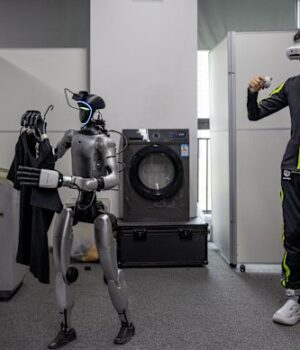
In one corner, a robot is doing the laundry. Kind of.
With slow, jerky movements, its mechanical hands reach out and grasp a shirt, removing it from a clothes hanger before trudging towards a top-loading washing machine and dropping it in. The whole process takes about 40 seconds, even longer if the robot tries to close the machine – its hands still significantly lack the dexterity of a human’s.
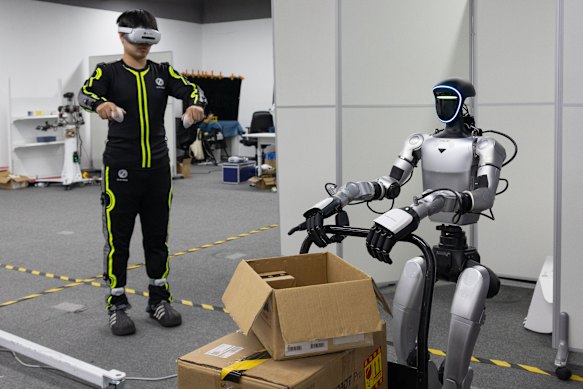
Trailing a few steps behind is an IO-AI employee wearing a VR headset and a full-body teleoperation suit that wirelessly controls the robot, enabling it to mirror his moves in real time.
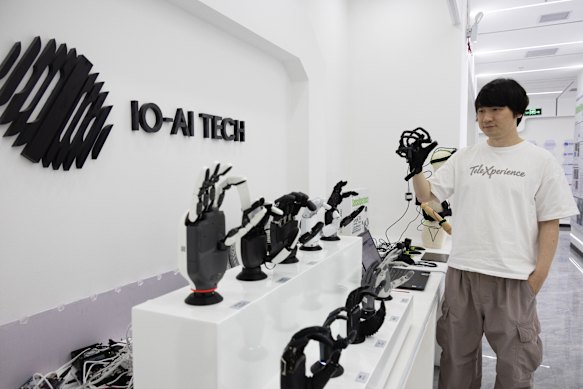
“We use a bunch of data, human movement data, to train the robot,” the company’s chief executive, Xiangyu Chen, explains.
“Gradually we think the robot can do some types of autonomous tasks. But [being] 100 per cent autonomous is, we think, not possible for now, or even for the next five to 10 years.”
But that fully autonomous future comes with a moral conundrum that Chen is frank about.
“We believe that robots are made to help people, not to substitute them; otherwise, people won’t have any work and the economy crashes,” he says.
Aged in their 30s, Chen and his Australian co-founder, Si Chen (no relation), met while working at the Robotics X Lab run by Tencent – one of China’s biggest tech behemoths, also headquartered in Shenzhen.
Their company doesn’t build robots. Instead, it’s part of the emerging data collection industry booming alongside it. IO-AI Tech’s customers send it robots they have bought to be trained in controlled, task-specific scenarios, or use the company’s teleoperation technology to train the robots themselves.
“The biggest challenge for robotics is that we don’t have millions of robots out there in the real world that are producing robot data. You need to organically create the data that the robot needs to learn from,” Si Chen says from her base in Sydney.
China v US robot race
IO-AI Tech is one of thousands of start-ups to emerge in China’s robotics ecosystem in the past few years – many in Shenzhen – powered by the breakneck speed of developments in artificial intelligence models since ChatGPT exploded onto the scene in late 2022.
Though still nascent and its utility uncertain, the humanoids field is quickly becoming a key battleground in China’s geopolitical contest with the United States, as policymakers in Washington grow alarmed at Beijing’s stranglehold on 85 per cent of the market.
Last month, the Trump administration, citing national security concerns, banned the import of new foreign-made humanoids and power inverters – hobbling Chinese manufacturers’ access to their largest export market. Beijing hit back this week, tightening controls on drone exports to the US.
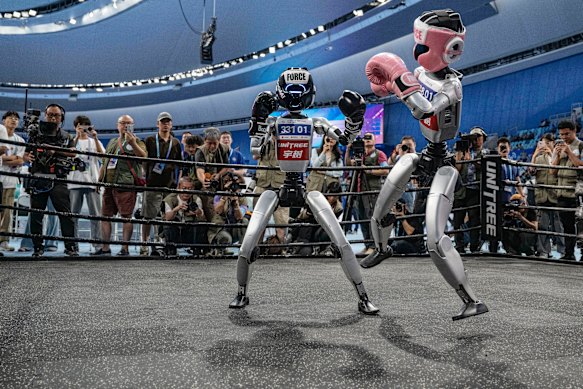
The US move also signals it is hedging its bets that humanoid robots won’t be limited to PR stunts of dancing, kick-boxing or marathon running for long, and wants to protect its fledgling robotics industry from Chinese imports.
“There is almost a kind of urgency to the way that Chinese policymakers are going about the humanoid push, and I think implicit in the background there is the knowledge that the US is also trying to do this, especially Elon Musk with the Tesla Optimus robots,” says Kyle Chan, an expert in China’s tech policy at the Brookings Institute.
“If this technology does end up becoming strategically very important, both for productivity and potentially for military applications, then China doesn’t want to be left behind.”
Just don’t expect to be putting a robot to work in your home doing the dishes or the laundry any time soon.
Experts are frank that humanoids are a long way from being deployed autonomously to perform complex real-world jobs. Exactly how much data is needed before they can be unleashed unsupervised is still being figured out by scientists. But it’s gargantuan.
Xiangyu Chen, who holds a PhD in robotics, draws a comparison with Tesla, which has collected billions of kilometres of driving data to refine its self-driving systems.
“For now, the robots only have millions of [hours of] data. It would have to be scaled more than 1000 times,” he says.
China’s big gamble on humanoids
China already operates more industrial robots than the rest of the world combined, though many are large-scale fixed machines on factory assembly lines and imported from Japan and Europe.
The Chinese government is making a huge bet that “embodied artificial intelligence” and automation will shape the future, revolutionising everything from manufacturing to healthcare, aged care, military systems and education.
It’s banking that the current capability gaps in humanoids can be closed through huge investments in science and research, and by fostering fierce competition among start-ups.
Put simply, embodied or “physical” AI systems combine a software-powered “brain” with a hardware “body” – such as humanoids, quadruped “dogs”, drones or self-driving vehicles – so the robots can interact and adapt to real-world situations.
Chinese President Xi Jinping has put AI and robotics at the centre of the nation’s industrial policy, which champions them as “new productive forces” that will revive stagnating growth, create new jobs and fill workplace shortages caused by an ageing population, even as competing concerns emerge around job erasure.
Last year, China set up a 100 billion yuan ($21 billion) fund to back homegrown high-tech start-ups over the next two decades, with embodied AI companies a key target.
“Waste is a feature, not a bug,” says Rebecca Arcesati from Mercator Institute for China Studies (MERICS), Europe’s leading China-focused think tank. “A lot of Chinese AI policy has been trying to throw things at the wall and then seeing what sticks.”
With the signal coming from the top, local governments in China have poured support and subsidies into hubs in Shenzhen, Beijing, Shanghai or Hangzhou, eager for their own tech capitals to claim the latest breakthrough.
The start-ups this masthead spoke to had received at least some form of government support, such as free or subsidised office rent, while also seeking private funding. IO-AI Tech, which has about 80 employees, said it was venture-capital funded.
“This industry would not exist in China were it not for the heavy targeting of the Chinese national government,” Chan says.
Chinese start-ups are far from the only players in this space, but they have scaled up and got to market faster and for less than their rivals. The big three manufacturers – Unitree, UBTech, and AgiBot – accounted for more than half of all global humanoid installations in 2025, according to market research firm Counterpoint.
Unitree’s entry-level humanoid can be purchased for $US5000 ($7140), a benchmark that its US rivals Boston Dynamics and Musk’s Optimus (the “Tesla bot”) won’t come close to matching when their products hit the market.
“Robotics is where EVs were a decade ago – a trillion yuan ($210 billion) battlefield,” Unitree founder Wang Xingxing said last year.
Musk, meanwhile, has assessed China’s robotics breakout this way.
“China is an ass-kicker, next level,” he said in January. “To the best of our knowledge, we don’t see any significant [humanoid robot] competitors outside of China.”
For now, China’s robotics industry is still heavily reliant on US technology, including Nvidia software, as well as precision components from Japan and Germany. But experts say it is rapidly closing the gap and increasingly becoming self-reliant.
Beware the AI bubble
At exoskeleton company Jimpoer’s rent-free headquarters in western Shenzhen, executive Pan Dinglong says it took less than a year for his team to get its product from a design concept to being sold on Chinese electronics platform JD.com.
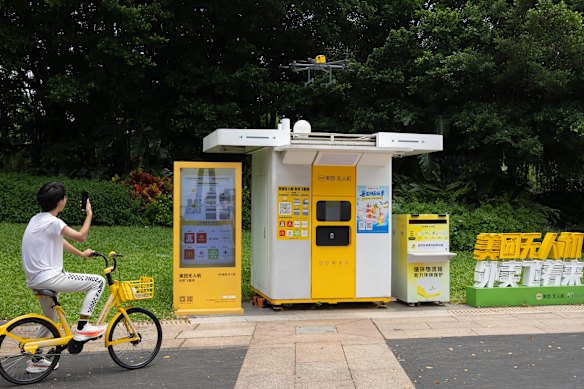
“In Shenzhen, this is normal. Indeed, we feel that it is a bit slow because the competition is becoming more and more fierce,” Pan says.
The exoskeleton is essentially a wearable robot that a user straps to their legs, propelling them forward and making certain exercises, such as climbing stairs, easier. After one year, the company is breaking even, Pan says, and has sold more than 4000 units, mostly for elderly people in China.
This concept of “Shenzhen speed” – the ability of start-ups to develop an idea and scale it to mass production at a pace unmatched outside China – is what has cemented the city as an incubator of innovation.
Key to this is Shenzhen’s deep networks of hardware supply chains, which helped transform it from a fishing village in the 1980s to the home of tech giants Tencent and Huawei, drone company DJI, and electric vehicle juggernaut BYD.
‘Robotics is where EVs were a decade ago – a trillion yuan ($210 billion) battlefield.’Unitree founder Wang Xingxing
Almost every conceivable off-the-shelf bolt, screw, sensor, motor and circuit board can be sourced from suppliers within a two-hour drive of Shenzhen for a fraction of the price in Western markets. The city also has rich pools of computer scientists, software developers, designers and engineers.
“We have customers in the US who are looking to partner with us because they don’t have access to the hardware. Their hardware development and prototyping plans are often in months or quarters. We’re operating in days and weeks,” IO-AI Tech’s Si Chen says.
But China’s robotics industry is already showing signs of the oversaturation now plaguing the EV industry after its subsidy-powered boom to global dominance.
Too many companies are competing in the same space, producing similar products, and without a clear path to profitability.
Some 400 Chinese EV brands have collapsed or merged since 2019, and only a dozen or so of the remaining 100 are expected to be profitable by the end of the decade.
Currently, around 150 Chinese companies are making humanoid robots, and thousands of other start-ups have flocked into the adjacent robotics field.
“If you can survive in this highly competitive environment, you do have an advantage when you take your products to the rest of the world,” Si Chen says.
No escape from automation
Then there are other start-ups, such as BlueX Robotics, that have partnered with research institutes and are state-sponsored creations.
BlueX has developed what it calls the world’s first blueberry-picking robot. It claims to have a top picking speed of 3 seconds, although its mechanical claw can pick only one berry at a time. Unlike humans, it can work around the clock and doesn’t require sick days and bathroom breaks.
“Our vision is to realise unmanned farming production – we want to build dark factories for agriculture,” founder Chen Zhijun, 49, says.
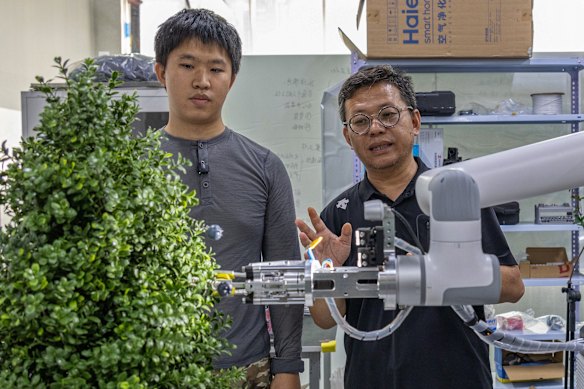
He says the company expects to have 500 robots deployed in blueberry farms by the end of the year, helping China’s farmers reduce costs but probably eliminating harvesting jobs in the process.
“We want to solve the difficulties they face in farming, reduce their input costs and increase their incomes,” he says.
“If they can afford to hire workers, they can afford to buy robots.”
Chen says agricultural robots are the company’s focus, but it also makes security “dogs”, which have been purchased by Chinese government authorities. BlueX Robotics has a partnership with the Harbin Institute of Technology, one of China’s top defence universities, which is blacklisted by the US government for research co-operation.
Being pioneers of the automation revolution puts China’s leaders at the forefront of concerns about AI’s impact on employment, particularly if it fails to deliver the “jobs of the future” necessary to absorb millions of STEM graduates each year while youth unemployment hovers around 17 per cent.
There are signs these anxieties are being acknowledged. In April, a Chinese court ruled a tech company had illegally sacked a worker after replacing him with AI software, with the decision promoted by state media.
The country’s ageing population means automation in certain industries will be essential. At the same time, China’s 300 million migrant workers are heavily reliant on the type of factory, farm and gig-economy work vulnerable to automation and have little safety net to fall back on.
It’s a delicate balance that could challenge the Communist Party’s social contract, which hinges on trading freedoms in exchange for economic progress, says Arcesati from MERICS.
“If people started really expressing discontent with this strategy of AI diffusion and adoption, which Xi Jinping has been pushing consistently over the past few years, what is the government going to do?” she says.
“This will be one of the main things to watch in China over the next few years.”
Get a note directly from our foreign correspondents on what’s making headlines around the world. Sign up for our weekly What in the World newsletter.