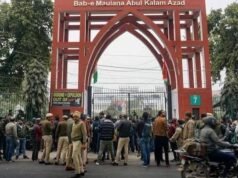
Source : INDIA TODAY NEWS
Just days after the change of regime in West Bengal, a painting appeared on a wall near the Chorebagan Durga Puja site, depicting Prime Minister Narendra Modi performing aarti before an idol of Goddess Durga. The painting became one of the most visible symbols celebrating the BJP’s victory in the state.
In early July, BJP leaders Locket Chatterjee and Kaustav Bagchi attended a grand khunti pujo—a ceremony that marks the beginning of pandal construction—organised by the puja committee. It was announced that Biman Saha would be the artist for this year’s puja, with Akal Bodhan as its theme.
advertisement
However, things soon took a different turn. On July 17, Jayanta Banerjee and his daughter, who had been associated with the puja management for years, resigned along with the rest of the committee, paving the way for a new committee dominated by BJP leaders. It was alleged that they had been forced to resign. A new theme was unveiled on July 30 at a second khunti pujo ceremony, and Sushanta Shibani Paul replaced Saha as the artist.
The changes marked a significant shift in the management and public positioning of one of north Kolkata’s prominent Durga Pujas. However, the festivities, which had begun amid political fanfare, would soon be overshadowed by tragedy.
On the evening of October 17, the second day of the Durga Puja celebrations, a stampede at Chorebagan claimed 19 lives, turning one of Kolkata’s most prominent community celebrations into the site of a devastating crowd disaster. The police have arrested seven people in connection with the incident: Raj Kumar Sewda, the puja secretary; Santanu Dubey, the vice-president; Biplab Mukherjee, who was involved in the construction of the bamboo structure; Koushik Sarkar, responsible for crowd management and checking VIP passes; Pintu Dey, who was also engaged in crowd control; and Suman Chakraborty and Rajesh Pal, who were in charge of private security.
The arrests, however, have raised a larger question: will accountability extend beyond those directly involved in the day-to-day organisation of the event? Questions have been raised over the roles of chief patron Debdeep Adhikari, said to be the nephew of Chief Minister Suvendu Adhikari; chairman Vijay Ojha, a BJP MLA; and Tamoghna Ghosh, the party’s North Kolkata district president. Critics have asked whether those occupying senior positions in the puja’s organisational hierarchy should also face scrutiny.
The Mamata Banerjee-led faction of the Trinamool Congress (TMC) raised precisely this question in a post on X, asking whether Kolkata Police would act against the senior figures or whether they were being shielded by the chief minister: “Will @KolkataPolice take any action against the first three names, or are they being protected by the illegitimate CM himself?” The post named Debdeep as chief patron, Ojha as chairman and Ghosh as chief advisor. Asking whether they were not equally responsible, the post pointed out that the chief minister had inaugurated the Chorebagan puja pandal. The post also asked whether security arrangements had been adequately examined during his visit and whether he would be held accountable for the lives lost.
The allegations have intensified the political debate surrounding the tragedy. The central question, however, remains one of responsibility: how were the crowd-management and safety arrangements handled, and could the loss of life have been prevented?
CM Adhikari has expressed grief over the incident and announced financial aid of Rs 25 lakh, along with job assistance, for the families of the deceased. PM Modi, too, has announced financial assistance for the victims’ families. Union Home Minister Amit Shah, who was scheduled to participate in the festivities, cancelled his earlier engagements to meet the injured.
The injured and the deceased were taken to Calcutta Medical College and Hospital (CMC). However, doctors alleged that senior officials in the state health department instructed them to offer the families of injured patients the option of transferring them to private hospitals of their choice. The doctors reportedly questioned why a tertiary-care institution such as the CMC was not being trusted to treat the victims. Subsequently, most of the injured were shifted to private hospitals. Adhikari has also announced financial assistance for the injured.
Meanwhile, eyewitnesses alleged that police personnel deployed near the puja site failed to come to the aid of those caught in the crush. According to their accounts, the injured and the deceased were transported to the hospital in private cabs.
These allegations have placed the spotlight on Kolkata Police and its much-praised crowd-management arrangements during Durga Puja. The city’s police force has long been credited with managing enormous crowds during the festival, making the events of October 17 all the more troubling. The incident also revives memories of earlier crowd-safety concerns at large religious celebrations. In 2015, a Durga Puja in south Bengal drew huge crowds after promoting itself as featuring the largest Durga idol. The police were eventually forced to close the venue to prevent a possible stampede.
In the Chorebagan case, the administration has reportedly claimed that an assistant commissioner of police attributed the stampede to an announcement by the organisers warning that the pandal was about to collapse. If confirmed, this raises further questions about how the announcement was made, how the crowd reacted, and whether adequate measures were in place to prevent panic from turning into a deadly crush.
The police have also come under scrutiny over their alleged role in the demolition of a bookstall set up by the CPI(M) near the Jadavpur 8B Bus Stand. The incident has drawn criticism from Left activists, who have questioned the force’s priorities in the aftermath of the Chorebagan tragedy. “Even after the tragic incident at Chorebagan, it is astonishing that the police still have the energy to come and demolish Left bookstalls,” says Srijan Bhattacharya, national secretary of the Students’ Federation of India (SFI), the CPI(M)’s student wing. “This shows the kind of inhuman government that is ruling the state Today, the APDR (Association for Protection of Democratic Rights) stall in Jadavpur was demolished. We managed to protect the CPI(M) and AISA (All India Students Association) bookstalls by keeping a continuous vigil through the night and resisting attempts to remove them. The police resorted to a lathi-charge for no apparent reason, injuring several young men and women. The police returned in the early hours of the morning, after which we gradually went home.”
Bhattacharya’s remarks have added another layer to the debate over policing in the state, with the Left alleging that law enforcement has been swift in acting against its activities even as questions remain over the handling of the Chorebagan stampede. Amid the political sparring, the chief minister has urged people not to politicise the tragedy. In a video message issued late on the night of October 17, he referred to previous fatalities during religious festivities, while cautioning against comparisons. “I would like to remind everyone that in 2025, 13 people died due to electrocution during the puja, while in 2022, a flash flood claimed eight lives in north Bengal during immersion. Everyone remembers the role played by the administration at the time. Today, all of us are actively monitoring the situation,” the CM said.
The government wishes to set up a Special Investigation Team under a sitting judge of the Calcutta High Court to investigate the matter. After the incident, entry to several pujo venues were restricted, while the fire and emergency services department sent notices to a few more. The chief minister said he would be personally looking into the role of the home guards who were on duty at the pandal to manage the crowd.
The deaths at Chorebagan have left questions that expressions of grief, compensation announcements and political appeals cannot, by themselves, settle. Who was responsible for ensuring the safety of the thousands who gathered at the pandal? Were the crowd-control arrangements adequate? Could the alleged warning about the pandal’s structural safety have been handled differently? And will the investigation examine the responsibilities of senior organisers and officials alongside those already arrested?
For a city whose Durga Puja celebrations are synonymous with elaborate pandals, immense public participation and carefully coordinated crowd management, the Chorebagan tragedy is a grim reminder that spectacle and celebration must never come at the cost of public safety.
Subscribe to India Today Magazine
– Ends
SOURCE :- TIMES OF INDIA