Source :- THE AGE NEWS
A leading neurologist says he will be stunned if there is an independent concussion consultant willing to clear Connor Watson to play in the NRL grand final after he was “clearly knocked out” in the preliminary final.
The Roosters named Watson in the No.14 jersey for Sunday’s showdown against Newcastle but will have to gain clearance from an independent doctor if the representative utility is to take the field.
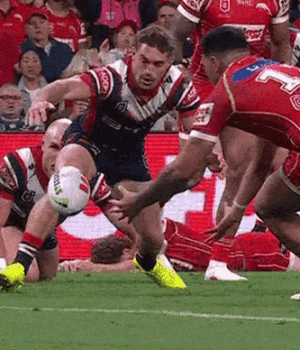
Watson’s head collided with the knee of Dolphins forward Kulikefu Finefeuiaki in his first minute on the field on Friday night. After an on-field head impact assessment, Watson was deemed to be displaying category-two concussion symptoms, which were upgraded to category one a few minutes later.
Under the NRL’s concussion rules, players suffering a category one concussion must be stood down from training and playing for a minimum 11 days.
In Watson’s case, the decider will be played just nine days after his collision.
Provided Watson was symptom-free on Saturday, the day after the game, and has not suffered a concussion the past three months nor had more than five concussions in his career, the Roosters are entitled to ask the NRL to review the category-one classification.
That would require the NRL to seek an independent concussion specialist to meet with Watson and review his case. As of Tuesday night, the Roosters had yet to make that application to head office.
Regardless, at least one respected neurologist said Watson should not be risked.
Professor Mark Parsons a neurologist for nearly 30 years, has worked with numerous NRL players and said it was almost impossible to imagine Watson would be able to take the field based on what he had seen.
“Personally, I don’t think you can justify an early return for Connor Watson, medically or legally – you can’t take a risk with this condition because it’s too dangerous,” Parsons said.
“I’d be very surprised if an independent neurologist would clear him. I’ve seen plenty of NRL players over the years. They’ll tell you they are fine, but now we can do neurophysiological tests to give objective evidence of how the brain is functioning.
“A lot of expert authorities suggest 11 days isn’t long enough when there has been a category one head injury where there has been a loss of consciousness – and looking back at the replays of the incident on Friday night, he definitely got knocked out and lost consciousness.
“It’s worth mentioning the reason an early return is so dangerous is that if the player suffers even a minor head knock, before his brain has fully recovered, it can lead to massive brain swelling with permanent brain injury, and even sudden death.”
Parsons made it known he lived in the Hunter, but had no affiliation with the Knights.
Tolu Koula failed a HIA during Origin I when he was knocked out by Newcastle captain and Queensland fullback Kalyn Ponga, and returned to play a club game in eight days. However, Koula was deemed to have suffered category two symptoms that night.
Roosters officials insisted they would follow the protocols, and had previously demonstrated that they took a conservative approach when bringing their players back from concussions.
Meanwhile, Adam Gee will officiate his second NRL grand final, with Chris Butler to work as the bunker official. Gee has previously officiated the 2023 grand final between Penrith and Brisbane.
Ashley Klein, who oversaw all three Origin games, but was demoted to bunker duties last weekend after failing to award an escort penalty to the Warriors in the final minute of their semi-final loss to Newcastle a week earlier, misses out.