

Source : ABC NEWS
As the issue of concussion begins to reshape sport across the country, experts say while greater awareness is largely a good thing, some parents have been left “terrified”.
A research paper published by the Murdoch Children’s Research Institute (MCRI) in June, based on a survey collected by the Royal Children’s Hospital in 2023, found almost a third of parents who responded had stopped their children playing contact sport due to fear of concussion.
Some of those parents had stopped their children from taking part in sport of any kind.
It comes amid rising public awareness and concerns about the impact of head injuries in some of Australia’s most popular sports.

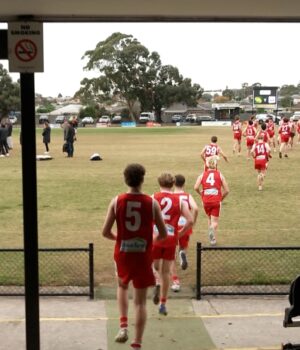
A recent survey of parents found almost a third have stopped their children from playing contact sport for fear of concussion. (ABC News: Jen Browning)
Earlier this week, Adelaide Crows AFLW star Chelsea Randall retired after multiple concussions, saying she had recently begun suffering symptoms such as “starry vision” after minor head knocks.
On Monday, Four Corners revealed dozens of Australian Rules Players, some in their 20s, had been diagnosed with the degenerative brain disease chronic traumatic encephalopathy (CTE), linked to head injuries sustained playing sport.
Professor Vicki Anderson, a paediatric neuropsychologist at MCRI, treats children who have suffered a concussion.
She said the parents of those children are often “terrified their children will develop CTE” as a result.
“There’s a lot of media out there that’s very frightening to the community, that potentially … hasn’t quite incorporated what the current evidence is in this field,”
she said.
“We don’t have the approach that you should play sport regardless, but if you’ve had one concussion, and you don’t get another one, then the chances that will have any repercussions are pretty low.
“In fact, I would say minuscule.”
Professor Vicki Anderson is a paediatric neuropsychologist at the Murdoch Children’s Research Institute. (ABC News: Peter Healy)
Adding to parental anxiety are widely held concerns that younger children who sustain a mild brain injury, such as a concussion, may either recover slower or face greater risk of long-term issues.
“If kids have severe brain injuries, the younger they are the worse outcome they have,” Professor Anderson said.
“If they have mild injuries … there is absolutely no difference in terms of that recovery rate.”
Mitigate, don’t eliminate
There is a risk that children will suffer a concussion while playing sport.
In January, the MCRI published a report which found 1,380 children were admitted to hospital with a sport related concussion in the 2023-24 financial year.
Rugby union and league combined (17.6 per cent) accounted for the highest number of those concussions, followed by AFL (14.5 per cent), cycling (13 per cent) and soccer (10 per cent).
A MCRI report, published in January, found 1380 children were admitted to hospital with a sport-related concussion in the 2023-24 financial year. (ABC Kimberley: Vanessa Mills)
But Professor Anderson said it is important to view those statistics in context.
“Most concussions we see aren’t from children playing sport,” she said.
“You’ve got more risk if you’re driving in a car, or if you’re doing a whole lot of other activities.“
However, the various sporting codes know they need to address the risk of concussion or risk losing junior players in droves.
The major tackle sports all have modified rules for kids to limit the amount of contact. Overseas, the US and UK banned junior soccer players from heading the ball until the age of 11.
Junior players suspected of concussion are now prevented from returning to play for several weeks, with restrictions varying depending on the sport and individual circumstances.
Professor Michael O’Sullivan, a leading neurologist at the Royal Brisbane and Women’s hospital and founder of one of the country’s first dedicated concussion clinics, said junior sport now needed to get the “simple things right”.
Neurologist Dr Michael O’Sullivan says the benefits of sport outweigh the risks of concussion. (ABC News: Mark Leonardi)
For example, as a parent of two “sport obsessed boys”, he observed that new rules designed to reduce high tackles were often being enforced by inexperienced umpires.
“I think we really need to be investing in things like developing referees for junior sport and getting some of our best referees to referee teenagers playing rugby codes at weekends.”
In the age of the ageless sports star, where 41-year-olds Cristiano Ronaldo and LeBron James are still playing at the highest level, Professor O’Sullivan said he wanted the same kind of changes which prevent career-ending knee injuries used to stop brain injuries.
The major tackle sports all have modified rules for kids to limit the amount of contact. (ABC News: Patrick Rocca)
“If we look at tennis … back in the 80s and 90s it was expected that you’d have a very short career and you’d burnout and you’d get injured. [Now] we see people playing into their late 30s.
“[In] soccer, the rate of serious knee injuries has diminished very significantly because of changes in the way tackles are refereed and the conditioning of players.
“I think those are the things we need to look for in relation to concussion and head injury.”
Both Professors Anderson and O’Sullivan agree; the benefits of sport far outweigh the risks of concussion.
“Our worry is that if parents are too frightened for their children to engage in any activity … then what will happen is kids will be spending more time on screens, and that’s not good for them,” Professor Anderson said.
“I believe we can really mitigate these risks in a very effective way and still remain a sporting nation.“