Source : THE AGE NEWS
Critica Limited has ripped up the old development playbook for its wholly-owned Mt Lindsay tin-tungsten project in north-west Tasmania, redesigning one of Australia’s largest undeveloped tin-tungsten resources around a modern underground mine as both commodity markets strengthen.
The rethink is being driven by a recently commissioned scoping study led by engineering firm DRA Global. It has gone back to first principles to build a development concept for today’s mining, environmental and commercial expectations, shifting away from the historical open-pit concept towards mining beneath Mt Lindsay.
The proposed underground mine would target the project’s two key mineralised bodies, the Main Skarn and No. 2 Skarn, which extend over a combined 2.8km of strike and remain open at depth. More than 83,000m of cumulative diamond drilling since 2007 has given Critica a substantial head start in targeting better mineralisation. The established resource contains an estimated 81,000 tonnes of tin and 32,000 tonnes of tungsten.
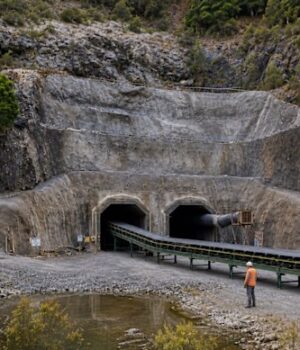
Taking the mine underground opens the door to a much tighter surface footprint. The proposed main portal would sit within the already disturbed historical HEC Quarry, 600m from the potential processing plant site. Sealed Pieman Road and existing electricity transmission lines are also close by.
‘Mt Lindsay has the potential to diversify the supply of two essential minerals that are becoming increasingly important to global technology, manufacturing and defence supply chains’
Critica Limited chief executive officer Jacob Deysel
Processing, mine services and water management are being designed as a single system, while hydroelectric power creates scope for electrification and lower-emission materials handling. Conveyors could improve efficiency, cut truck movements and reduce road construction.
Management says some process tailings could be returned underground as backfill to support mining and reduce permanent surface storage. Remaining tailings would require surface storage, with the final split hinging on engineering and testwork.
An updated mineral resource estimate is underway to underpin final mine optimisation and scheduling. Rather than maximising tonnes or mine life, Critica is looking for the sweet spot between economics, capital requirements, operational efficiency, mine life and long-term footprint.
Critica Limited’s chief executive officer Jacob Deysel said: “We’ve gone back to first principles, evaluating every major component as part of an integrated development concept. Our objective is to build a better Mt Lindsay — one that is technically robust, commercially compelling and designed responsibly from the outset.”
The remaining scoping study work will integrate the updated resource with mine design, processing, infrastructure, materials handling and tailings to test the technical, operational and economic case. Completion remains targeted for the third quarter of 2026, with development subject to environmental studies, stakeholder engagement and regulatory approvals.
There could be more in the Mt Lindsay mix too, with potential copper, boron, fluorspar and other minerals identified across the broader mineral system and under consideration in the project evaluation.
Mt Lindsay has geography on its side, sitting in one of Australia’s classic polymetallic mining provinces in northwest Tasmania and alongside one of the world’s significant operating tin mines at Renison. The region is home to a skilled workforce, mining services and export infrastructure through the Port of Burnie. Critica says development could generate meaningful investment, employment and economic benefits for Tasmania.
The market backdrop adds another tailwind to the Mt Lindsay rethink. Ammonium paratungstate, the key intermediate product commonly used to benchmark tungsten prices, was quoted at US$3075 (A$4330) per metric tonne unit (MTU) earlier this month, where one MTU equates to 10 kilograms, while London Metal Exchange (LME) tin was fetching US$56,050 (A$78,900) per tonne.
Tungsten’s strategic importance is growing alongside the push for secure technology, manufacturing and defence supply chains. Tin’s dominant role in electronic solder puts it at the heart of semiconductors, circuit boards, vehicles and data centres.
Work at Mt Lindsay made up one half of a busy quarter for Critica, with a scoping study for its flagship Jupiter rare earths project in Western Australia also targeted for the third quarter. At Jupiter, the company is similarly rejecting waste before expensive downstream processing, reflecting a common philosophy: only move and process the tonnes that matter.
Together, the projects give Critica exposure to rare earths, gallium, yttrium, tin and tungsten. For Mt Lindsay, however, a changed market could revitalise the established resource and give it a very different future.
With a substantial resource already defined, Critica is betting that a smarter underground design, infrastructure already on its doorstep and stronger tin and tungsten markets can give the Tasmanian giant a new lease on life.
Is your ASX-listed company doing something interesting? Contact: mattbirney@bullsnbears.com.au