Source : Perth Now news
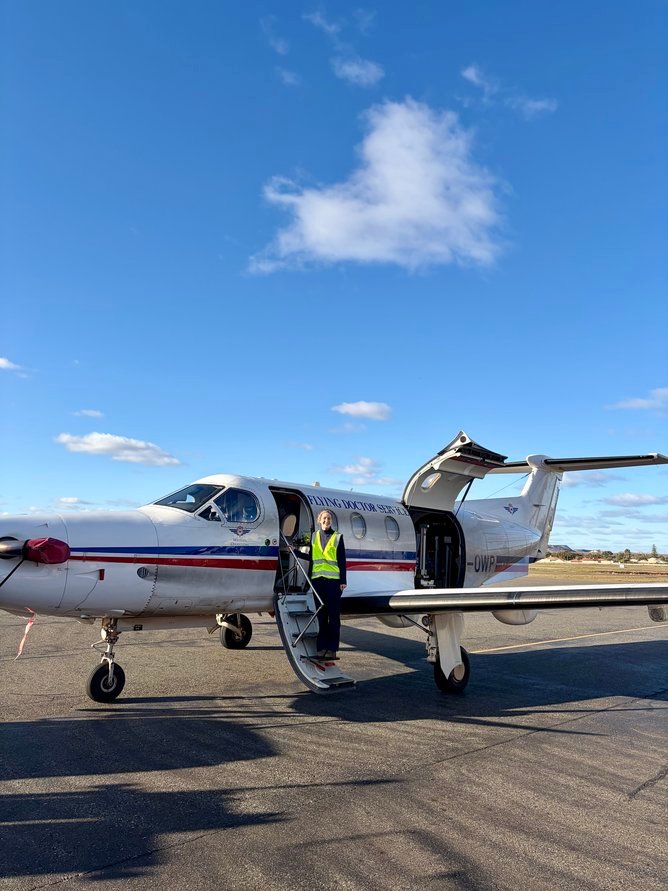
A final-year medical student had an exhilarating start to her practical experience with the Royal Flying Doctor Service.
Curtin University student Georgie Blevin spent two weeks with the RFDS Western Operations team in Kalgoorlie as part of her practical learning with Curtin Medical School.
The 23-year-old observed how pilots, nurses and doctors work in tandem to provide critical care to patients in WA’s regional areas, and learnt how retrieval medicine works to assess, stabilise and transport seriously injured or ill patients from emergency scenes and smaller hospitals to major medical centres.
“I’ve been fascinated by how the pilot, nurse and doctor work closely together as a team to help patients in rural and remote communities access the care they need,” Ms Blevin said.
“I’ve also really enjoyed learning about retrieval medicine and the unique considerations that come with providing care in the air, from how altitude can affect a patient’s condition to the different aircraft used to reach people across the state.
“I feel really lucky to have been able to experience this first-hand, and I’m so grateful to everyone at the RFDS for having me and for sharing their knowledge with me over the two weeks.”
Ms Blevin had previously attended the Kalgoorlie base as part of Curtin Medical School’s immersion program in her second year.
RFDS Western Operations senior specialist medical practitioner Anoop Pem said he felt excited to welcome her back and continue the educational experience.
“Having students experience rural medicine and the role of the retrieval service first-hand provides a valuable insight into the unique opportunities and challenges of working in regional and remote WA,” he said.
“It is incredibly encouraging to see students choosing placements with significant rural exposure, and we hope experiences like these inspire the next generation of doctors to pursue a career in rural and remote medicine.”
Curtin Medical School began taking students in 2017, placing an emphasis on providing them access to regional healthcare experiences early in their training.