Source : PERTHNOW NEWS
Strip away the bonnets, corsets and foppish suitors and Jane Austen’s Sense And Sensibility is an examination of the patriarchy and disenfranchisement of women during Britain’s Regency era.
Yet, when Austen’s first book was published in 1811, critics at the time preferred to see it as an instruction manual for the proper behaviour of a lady.
It tells the tale of the Dashwood sisters, penniless after the death of their father and struggling to find their place in society, with the only lifeline to cling to the possibility of a match with a minted man.
Elder sister Elinor is the “sense” part of the equation, sacrificing her own happiness and repressing her emotions for the benefit of her family, while the impetuous Marianne is “sensibility” incarnate, and would rather perish than put duty above burning passion.
The book was seen as a celebration of Elinor’s stoicism and an indictment of Marianne’s imprudence — after all, this is the land of the stiff, upper lip — but viewing it through a modern lens suggests Austen had something else in mind.
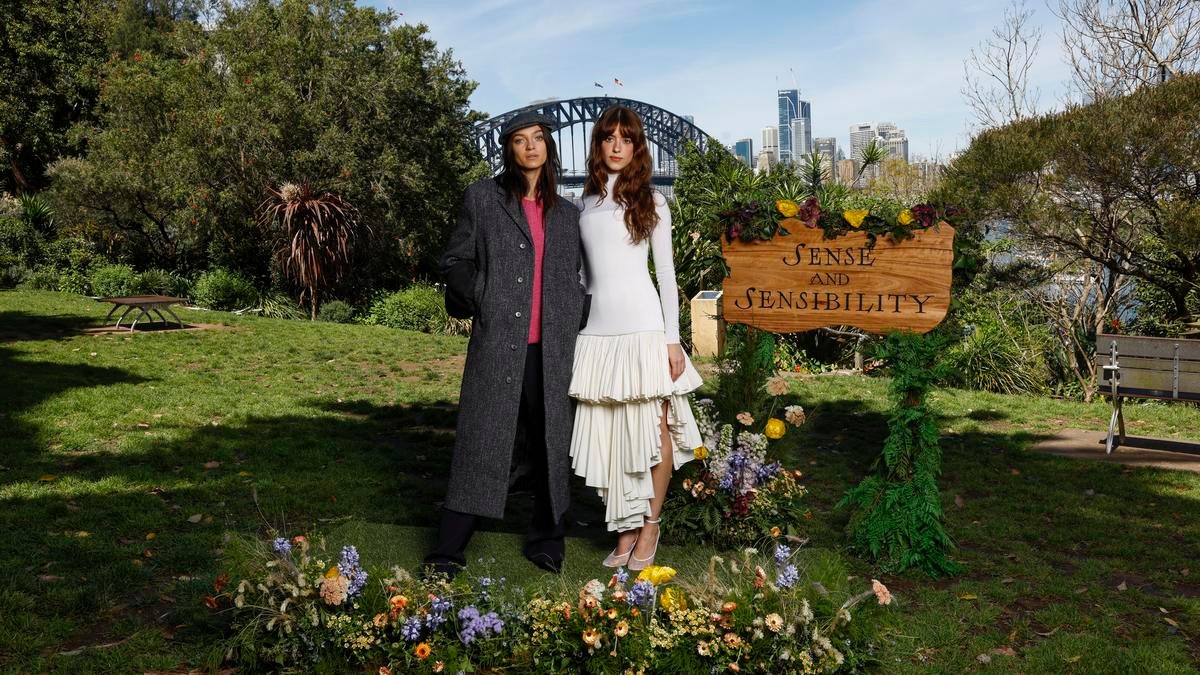
Which is why the story feels so fresh in the latest movie adaptation, starring Daisy Edgar-Jones and Esme Creed-Miles as Elinor and Marianne respectively.
And that’s without the revisionist flourishes that have become so trendy following the successes of Bridgerton and The Great.
“I think Austen was actually exploring the exhaustion and how difficult it was to be a woman at that time, where you have all this emotion and you have all these feelings, but you can’t express them,” Edgar-Jones tells PLAY.
“You have to figure out how to kind of fill in the gaps that have been left for you by society, and that’s something that women can . . . relate to in many ways, even today.
“We should be allowed to be messy and vulnerable and selfish, and that you don’t always have to be good.
“And this kind of idea of a good girl and a good woman and how you should be, I think I totally related to that, and found it very exciting to be able to sort of explore a character like that on screen.”
For Creed-Miles, it was Marianne’s loss of perspective in moments of heightened emotion that resonated.
“She doesn’t have much of a filter,” Creed-Miles admits to PLAY.
“She really wears her heart on her sleeve, and I love that about her, and she started to feel like a real person in my life — she almost felt like someone I knew by the end of it.”
Directed by Georgia Oakley, from a screenplay by Diana Reid, this is the first adaptation of Austen’s novel to have women in both of those roles.
“I think that will always bring a certain authenticity to a work,” Creed-Miles says. “When there’s an authorship there that is lived in.
“Georgia and I both spoke a lot about our experiences as queer women when we first met to talk about this, and how obviously at that time that wasn’t allowed or even legal, and there are still elements of our lives today that are shaped by society in that way.”
When it comes to adaptations of this work, two previous iterations are worth noting, with the most recent being a 2008 BBC miniseries that is generally considered the most faithful to Austen.
But, if you pressed most fans for their favourite, it would be the earlier 1995 film, because it really was magnificent.
The great Emma Thompson won an Oscar for penning the screenplay, Ang Lee earned an Oscar nomination as director, and the cast included Thompson as Elinor and Kate Winslet as Marianne, with other key roles filled by such British luminaries as Hugh Grant, Alan Rickman, Hugh Laurie and Imelda Staunton.
“As a lover of that film, it’s definitely something that I’ve absorbed, and it’s been part of my life since I was young, because I watched it at a very formative age, and those performances have really stayed with me,” Edgar-Jones says.
“(But) that adaptation was made 30 years ago . . . and that’s the great thing about great literature, there’s always more to mine and find.
“What can we bring out of it to speak to today’s world?
“Georgia really wanted to explore that the true love story of this film is the two sisters, and that be the central focus of the movie.
“And her want to strip away maybe some of the more ornate sides of Austen that can, at times, make it feel like there’s a bit of a distance between you and this world.
“Even though it feels very much grounded of its period, there’s something about the filmmaking that feels so fresh and immediate that you feel like these women are alive and existing in today’s world.”
On that topic, one does wonder how the Dashwood sisters would fare in modern society, trading reserved social interactions and painfully polite correspondence with dating apps.
It’s hard enough for them dealing with that rotter, Mr Willoughby, so imagine a cad at every swipe.
“I feel like Elinor is somebody who quietly yearns,” Edgar-Jones offers.
“She feels a lot, but she keeps it hidden, so I’d imagine that, whomever she was courting, that she’d probably frequent their page quite a lot. She’d be a sort of lurker, but not ever really do anything about it.
“I don’t know if she’d even have a dating app. I think she’d find that too anxiety-inducing.”
Creed-Miles also believes you wouldn’t find Marianne on Tinder or Bumble, but for very different reasons.
“She’s so outgoing, and she loves to be out in the world and experiencing people in real life,” she says.
“She’s so excited about going to these balls, she’s like the opposite of a wallflower, which is the one part of her I don’t relate to, and she’s so out-and-about that maybe she wouldn’t need (dating apps), because she’s really experiencing people in the flesh.”
If she’d been born 225 years later we might know how Austen felt about modern dating, but there’s no doubting how these actors feel about bringing her work to audiences now.
“I think growing up loving Austen’s books, loving every adaptation of her novels, I felt (when I was offered this role) that this is pretty much the peak and maybe I should quit now,” Edgar-Jones laughs.
Sense And Sensibility is in cinemas October 15.