source : the age
For six years, as new homes were built on farms that had been turned into suburban streets, traffic around the main intersection of Grantham Farm, a virtually new suburb at the edge of Sydney’s north-west urban sprawl, had become increasingly congested. Then Bathla came to town.
The large western Sydney developer, which collapsed four weeks ago and has administrators scrambling to avoid liquidation, had purchased a small plot of land at the edge of the estate with plans to build a row of freestanding homes.
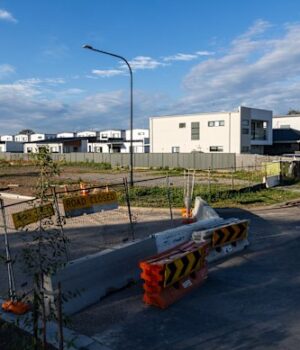
As part of the developer’s agreement with the council to approve its buildings, Bathla agreed to repair Edmund Street, the crumbling thoroughfare onto which its new homes would face.
There was one problem: Edmund Street was one of the main exit points for the estate, and it has been closed since late last year.
Now, hundreds of residents are being funnelled into long traffic jams of up to 250 metres to get out of their estate and onto Garfield Road East, the major arterial road between Richmond Road and Windsor Road. Those who can’t wait are resorting to driving down very steep and unstable dirt patches.
“We’re going to end up with a death and destruction situation here,” said Grantham Farm resident Joni Armstrong.
She has lived in the area since 2019 and regularly witnesses people “putting their foot down and hoping for the best” as they race through the infamous “dog leg” intersection, where streets are not aligned and cutting into fast-moving traffic leads to crashes.
The intersection has worsened since Bathla closed Edmund Street, Armstrong said.
“All the traffic that would normally have funnelled to Edmund Street, dissipating the issues here, is now coming through on Hamilton Street.”
The traffic nightmare raises questions about the nature of developer contributions accepted by high-growth councils such as Blacktown, which relies on developers to create large amounts of new infrastructure needed for rapidly growing communities because of a 2012 cap on contributions that has not been adjusted for inflation.
A spokesperson for the council said work had stopped before Bathla collapsed. Bathla contracted the roadworks to Jay & Lel Civil Contractors. Its workers walked off the job earlier this year, telling residents they had not been paid for work.
The company is listed as a creditor to Bathla, owed $1.27 million. It has also placed a caveat on the plot of land, which Bathla’s administrators are now trying to sell, meaning they will be the first to get money from proceeds of the sale.
The closure is also causing problems for schools in the area. Four schools containing about 4000 students are located at the notorious intersection about a block away from the closed street. Jane Misek, principal of Catholic school St John’s Primary, said parents, despite wanting to walk their children to school, were forced to drive because it was not safe to cross the road.
When the Herald observed the conditions on Monday morning, students on foot were forced to wait for merciful truck drivers to slow down and let them cross because there was no pedestrian crossing on the road that takes 42,000 cars a day. There were some near-misses.
“The traffic in the mornings and afternoons is just really chaotic. There are many schoolchildren [who] use this intersection,” Misek said.
“The development in this area has grown so quickly and you’ve got all the schools along here growing, and a lot more children and people coming out of Grantham Farm.
“[School parents] really advocate for the children’s safety. We ask them to be patient because we know something is happening, but it needs to happen quicker than what it is … for safety’s sake.”
In August, the NSW government signed a contract with a construction group to turn Garfield Road East into a four-lane road, which it says will take pressure off the road and improve safety.
A spokesperson for Blacktown Council, which is owed $1 million by Bathla, said the council understood the “frustration and concern” with the closure, and was “assessing the unfinished works and relevant legal, contractual and planning arrangements to determine responsibility for completing them”. They could not give a time frame for when the road would be reopened.
Armstrong, who admitted she has used the dirt patch escapes when she was running late dropping off her children at day care, just wants the road completed.
“It’s tantalising to see it almost finished,” she said. “It looks like it just needs the asphalt to go down.”
 Anthony Segaert is the Parramatta bureau chief at The Sydney Morning Herald. He was previously an urban affairs reporter.Connect via X or email.