

source : the age
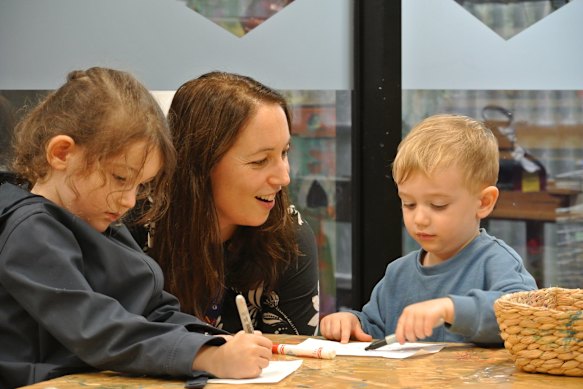
Early childhood educators change how they speak when they are talking to boys versus girls, mirroring a gender divide observed within homes, a study has found.
Researchers at the University of Queensland found educators were more likely to use words centring on perception and senses when speaking to boys, and words linked to more abstract “desire” concepts – such as wants and needs – for girls.
“Words about wanting and needing help children understand goals and intentions, which are important for social and emotional development,” lead researcher Elizabeth Brook said.
“Words about seeing and noticing tend to support attention and awareness.”
The study analysed data from almost 200 interactions between educators and children aged between one and 3½ years, pulled from UQ’s 10,000 hours study – a three-year research project dissecting environmental, linguistic and socio-economic impacts on young children’s development.
Sveitlana Kyrchei, a Brisbane-based mother of two young boys, said she found boys simpler to understand.
“From my perspective, we [girls] will be more moody … boys have more energy for sure,” she said.
Margaret Cribb Early Learning centre manager Sunny Kim, who has 24 years’ experience as an early childhood educator, said at her centre there was a noticeable gender divide in the types of activities children gravitated towards, which impacted how they spoke with educators.
“The girls tended to have a much more expressive way to engage, whereas the boys sometimes tend to lose their interest because they are often inclined to outdoor play,” she said.
“So, it is harder for us to have a meaningful conversation with, let’s say, boys for longer periods of time.”
She said girls at the centre would spend longer on inside activities, which mean educators could speak to them for longer periods – and in more detail – about the activities they were doing, such as arts and crafts.
“We always take opportunities to talk to them by asking questions like ‘oh, tell me about your drawing’, and so on and so on,” Kim said.
Brook said the findings were not a mark against how early childhood educators interacted with kids.
The research indicated in group settings, the kinds of language used would change on a scale between perception and desire language depending on how many boys were in the group.
The number of children present also had an effect, the paper found, with one-on-one interactions more featuring more emotion-focussed language.
Research supervisor Dr Aisling Mulvihill said other studies in the field found parents also used different languages with boys and girls.
However, Mulvihill said using abstract language – like emotion-based words, or desire-based words – were used with younger children, were linked stronger social skills and emotional understanding.
“There’s always this kind of chicken-and-egg scenario of what comes first,” she said.
“Is it that boys are presenting a certain level of social emotional maturity, and then we’re responding to that with our language? Or is it that our language and the exposure to that is associated with their social and emotional outcomes?”
“If we could try and get to the mechanisms underneath it, we can try to understand how best to change this and ensure that boys and girls get equitable opportunities in this type of language exposure.”
Kim, who was also as a parent of a young boy, said she found her experiences with her kids at home made her a better educator.
“A lot of experience that I have from my own, I share with the families who are struggling with their young boys because they didn’t have the same sort of challenges when they had girls,” she said.
She said there wasn’t always a one-way approach to speaking with a young child.
Mulvihill said, above all, children needed to hear and use multiple different kinds of language, including words abased around perception, thinking, emotions, and desire.
Start the day with a summary of the day’s most important and interesting stories, analysis and insights. Sign up for our Morning Edition newsletter.