

Source : Perth Now news
Drastically altering the night sky and the future viability of astronomy are just some of the concerns raised by the global science community after the Trump administration approved Elon Musk’s Starmind this week, authorising the world’s richest man to deploy one million AI data centre satellites into orbit.
Fewer than 5000 stars are visible to the naked eye, so Mr Musk’s proposal will drastically change the night for every human on Earth — but the impacts go far beyond that.
The SKA-Low radio telescope, the most expensive science project in Australian history, will simply not be able to function as intended with such significant interference from the mega-constellation of satellites.
Astrophysicist and executive director of the International Centre for Radio Astronomy Research, Simon Ellingsen, told The West Australian the Starmind proposal “would have a devastating impact” on the yet-to-be-completed observatory in WA’s Murchison.
“These instruments are so sensitive they can pick up (interference from) the electronics working on the satellites themselves, so if we have a million data centres, or data centre compute nodes, up there, it will probably be even noisier, so it would be bad for essentially all forms of astronomy, but particularly radio astronomy,” Professor Ellingsen said.
Industrial Transformation Training Centre in Space Domain Awareness director David Coward leads a $20 million initiative to enhance Australia’s ability to manage satellites, space traffic and space hazards.
Associate Professor Coward said tracking the estimated 17,000 spacecraft currently in orbit around the Earth was already “extremely challenging”, but the difficulty would increase exponentially with Starmind’s mega-constellation of satellites. Then there’s the issue of space debris, which is already hurtling around our planet at a hyper-velocity of eight kilometres per second.
“These centimetre-size objects are the ones to watch out for because they’re very, very difficult to track,” Professor Coward said. So, what would happen if space debris the size of a marble hits the International Space Centre?
“Something about a centimetre in size more than likely would totally destroy it,” Professor Coward said.
The big selling point of Mr Musk’s space-based compute nodes is that they remove the negative impacts associated with terrestrial data centres, which have become political kryptonite around the world.
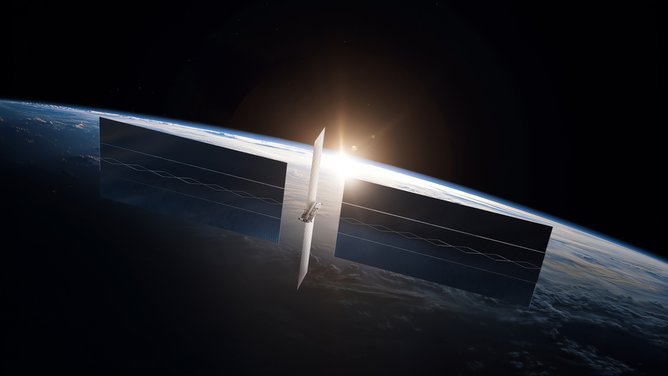
The satellites will have large deployable radiators to dissipate heat into space and large solar sails to harness the Sun’s energy, greatly increasing their surface area.
“It means the probability of an impact from space debris skyrockets. These would be the biggest targets for space debris impacts in Earth orbit,” Professor Coward said.
Citing Sandra Bullock’s hit sci-fi flick Gravity, Professor Coward said the film depicted the very real Kessler Syndrome theory, which posits a catastrophic scenario in which orbit density reaches a tipping point after which a couple of space collisions trigger a chain reaction that eventually renders orbital space unusable for generations.
“If you’ve got large bodies like these AI satellites, that chain reaction is more probable to happen,” Professor Coward said. SpaceX’s Starlink satellites currently have a lifespan of five years, after which they are programmed to fall to Earth and burn up in the atmosphere.
If Mr Musk achieves the one million mark, there could eventually be as many as 500 Starmind satellites per day burning up on re-entry, injecting heavy metals into the upper atmosphere and potentially having a catastrophic impact on the ozone layer.
This was not considered under the scope of the US Federal Communications Commission approval process.
FCC chair Brendan Carr, a Trump appointee, previously led the charge to have popular late-night talk show host Jimmy Kimmel suspended.
“This fundamentally changes the night sky for everyone on every corner of the earth, and that’s one of the big concerns,” Professor Ellingsen said.
“The skies belong to to all of us, not to any single individual nation.”


