

SOURCE :- THE AGE NEWS
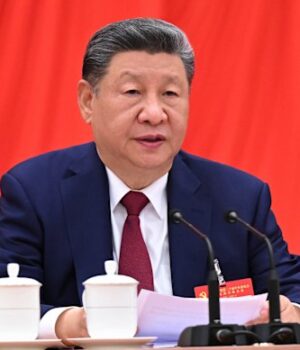
Beijing: In about a year from now, if the weight of expectations holds, Xi Jinping will secure a fourth, unprecedented term as China’s paramount leader.
Having already abolished terms limits in 2018, and purged factional friends and foes alike, Xi is preparing the ground for the loyalists he wants by his side when he extends his rein for another five years at the 21st Party Congress, due in the second half of next year.
One of those loyalists appears to be Zhang Shengmin. The top general, and Xi’s anti-corruption enforcer inside the military, was promoted to the powerful Politburo during a meeting of hundreds of party officials on Thursday.
Zhang is just one of two remaining members on the party’s Central Military Commission, China’s supreme military decision-making body. The other is Xi.
Over the past two years, Xi has purged the five other generals he hand-picked to serve on the commission, in a near-total decapitation of the leadership of the People’s Liberation Army. Since 2012, hundreds other senior and lower-ranked officials throughout the party have been removed or placed under investigation as part of Xi’s campaign to root out corruption and disloyalty.
Zhang’s elevation should see him survive through to next year’s party congress, but nothing is guaranteed.
“It’s hard to read a PLA general’s future these days,” says Shengyu Wang, a researcher of Chinese elite politics at the Asia Society Policy Institute.
“It’s a case of now you see me, now you don’t.”
Zhang’s promotion is the first time in decades the party has restocked the Politburo during the middle of a five-year term. The decision was announced after the conclusion of the “fifth plenum” – a gathering of several hundred delegates on the party’s hollowed-out Central Committee, which meets annually to rubber stamp Xi’s agenda.
For four days this week, these officials were holed up behind closed doors at a guarded hotel in Beijing to endorse his directives on strict party governance and discipline.
Dozens of faces were missing from this year’s cohort.
Just 279 delegates were present, an attendance rate of 74 per cent — the lowest on record since the Mao Zedong era, and a sign of the sharpness of Xi’s scythe in his long-running anti-graft campaign.
Among the confirmed fallen were 33 officials, including former Politburo member Ma Xingrui and former senior military leader Zhang Youxia, who were expelled from the party.
The message delivered at the plenum, and intended to filter down to millions of party cadres across the country, is there will be no slowing down.
“We must maintain a high-pressure stance against corruption,” said a communiqué released after the meeting wrapped on Thursday.
The document endorsed the strategy of “not daring to be corrupt, not being able to be corrupt, and not wanting to be corrupt” as key to strengthening party discipline — a slogan that was repeated three times.
For connoisseurs of China’s elite politics, plenums are also an empty chair watching exercise — who’s in, who’s out, and who’s been promoted — with extra attention paid this year in the run-up to the big show next year.
“This is a very interesting time for China watchers to see who is actually still sitting in the meeting hall, which means they are still safe at this moment,” says Mingda Qiu, senior analyst of Eurasia Group’s China practice.
“And if they disappear or if they are not attending the plenum without an explanation, then that person might be in trouble.”
Analysts will now study, frame by frame, the shots of the meeting hall aired by China’s state broadcaster CCTV to gauge who is missing and might be under investigation.
For months, Xi has been sketching out his vision on party building and governance, signalling his frustration that directives from Beijing were not filtering down and duly obeyed by provincial officials.
In a speech published this month, he complained about “two-faced people” who loudly commit to major party decisions “while inwardly resisting, acting arbitrarily, and even disobeying order”. They must be exposed and eliminated he warned.
China expert Neil Thomas and his colleagues at the Asia Society, have likened Xi to Leninist Logan Roy, the patriarch in HBO hit series Succession.
“He presides over an enormous enterprise, exercises commanding authority, and remains perpetually disappointed by the people expected to carry out his wishes,” they said in a recent paper.
Xi has made a point of ensuring he has no successor, to firm his grip on power.
But its left him with another challenge: grooming a new generation of trusted cadres, while filling vacancies in senior leadership positions from a shrinking talent pool.
Get a note directly from our foreign correspondents on what’s making headlines around the world. Sign up for our weekly What in the World newsletter.
 Lisa Visentin is the North Asia correspondent for The Sydney Morning Herald and The Age based in Beijing. She was previously a federal political correspondent based in Canberra.Connect via X or email.


