Source : the age
Sydney Opera House, September 22
Until October 31
Someone said to me, “Not My Fair Lady again!” But when it’s this good, 10 years seems rather too long between elocution lessons. It still makes most other musicals seem trashy, with their cartoon characters, simplistic stories and limp or overwrought songs.
Nor could Alan Jay Lerner (book and lyrics) and Frederick Loewe (music) ever replicate such mastery. But then, they never again had such robust raw material as George Bernard Shaw’s Pygmalion.
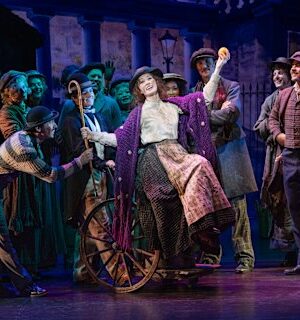
The pressure on the performers playing Eliza Doolittle and Henry Higgins is frightening given the many brilliant predecessors, beginning with Julie Andrews and Rex Harrison in 1956. Claire Lyon and Nathaniel Parker duly won us anew.
Lyon has wanted to play Eliza all her life, unsuccessfully auditioning for the 2016 incarnation of this production, which, directed by Andrews and produced by John Frost and Opera Australia, was conceived to replicate the original Broadway designs. Now Karen Johnson Mortimer replicates Andrews’ direction.
Lyons performance is a victory for all who don’t give up and a lesson for all directors and producers. She’s 18 years older than Eliza is supposed to be, yet she’s so right for the part that this discrepancy is swept away – other than for allowing her to present an Eliza who’s a little more knowing, a little less the ingenue.
Lyon blossomed more after the opening scene, blossomed yet more when she mastered “the rain in Spain”, and still more when she tapped into the inner steel to stand up to Higgins’ bullying. All Elizas must own our hearts, and Lyon’s performance enchants as she effortlessly blends comedy, elegance and singing with a beautifully rounded soprano voice.
The trick with playing Higgins is for the actor to charm us into forgiving his tyranny towards Eliza, as he elevates her from a flower girl to gentlewoman, just to win a bet. If that charm is not in place, why does Eliza fall for him, given her treatment?
Parker being two decades older than Higgins’ putative age of 40 creates a fatherly dimension that clouds the phenomenally nuanced frisson of allure between Higgins and Eliza. Nonetheless, he’s splendid at being bumptious, intelligent and emotionally asinine. His delivery of the fizzing lyrics was supreme in You Did it and Hymn to Him, although he undersold some of the delicious lines in I’ve Grown Accustomed to Her Face.
Reg Livermore, Tony Llewellyn-Jones and Robyn Nevin reprise their roles as Alfred Doolittle, Colonel Pickering and Mrs Higgins to sterling effect, with Livermore somehow evading the passing years.
The recreations of Oliver Smith’s sets and Cecil Beaton’s costumes are also stars, as are the songs, of course, realised with intricate detail by the orchestra under David Young. The ensemble looks transcendent in the Ascot scene (with choreography by Christopher Gattelli), as the English stiff upper lip migrates to stiff upper bodies. You’d be mad to miss it.
Ensemble Theatre, September 22
Until October 18
Put three people into a confined space. Add a few ominous noises and a nasty smell. Stir gently and leave to simmer.
Eloise Snape’s new play, The Elevator, commissioned for the Ensemble Theatre, has an elegant simplicity. Margot is the chief executive of Eco Engines, an AI-powered start-up. Alison is her crisis communications expert. They are in the lift on their way to the 48th floor to face a press corps which is baying for blood after a tragic accident involving a self-driving car and a pedestrian.
Also in the lift is Ollie, a sanitation engineer – that’s a cleaner to you and me – who has a coffee and a job to get on with. When the lift malfunctions and the accidental trio are stuck in a confined space for an undefined period of time it’s all there – class, race, sexism, climate change and the AI apocalypse – just waiting to blow.
Concert Hall, Opera House, September 19, also September 21.
Mozart’s symphonies are the Australian Chamber Orchestra’s (ACO’s) heartland, and the last three, written for unknown reasons in 1788, are a cornerstone of their artistic practice, to which they have returned many times, with consistency of ethos but evolving musical perspective.
Their current approach under director and violinist Richard Tognetti displays maturity without conventionality. Familiar music is experienced as though in a constant process of formation and renewal through close attention to articulation, balance and nuance, to convey a sense of distinctive shapes being created in the moment. Although the three works have contrasting expressive purposes, there were common features to the ACO’s approach to all three.
The first movements were unrushed, each imposing and weighty in its own way. The slow second movements were, for each symphony, a highlight for their translucent balance of strings and woodwind sounds (and what a glorious section of guest wind players they had assembled). The minuets revelled in carefully articulated individuality and grace, and the finales were each exhilaratingly brilliant in their own way.
Opera House Concert Hall, September 18
She was, well, fine. Adequate seems harsh, good seems flattering, and middling is about right, but the show was probably elevated beyond the implications of that term by Suzanne Vega’s efforts to charm.
Efforts like the donning of a top hat for the first and last songs, as a kind of “showbiz starts/ends here” signal that amused while also nodding to her early notoriety as, and natural inclination to being, a reticent public performer.
You can include self-deprecating background stories, such as the paired Gypsy (early in the show) and Liverpool (in the encore), which chronicled her own summer teen romance and its real-life denouement decades later (earning a droll line from her husband that the former boyfriend didn’t need a third song, thank you).
Opera House Studio, September 16. Until September 19
In the most true-blue modern dance biography you’ll ever read, Lewis Major describes himself as an enterprising sheep shearer-turned-award-winning-choreographer. “He is the only dance artist he’s ever heard of,” his biography quips, “who can reverse parallel park a tractor.”
I was slightly crestfallen that there were no sheep or tractors for Triptych, the Opera House season of Lewis Major Projects. Despite the name, Triptych contains four segments from three award-winning works, teasingly named Prologue, Epilogue: Act 1, Unfolding and Epilogue: Act 2, performed by four statuesque dancers.
Major was mentored by British choreographer Russell Maliphant and lighting designer Michael Hulls. Here, he trips the light fantastic by pairing with award-winning lighting designer Fausto Brusamolino for Prologue and Unfolding – with the lighting emerging as Triptych’s five-star gem.