

source : the age
To submit a letter to The Age, email letters@theage.com.au. Please include your home address and telephone number. No attachments, please include your letter in the body of the email. See here for our rules and tips on getting your letter published.
Climate work crisis
Your correspondent (Letters, 31/7) answers her own question on the Bordeaux fires. Should we recognise the more frequent disasters like this, or risk hitting the tourism industry?
Of course, the world needs to acknowledge the direct link of extreme weather to fossil fuels burning.
People and governments have been complacent for many reasons. Problems like cost of living take precedence when results are wanted by the next election.
Individual floods and droughts are complex, not caused by global warming alone. Australia has always been a land “of droughts and flooding rains”.
But these are excuses, demolished for years by science, and recently by unprecedented fires in places like Bordeaux.
More needs to be done now to reduce the even worse impacts that will come in the second half of this century.
John Hughes, Mentone
AI as a subject
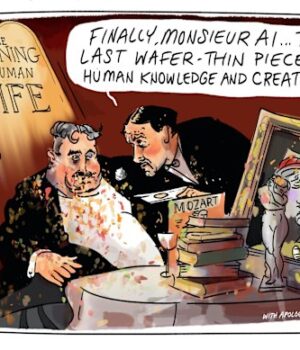
Kylie Moore-Gilbert (Comment, 30/7) expresses deep concerns about the use of AI in high schools, worrying that children whose brains are still developing will become deskilled in thinking for themselves. I recognise these concerns, but wonder whether it is possible to safely and proactively equip students to responsibly use AI by focusing on process more than outcome. Prompts are key to AI use. Students could start by looking at a question from numerous angles to elicit a large number of prompts, explaining their reasoning along the way. No one achieves a final draft immediately, so students could submit their drafts as well with their own evaluation of them. Hopefully, by incorporating AI as a compulsory subject in the curriculum, the next gen – ″AI natives″ – will have the knowledge and understanding to ethically, creatively and confidently function in an uncertain future.
Sue Fisher, Coburg
A depressendon thought
Depressendon–- couldn’t have picked a better word, Kate Halfpenny (Comment, 01/8). If James Hird gets another crack after two previous failed attempts, I’m out, too. Will make it to the Fitzroy ground and barrack for the Royboys in the amateur league. Maybe that’s where the Bombers should be.
Moira Macdonald, Daylesford
Outsourcing to the client
Waleed Aly has hit the nail on the head (Comment, 31/7). One wonders sometimes, how some people manage tasks that used to be so straightforward. The reality is that businesses have, in effect, outsourced to us what used to be their service offering or obligation. We now do the work, carry the risk, do the waiting and experience the frustrations while they claim ″efficiency″! The organisation that comes up with a better ″digital solution″ will be a winner.
Charles Griss, Balwyn
Learn the new ways
Remember the abacus and ″log books″ of logarithmic and trigonometric functions? In the ’70s, my mentor began teaching me how to repair three-legged transistors, diodes, resistors and some capacitors operating as a four function 20kg lump of desktop calculator.
Decades later, I lifted the lid on an Intel Pentium microprocessor and with a decent microscope you could probe a subminiature world for two etched signatures left by the ″artwork″ engineers. Presumably there are still people who understand how (now) billions of transistors connect and operate in modern devices.
A friend is trying to guide me through the mathematics of crude image recognition AI. It troubles me that few people understand or care how anything actually works in our brave new world.
Ronald Elliott, Sandringham
City needs the SRL
Melbourne 2050 – population nine million. Hundreds of thousands of more cars on the streets. Gridlock wherever you go. Why didn’t we build the SRL, like every other major world city which has one? It’s there for generations to come.
George Djoneff, Mitcham
Longer vision needed
The SRL is a perfect example of the moral and political dilemmas those politicians with a long-term vision always face (“Carroll considers rail loop’s future”, 30/7).
There will always be a choice between spending money to benefit future generations and the immediate needs of the voters, especially in health, education, and housing. The benefits of the SRL will not be felt until there is appropriate supporting development and people start to see the need to rely on public transport far more than we currently do.
When we say we should leave the world in good condition for future generations, most people are thinking about their children, grandchildren and maybe even their great grandchildren, when inreality we should be thinking more like Indigenous peoples around the world.
They think about the impact of their behaviour on the next seven generations or beyond. As current representatives of humanity, we are far too self-focused.
There was much ongoing opposition to London’s underground rail system when it was first proposed in the mid-19th century.
Howard Tankey, Box Hill North
Widen commission
At best, SRL East would rank at the bottom of a top 10 priority strategic infrastructure projects list, if the best interests of all Victorians were considered, not least jobs, economic productivity and air quality for the western suburbs and growth corridor to Geelong and beyond.
With news of yet more cost blow-outs on this project too, this project should also come within the purview of the royal commission, along with all these dubious planning approvals for excessive height and site coverage around train stations.
There’s no reason Melbourne has to become a mega city of highrise towers leaving no room for sunshine and trees, certainly not if it means trashing liveability, so the question remains, who benefits?
Bernadette George, Mildura
Recall Kennett years
Your correspondent (Letters, 31/7) confidently suggests that “the Liberals would never be so reckless with taxpayer money” as they imply Labor has been. We might also reflect on the short-term budget gains over long-term public value of the privatisations and public sector restructures prioritised by the Kennett Liberal government (1992-99).
Bruce Watson, Clifton Springs
Weighing the risks
Cartoonist Cathy Wilcox (1/8) has captured the irony of modern technology by showing how ludicrous it is to use a valuable resource to cool down data centres and the risk of more wildfires? What is the balance between supporting these digital services that rely on water and the use of a resource that is essential for people, agriculture and the environment?
Julie Ottobre, Brunswick East
The pleasure of trees
Like columnist Melissa Hoyer (Comment, 30/7) I find it extremely sad when mature trees are cut down, whatever the reason given – the beautiful mature peppercorn trees near the tennis courts next to the council gym in Gleadell Street, Richmond, for example.
I’ve been going to the gym for nearly 40 years and I’ve always passed those trees with a feeling of intense pleasure at the sight of them: they’ve provided deep shade and beauty to generations of tennis players and passers-by, and heaven knows we need them in such a heavily concreted area.
Bill Mack, Kew
The bee all and end all?
With the escalation of climate difficulties being so vivid across the planet, how are bees fairing?
Richard Pentony, Hawthorn