

Source : the age
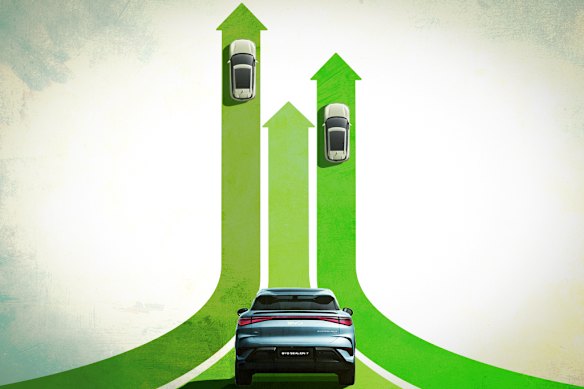
Electric vehicles have notched a new milestone, reaching nearly half of all new vehicle sales last month, revealing the potential for clean cars to defy the sceptics and help Australia to meet its climate goals.
The government’s 2035 climate target was deemed unachievable by many commentators when the independent Climate Change Authority, headed by former NSW Treasurer Matt Kean, declared last year that half of all vehicles must be electric if Australia was to reach its goal.
Industry figures released today show that target may, in fact, not be so unrealistic after all.
Whether people regret their choice of an electric vehicle is another matter, and could come down to the roll-out of charging stations needed to keep the growing fleet of EVs powered up.
Figures released by the Federal Chamber of Automotive Industry and the federal Department of Climate Change, Energy, Environment and Water on Wednesday showed that 48 per cent of all vehicle sales in May were either full EVs, conventional hybrids or plug-in hybrids.
This falls short of the finding of the Climate Change Authority that EVs must comprise 50 per cent of all sales in the decade to 2035 in order for Australia to hit its target and cut emissions at least 62 per cent.
However, it shows motorists’ growing desire to wean themselves off petrol and diesel since the Iran war created a global oil shock, raised fuel bills and flagged the prospect Australia could be forced to ration petrol or diesel.
In May, 21 per cent of all cars sold were EVs and 9 per cent were plug-in hybrids. The overall figure for electrified vehicle sales rises to 48 per cent of the market when including conventional hybrid vehicles that have an electric motor but cannot be plugged in to recharge.
Nearing the 50 per cent milestone shows it is now a plausible prospect given the exponential growth in EV sales, coupled with the falling cost of fully electric vehicles and increasing focus of carmakers on EVs, as opposed to hybrids.
A key sticking point in future sales growth will be the contentious roll-out of charging stations.
Lobby group the Electric Vehicle Council said state and federal governments must offer more financial support if they want to meet emissions targets.
The transport sector is the second-biggest source of greenhouse pollution, following electricity generation, but its emissions only fell 0.6 per cent in 2025. Despite the growth in EV sales, purchases of petrol cars have also grown with the population.
“When petrol prices surged, Australians had an alternative to the bowser – and they chose it in record numbers,” council chief executive Julie Delvecchio said.
“While the government has rightly invested in charging infrastructure, with adoption increasing, the federal, state and local governments all need to work together to redouble efforts to meet demand.
“We need to make sure the infrastructure keeps pace with the surge – so when Australians choose electric, the charger is there when they arrive.”
Generous tax breaks have helped drive EV uptake. The federal government retained in the May budget its exemption on fringe benefits tax for EVs priced under $75,000. However, the discount will be wound back for vehicles priced over $75,000, which will only attract a 25 per cent discount on the fringe benefits tax from April 1 next year.
Energy Minister Chris Bowen said the government’s policies to support EV uptake are helping drivers save money on petrol costs.
“We want Australians to have access to cheaper to run cars that suit the needs of their families,” Bowen said.
“Under Labor, EV charging has effectively tripled – as a combination of the market and government support sees a solid rollout of charging infrastructure.”
However, it was revealed last week that the government had downgraded its commitment to partner with the NRMA to build 117 electric vehicle charging stations on key highway routes, reducing the number of charging stations to 77 and reducing the funding from $39 million to $27 million.
Government officials told a Senate estimates hearing in May that the reduced funding would be sufficient to plug key network gaps.
Cut through the noise of federal politics with news, views and expert analysis. Subscribers can sign up to our weekly Inside Politics newsletter.
 Mike Foley is the climate and energy correspondent for The Age and The Sydney Morning Herald.Connect via email.
 Shane Wright is a senior economics correspondent for The Sydney Morning Herald and The Age.Connect via X or email.