SOURCE :- SIASAT NEWS
Hyderabad: Prashanth’s family earns Rs 1.5 to 2 lakh a year from small-scale farming in Kamareddy. He enrolled in a German-language programme run through the Telangana Overseas Manpower Company (TOMCOM), a state government agency and one of its key foreign employment programmes. Its first batch was charged Rs 4.1 lakh. Prashanth says he was also made a promise.
“HR Sravani Talasila said during admission that if I pass German B1 level, she guarantees a job,” he said. However, like Prashanth, none of the 24 candidates who spoke to Siasat.com, from an estimated 70 to 75 who joined TOMCOM’s Ausbildung (German vocational training) programmes in the Technical, Food Technician, Hospitality and Logistics streams between October 2024 and January 2025, could name a German employer that had interviewed them for a job.
Siasat.com examined the accounts of the 24 candidates from 15 districts in Telangana and Andhra Pradesh, along with programme documents, and sought responses from TOMCOM and its implementation partner, Fairstreet India Pvt Ltd.

Despite candidates alleging “zero success rate,” such assurances continue. Inaugurating a TOMCOM German-language programme in his constituency of Chennur in June 2026, Labour and Mining Minister Gaddam Vivekanand said responsibility for “good jobs” for those who trained well rested with “TOMCOM and himself.”
Many candidates told Siasat.com they felt cheated, saying the programme had failed to deliver the Germany employment opportunities they believed they had been promised.
The promise and the price
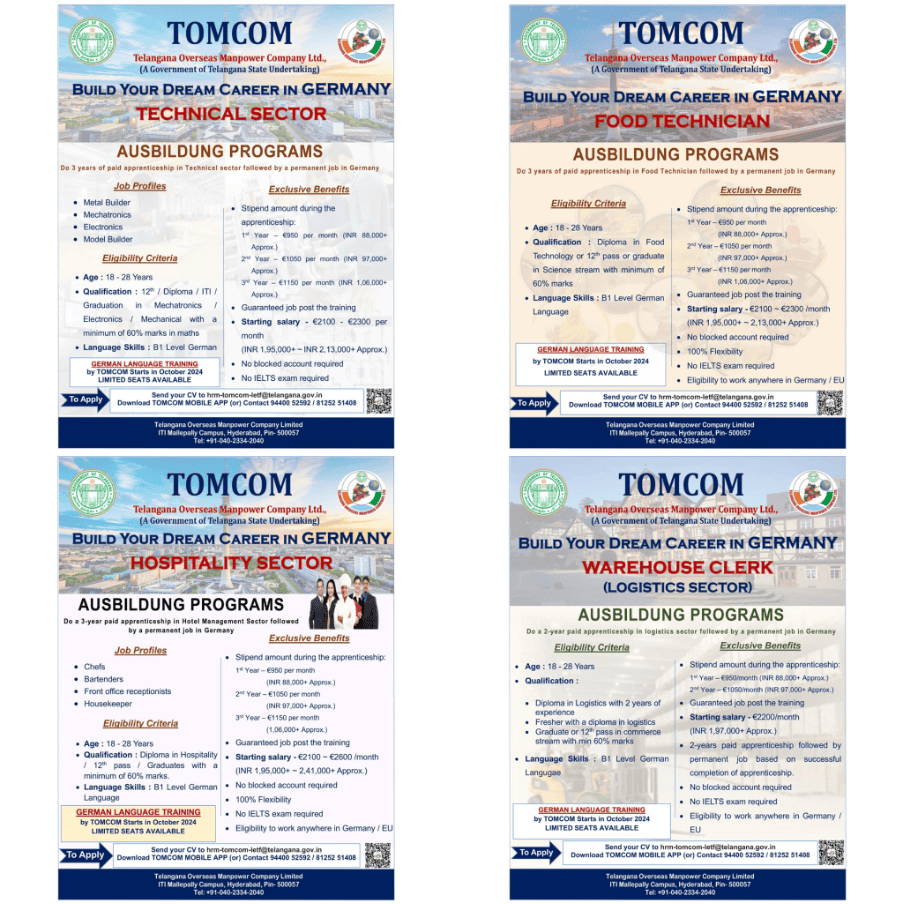
TOMCOM’s posters, under the slogan “BUILD YOUR DREAM CAREER IN GERMANY,” advertised three-year paid apprenticeships with monthly stipends of EUR 950-EUR 1,150 (roughly Rs 1-1.26 lakh) and starting salaries of EUR 2,100- EUR 2,600 (roughly Rs 2.3-2.9 lakh). Only B1-level German was needed, with no blocked account or International English Language Testing System (IELTS) requirement.
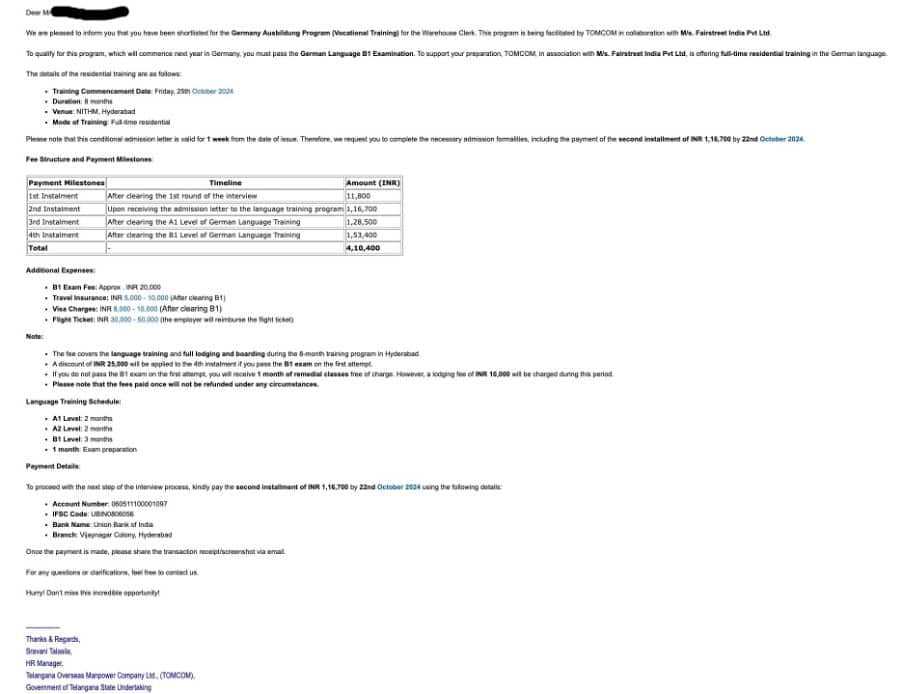
Emails from Sravani Talasila described eight months of full-time residential training with Fairstreet in Hyderabad at the National Institute of Tourism and Hospitality Management (NITHM) for Batches 1 and 2 and the National Academy of Construction for Batch 3. Batch 1 began on October 25, 2024.
Its non-refundable fee of Rs 4,10,400 came in four instalments: Rs 11,800 after screening, Rs 1,16,700 on admission, Rs 1,28,500 after an internal A1 assessment and Rs 1,53,400 after passing the Goethe B1 exam. A first-attempt pass took Rs 25,000 off the last. On top of this came about Rs 20,000 for the exam, Rs 5,000 to Rs 10,000 for insurance, Rs 8,000 to Rs 10,000 for the visa and Rs 30,000 to Rs 50,000 for flights, which employers were said to reimburse.
Those who failed B1 the first time would get remedial classes but pay extra for lodging.
For Vinod (name changed) from Srikakulam district, the government’s involvement was reassuring. “Even though I am from Andhra, I thought the Telangana government would take care of me,” he told Siasat.com.
The money came from parents, savings, relatives and loans; some raised against gold jewellery belonging to mothers or wives. The candidates come from farming and daily-wage households and the families of drivers, electricians, carpenters, government employees and small business owners.
Twenty-two of the 24 put their net payments from Rs 2.5-3 lakh each, an average of about Rs 2.62 lakh after later refunds and discounts. The figures cover these 22, not the whole group.
The fine print came later
Fairstreet’s Admission Letter required candidates to pay on time, deal only with Fairstreet, pass B1 within nine months, clear an interview with a German employer and submit visa and medical papers. In return, it said up to three interviews with German companies “will be scheduled” and that candidates who met the conditions “will receive” an Ausbildung contract with visa documents.
Candidates said it was the only Fairstreet document they had when asked to deposit a non-refundable Rs 1,16,700 into TOMCOM’s account.
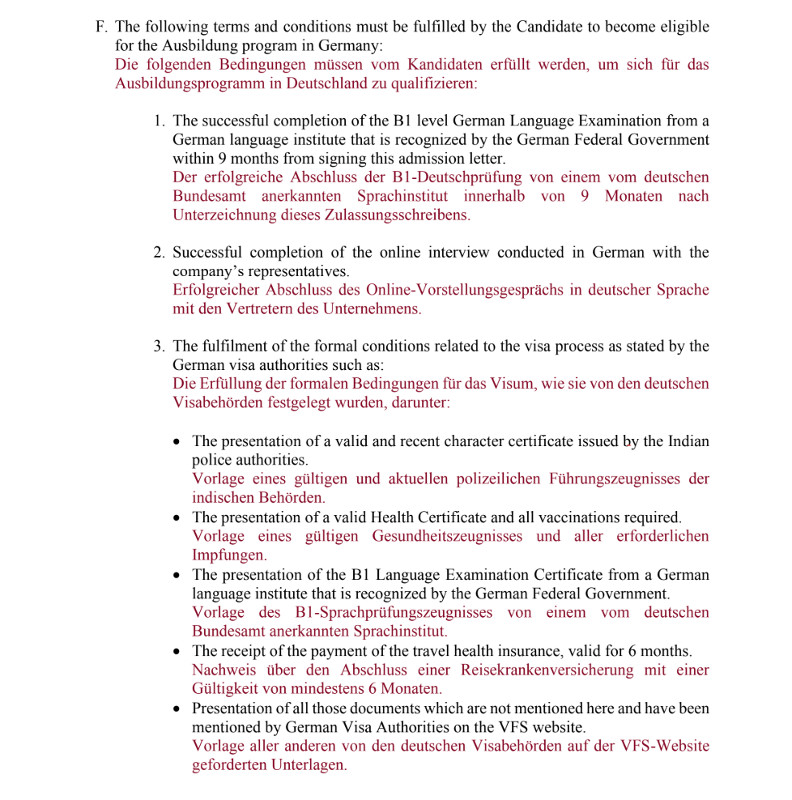
Candidates from all three batches said a second document, the Candidate Agreement Form (CAF), arrived a week or more after training began. By then, they had moved to Hyderabad and paid about Rs 1.28 lakh each. Some signed it more than once over “format issues.”
“They even gave the CAF to us multiple times,” said Lohith (name changed) from Hyderabad.
Srikanth (name changed), 24, from Bhadradri Kothagudem, said Sravani Talasila brushed off questions about the form as “procedural” and said “it did not play a serious role.” The money already spent and trust in a government-backed agency made them sign, the candidates told Siasat.com.
The CAF added conditions absent from the Admission Letter – 100 per cent attendance, at least 80 per cent in internal A1 and A2 assessments and removal without refund for missing three classes or failing assessments twice.
The form also recast Fairstreet’s role as “organising and facilitating interviews with up to three potential employers if required.” It disowned communications outside the agreement and any commitments beyond it. It allowed candidates’ details to be shared with lenders and their first names, photographs and videos to be used for publicity. Disputes would go to courts in Lucknow, over 1,000 km away.
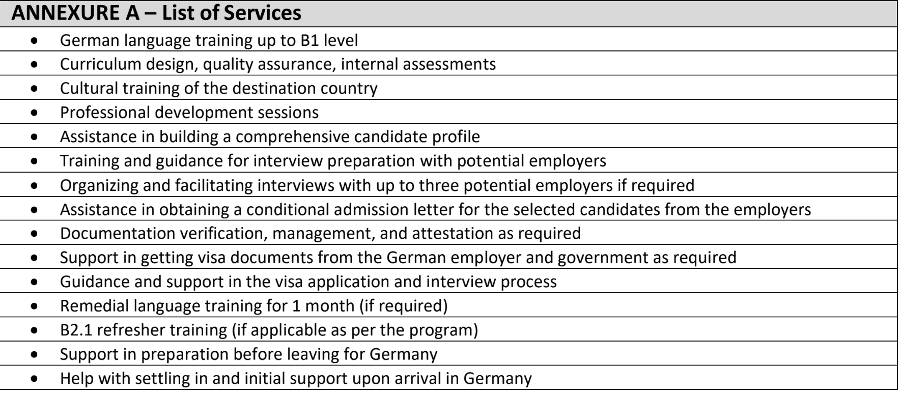

Siasat.com asked TOMCOM and Fairstreet why the CAF was introduced after training began and whether other TOMCOM programmes followed the same practice. There was no response till the time of filing this report.
Candidates ‘flying to Germany’ claim
On August 2, 2025, Fairstreet’s Instagram account congratulated nine candidates, by name and with photographs, on clearing Goethe B1 at the first attempt, saying they were “all set to fly to Germany.”
Four of them, all of whom Siasat.com interviewed, said that as far as they knew, none of the nine had travelled to Germany through the programme. TOMCOM has not confirmed whether any did later, even as the post is still up.
The wait after B1
Of 21 candidates who commented on the training, 12 called it “bad.” One said it was “not worth it” or “improper”, one “not good”, three had mixed views and two found it incomplete. Two rated it good.
Sarayu (name changed) from Mahabubnagar felt the teaching left candidates poorly prepared. Others questioned the trainers. “We have doubts whether the trainers actually had B1 level certification or prior experience in teaching German,” Srikanth said.
Rajesh (name changed) from Nizamabad thought the cost of training, hostel and placement support was high against market rates. Many fell back on YouTube to fill the gaps.
According to candidates, fewer than 10 cleared B1 within the nine-month deadline, which for Batch 1 ran out at the end of July 2025. Others passed later, but how many is unclear.
Some said TOMCOM and Fairstreet helped book their first exam slot, though accounts were inconsistent. Later slots were scarce and some travelled to centres in Kolkata, Chennai and Bengaluru at their own cost.
Neither the Admission Letter nor the CAF, which excluded exam fees and described Fairstreet’s role as “training and preparing candidates for the exam,” commits the providers to securing slots. The documents therefore set a deadline for candidates to clear B1 without explicitly committing TOMCOM or Fairstreet to securing examination slots.
Candidates said the difficulty of finding available slots added to the pressure of meeting that deadline. It remains unclear whether TOMCOM or Fairstreet considered the difficulties candidates faced in booking Goethe B1 examination slots when setting the nine-month deadline.
Passing the test did not end the uncertainty.
Questions about interviews went unanswered. Some who earned the discount heard nothing about next steps. Yeshwanth from Hyderabad said HR Sravani Talasila had promised interviews by October 2025. None came. Several recalled “orientation rounds” but were never told what followed or whether their profiles reached employers.
Ramesh (name changed) from Bhadradri Kothagudem finished his B1 modules by September 2025, only to be told by TOMCOM officials to complete B2 within two to three months to get opportunities.
“How is it possible to complete B2 in two months? It takes at least six months,” he told Siasat.com. Calling it “time wasted,” he wants TOMCOM to “provide us interview opportunities or give us a refund.”
Those who paid the final instalment got part of it back only after months of visits to TOMCOM’s office at ITI Mallepally, they said. Hareesh from Warangal, one of the first to clear B1, said he served TOMCOM a legal notice over his refund and that officials kept setting deadlines and missing them.
What ‘zero success’ means
According to candidates, five or six of the 70 to 75 had offer letters from German employers by early 2026, for roles outside their streams and sometimes their qualifications. They doubt the jobs pay what was advertised.
An offer letter is a long way from a visa, a flight and a job. If the candidates’ numbers are right, that is about 7 to 8 per cent of the group: an indicative offer-letter rate, not a verified placement rate.
Some have since gone to private consultancies and some have reached Germany by other routes. Nearly all spoke of lost time and many want compensation as well as a refund.
The candidates also demanded an investigation into the programme, seeking accountability for what they say were unfulfilled promises of employment in Germany.
Mahesh (name changed) from Peddapalli district found his own way to a job in Germany. He is speaking out anyway. “The reason we are speaking up now is that we want everyone to know what happened,” he told Siasat.com.
On September 16, Siasat.com wrote to TOMCOM Managing Director A Nirmala Kanthi Wesley, General Manager Naga Bharathi and Fairstreet about the Ausbildung and Bus Driver programmes, asking for batch-wise figures on offers, vi∂ƒsas, travel, joining and retention, and how a “successful” placement is defined.
Saurav Pandey, Fairstreet’s business head, said the company had “diligently fulfilled its obligations” under its memorandum of understanding (MoU) with TOMCOM. Citing confidentiality, he said it could not comment on documents or candidates without TOMCOM’s prior written consent and referred Siasat.com to the government agency.
Sravani Talasila, no longer in the role, also referred questions to TOMCOM’s General Manager. Naga Bharathi said responses were under review in the Managing Director’s office and would be sent soon. Despite repeated assurances, none had come by the time this report was published.
Two Right to Information (RTI) applications filed by Siasat.com, seeking batch-wise records on selection, training, exam results, offers, placements, visas, travel, fees, refunds and government oversight, have gone unanswered past their 30-day deadlines and first appeals are pending. The first was transferred from the Labour Department to the Directorate of Employment and Training on August 6; the second went straight to the Directorate on August 21.
(This a two-part series on how TOMCOM allegedly misled the candidates. Part two looks at TOMCOM’s Bus Driver programme, launched in January 2025)
SOURCE : SIASAT