
Source : the age
The $12 billion Snowy 2.0 scheme will cop further cost and timeline blowouts, auditors say, but the project is beset with management failures and the government-owned corporation delivering the project cannot yet say how much more it will cost and how much longer it will take.
The findings of likely billion-dollar blowouts to the largest renewable energy development in the country are a significant challenge for the federal government, which is under pressure from One Nation and the Opposition over the cost of its ambitious emissions reduction goals.
The Australian National Audit Office issued a long list of failings by the government-owned corporation and recommended Snowy publish regular updates on its progress on the pumped hydro project.
Snowy Hydro only “partly agreed” with this finding despite Energy Minister Chris Bowen previously declaring the government was committed to transparent reporting of project progress.
However, Snowy Hydro told the auditor that there was an “extreme” risks to the project’s cost as well as further complications on its geotechnical tunnelling work and construction productivity.
Snowy 2.0’s cost has already blown out from an initial $2 billion estimate to more than $12 billion.
The auditors found that Snowy’s management “does not have a robust understanding of the cost to complete the project”, had failed to developed adequate governance to control blowouts, was overly reliant on inadequate cost forecasting systems of its contractors and significantly underestimated costs of a wage deal with the workforce.
Despite the complexity of the project and cost risks associated with huge underground excavations, the auditor said Snowy did not conduct quality control audits on work of its construction contractor, Italian company Webuild, between mid-2023 to November 2024.
This masthead published last month videos of water gushing through a tunnel and cavern that revealed the obstacles the multibillion-dollar project was encountering beneath the Kosciuszko National Park, and away from the public’s eye.
A source familiar with the project said the high-pressure torrent of water should not have been a surprise given contractors pressed ahead with drilling in an area they were advised was likely to tap into significant volumes of groundwater.
Energy Minister Chris Bowen said the project was important and “must be done right”.
“It’s good that Snowy Hydro has agreed to implement the ANAO’s sensible recommendations – the Snowy Board has a a responsibility to uphold the highest standards,” Bowen said.
“Once completed, Snowy 2.0 will have a lifetime of 150 years and be one of the world’s largest batteries, storing excess renewable power via pumped hydro for use when it’s needed.”
Snowy Hydro is conducting an internal audit that is expected to quantify cost blowouts.
Cost blowouts are being driven by the cost of materials including steel and concrete. The cost of major infrastructure projects have spiked since the pandemic, which coincided with a global energy crunch spurred by Russia’s invasion of Ukraine.
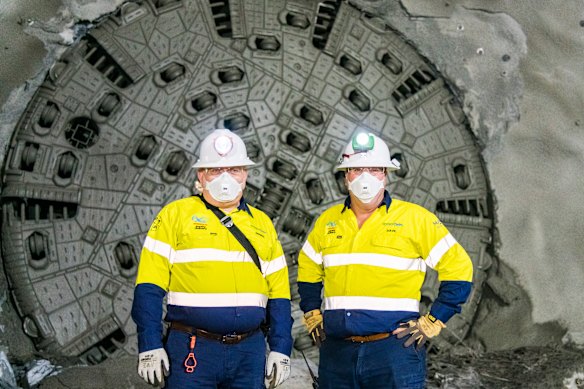
The physical challenges of building Snowy 2.0, which is located under a national park in a sensitive alpine environment, is typified by the fate of a tunnel-boring machine. It spent most of 2023 stuck in soft ground less than 100 metres into its 15-kilometre task. It was freed and on May 16 became wedged in hard rock while excavating a curve in the tunnel. A team of contractors with high-pressure water jets took seven weeks to blast it free.
Adding further costs to Snowy 2.0, tunnel workers contracted to the project in September secured wage rises of 26.5 per cent over four years, raising their annual salary to more than $300,000.
Snowy 2.0 can supply power on demand when the grid needs it most, supplying back-up for renewables when wind isn’t blowing and the sun isn’t shining.
The project will support intermittent wind and solar power by harnessing surplus electricity to pump water from a reservoir at the bottom of a hill to the top, from where it will be released to flow down and spin turbines.
Snowy 2.0 is a massive upgrade to the existing Snowy scheme – taking total storage capacity to 375,000 megawatt hours, or enough to power 3 million homes for a week.
Former prime minister Malcolm Turnbull commissioned Snowy 2.0 in 2017, declaring a completion deadline of 2021. But his price tag of $2 billion was announced before a feasibility study was complete. Once the report was in, the cost was placed at $6 billion.
The official price tag was changed to $12 billion in 2023, and the deadline extended to 2028.
 Mike Foley is the climate and energy correspondent for The Age and The Sydney Morning Herald.Connect via email.