

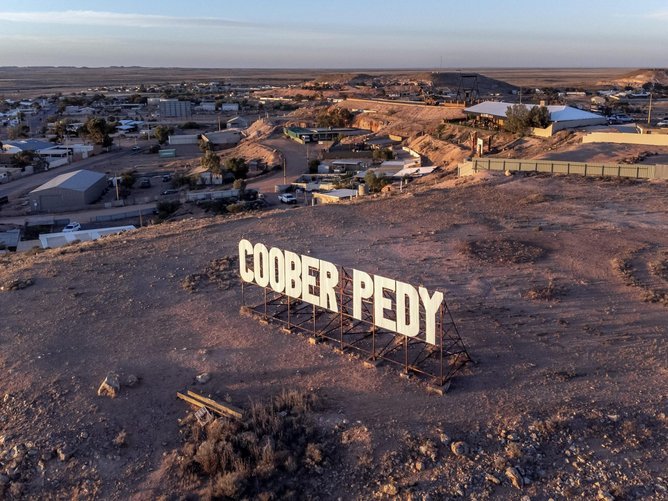
Source : Perth Now news
It has the enviable reputation as the opal capital of the world and its unique characteristics have made it a must-see for outback tourism.
But the South Australian mining town of Coober Pedy, much of which is underground, has a serious problem – nobody seems to want to work there.
Sitting roughly a nine-hour drive north of state capital Adelaide, Coober Pedy’s dug-out dwellings have sparked fascination among tourists, as has its opal mining stature.
However, in recent years, job recruitment and retention across many other sectors has been a real struggle.
As a result, Coober Pedy has now been left with a dwindling population, crippling care shortages and a police station that is so understaffed it has sparked a bitter court battle.
Over the past two decades, the town’s population has almost halved, with Tom Venning, its Liberal MP, saying the community has become overlooked.
“Coober Pedy is a community that too often has been forgotten. In only 20 years of census data, the population has fallen from 2874 residents to 1566,” Mr Venning said.
“Recruiting and retaining local workers has become increasingly difficult. Much of the workforce now commutes into Coober Pedy and this challenge is particularly acute in frontline services, such as paramedics, police, allied health and other essential roles.
“The town faces a range of long-term challenges, including the need to re-establish stable local government after being under administration since early 2019.
“For many residents, this has meant local voices have not been adequately represented or heard.”

Mr Venning, who represents the Grey electoral division, said this struggle had left access to essential service as a “major issue” – along with affordable and reliable water and energy.
“The consequences are significant. Coober Pedy effectively has no aged care facility for non-Indigenous residents,” he said.
“Local businesses are also under pressure – insurance costs have risen sharply and increasing anti-social behaviour has contributed to higher operating costs and reduced confidence.

“More recently, fuel shortages have disrupted tourism at what should be peak season, placing further strain on the local economy.
“When speaking with longstanding opal miners and cutters, one message comes through consistently: their biggest concern is the long-term sustainability of the community itself.
“They are worried there are not enough training pathways and opportunities for younger generations to enter and sustain the opal industry.
“Residents do not want Coober Pedy to suffer the same fate as Mintabie, which was recently forcibly closed.
“Without action to support services, workforce attraction and local industry development, Coober Pedy risks continuing its population decline.”
Police station saga
The are few more visible examples of the recruitment struggles facing Coober Pedy than the long-running saga surrounding its police station.
Such is the desperation at the station that it has led to a bitter legal dispute between the Police Association of South Australia and the state’s police force.
As a result of longstanding understaffing, the union representing SA police officers took the force to a tribunal hearing in an effort to find new solutions for the problem.
A ruling handed down last month made a host of recommendations for ways to remedy the troubles.
These included suggesting a swath of incentives to encourage officers to relocate – including the force footing the bill for housing, utilities and additional job perks.
However, Police Commissioner Grant Stevens rejected these recommendation due to the hefty financial implications.


“Adopting the recommendations made by the tribunal – which we are not bound to implement – will have widespread ramifications for SAPol,” Mr Stevens told The Advertiser.
“The tribunal’s recommendations have significant underfunded financial implications for us and importantly significant equity implications for officers working at other country locations.”
But Police Association of South Australia president Wade Burns said the situation at the station had become “dire”.
“After more than a year of serious, dangerous understaffing, SAPol has failed to pursue or implement any realistic solution to these urgent problems,” Mr Burns said.
“Community constables have been required to perform duties well beyond the scope of their role and function.
“It is clear to any rational observer that SAPol is not adequately addressing fatigue, workload and psychological risks in line with its own hazard management policies.
“Members on the ground in Coober Pedy have shown remarkable professionalism and a continued commitment to improving working conditions for their colleagues and the local community despite a system that is working against them.”
Need for incentives
It is not just the police station that historically has faced challenges in recruiting – other sectors have found the need to offer unique incentives in an effort to fill vacancies.
Coober Pedy Hospital is a small medical facility in the town with just 11 acute beds as well as six residential aged care beds and a tiny, three-bed emergency department.
While its issues with recruiting are a far cry from those experienced by the police station, it too has been required to offer incentives to make it a more attracting prospect.
“The Coober Pedy Hospital workforce remains stable and the hospital is operating at a normal capacity,” Eyre and Far North Local Health Network chief executive Julie Marron said.
“Coober Pedy Hospital offers fly-in-fly-out employment opportunities, with nurses able to work in rotation of weeks on site and weeks off duty, negotiated to suit.
“We are not immune from the challenges regional medical operators face in recruiting and retaining qualified medical professionals and we work hard to make employment at our regional sites as attractive as possible.
“There are a number of significant financial incentives available to work at Coober Pedy, which include attraction and retention payments and a dedicated regional allowance.”
Remote struggles
Significant parts of the struggles facing Coober Pedy are simply down to geography.
The town is about 850km away from the state capital of Adelaide and several hours away from other major settlements, such as Port Augusta.
Bush Recruitment director Dugald Storie, whose business focuses on finding recruitment opportunities for rural businesses in the Aussie bush, said the remote location caused difficulties for places like Coober Pedy.
“It is definitely harder to find people who want to go and work in a remote area due to the lack of social activities and opportunities,” Mr Storie said.


“Most people are just simply not prepared to go and live and work in such remote areas – it takes a certain type.”
Mr Storie, who set up his business more than a decade ago, said it was vital that remote areas were funded to be able to provide services to entice more people to work in them.
“There simply has to be services in place, doctors and clinicians available and there seems to be a real shortage of that in remote locations,” he said.
“The government just does not seem to be spending enough on remote, bush areas.”