

Source : the age
The federal government has begun assembling a long-awaited strategic fleet of Australian-flagged and crewed vessels, starting with a 175 metre-long cargo ship that can be used to deliver essential supplies in times of crisis.
The maritime sector has been frustrated by a lack of action on Labor’s 2022 election pledge to create a strategic fleet of 12 merchant vessels, but the closure of the Strait of Hormuz due to the war in Iran this year has created a new sense of urgency.
The number of large Australian-flagged ships has dwindled to just nine – down from a peak of more than 100 large ships 50 years ago, according to peak body Maritime Industry Australia Limited.
A 2023 report prepared for the government found the precipitous decline in Australian commercial vessels meant the nation would have “great difficulty accessing and controlling the maritime assets that we might require” in times of emergency.
“This puts us in a dangerous position and needs to be reversed,” the report found.
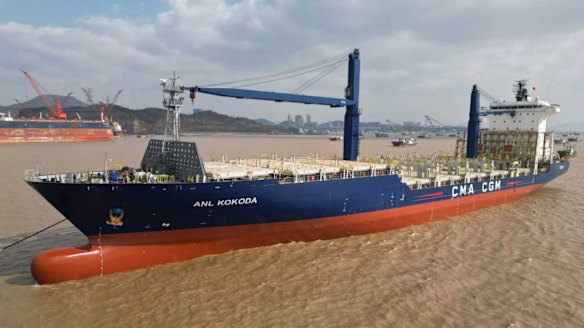
Transport Minister Catherine King will announce on Friday that the government has signed a contract for container ship ANL Kokoda, which is 175 metres long and 27 metres wide, to be the first of three vessels in a pilot program for the strategic fleet.
Built in 2011, the ship has a maximum capacity of 23,000 metric tonnes and has a crew size of 36. It had previously been sailing under the Maltese flag.
The government still hopes to create a fleet of 12 privately owned and commercially operated ships that can be requisitioned in times of crisis, including natural disasters and supply chain disruptions.
King said the move marked an “incredible chapter in Australia’s maritime history” and would make the nation more resilient.
“Recent global events have emphasised the importance of Australia having a resilient domestic maritime sector,” she said.
“The ANL Kokoda will provide critical maritime capabilities, including by adding a new tool to be able to respond to disruption events.”
An estimated 99 per cent of Australia’s trade occurs via sea, and virtually all of this travels in foreign-flagged and owned vessels.
Australian-flagged and crewed ships are estimated to cost operators around $7 million a year more than foreign vessels, explaining the decline in the local industry.
Angela Gillham, chief executive of Maritime Industry Australia Limited, said the announcement “could not have come soon enough”.
“Our geography dictates that a strong sovereign maritime industry should be fundamental to the fabric of our economy,” she said.
“The strategic fleet is an appropriately strong response to the troubling decline in Australian maritime capability, which calls for urgent and aggressive policy action to turn the trajectory of the industry around.”
The idea is controversial. The Productivity Commission argued against a strategic fleet in 2023 on the grounds that there were cheaper alternatives to address skill shortages and supply chain disruptions.
Jim Wilson, policy manager at Shipping Australia, has argued that a strategic merchant fleet is bad policy and “the whole thing is going to fail because of its economics”.
Unions have been strong supporters of the idea as a way to improve pay and conditions for Australian workers.
International Transport Workers Federation President Paddy Crumlin, a former head of the militant Maritime Union of Australia, said the decision “puts shipping back, front and centre, in the national supply chain and the national psyche”.
“Shipping is the lifeblood of Australia’s social and economic wealth, but for too long we have been dependent on foreign multinational-owned and controlled ships that pay vulnerable workers slave wages to deliver it,” he said.
“Not only is this exploitative … it undermines our national security and supply chain sovereignty.”
Maritime executive Peter Court wrote in a piece for the Australian Strategic Policy Institute last year that “Australia lacks an Australian-controlled, internationally trading merchant shipping fleet”.
“This means we have no national capability to move essential fuel, food, medical supplies or military stores. In a crisis – be it conflict, global logistics breakdown, fuel disruption or natural disaster – we rely entirely on foreign-flagged vessels to move crucial imports and exports,” he wrote.
Cut through the noise of federal politics with news, views and expert analysis. Subscribers can sign up to our weekly Inside Politics newsletter.
 Matthew Knott is the foreign affairs and national security correspondent for The Sydney Morning Herald and The Age.Connect via X, Facebook or email.