


Source : INDIA TODAY NEWS
On August 1, the Union government sent Rs 1,09,019 crore to the states, an advance instalment released ahead of the regular monthly transfer due on August 10. Tamil Nadu’s portion came to Rs 4,466 crore.
Spread across the state’s people, that is Rs 619 per person. The average across India was Rs 926. Bihar got Rs 1,042 a head, Odisha Rs 1,148. Of the 28 states, only Haryana did worse than Tamil Nadu.
advertisement
That works out at 67 paisa for every rupee the average Indian gets, and it is not a one-month quirk. The Commission’s formula fixes each state’s share, so the same gap shows up in every transfer. Those per-head figures use the 2011 Census, the last one India has held, which is the same population count the Finance Commission itself uses to work out the shares.
The shortfall is the argument behind the resolution the Tamil Nadu Assembly passed on August 7, 2026, moved by Finance Minister N Marie Wilson. It asks the Centre for a transparent and fair way of dividing tax money, and asks that states not be penalised for succeeding at population control.
The Sixteenth Finance Commission has already answered one of those requests, in writing. The answer is no.
FIFTY-FIVE YEARS OF LOSING GROUND
The split is not decided by any minister. Every five years, the Centre appoints a Finance Commission to settle two questions: how much of its tax revenue it must hand to the states, and how that pot is divided between them. The Commission writes a formula, and the money follows it.
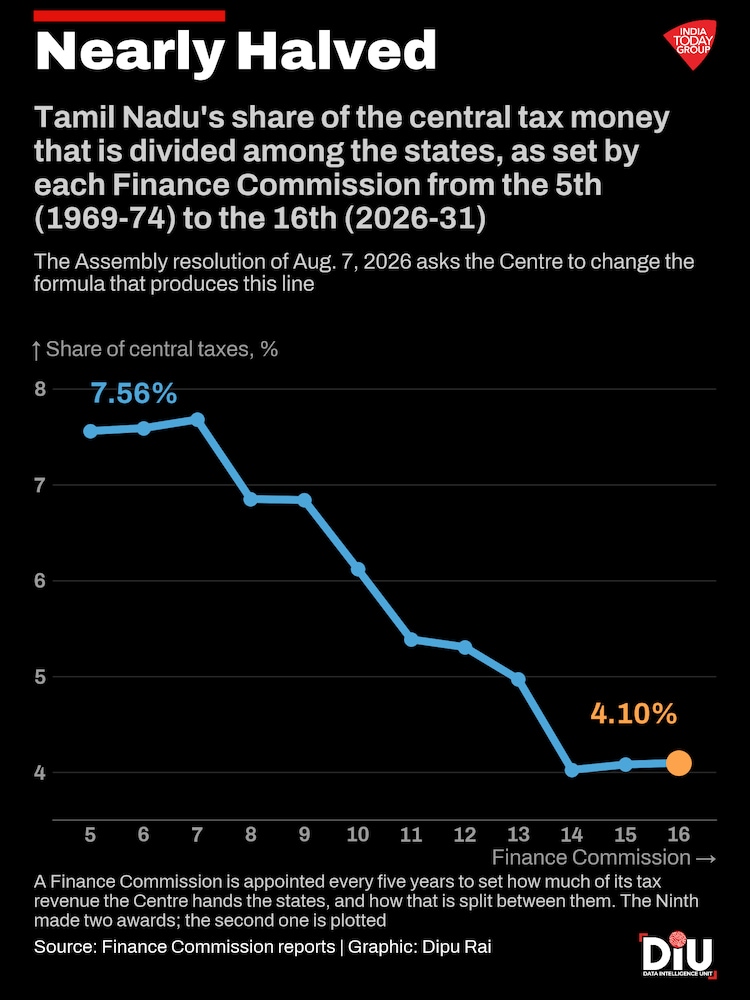
Tamil Nadu has been losing ground in that formula for half a century. Its share was 7.56 per cent when the Fifth Finance Commission reported in 1969. Under the Sixteenth, whose award began this year, it is 4.097 per cent. Nearly half the share has gone across 12 commissions and governments of every party.
THE RULE THAT WAS MEANT TO HELP
The Sixteenth Commission was expected to fix exactly this. It added a criterion called contribution to GDP, worth 10 per cent of the formula. It was meant to reward states that produce more. Tamil Nadu produces a great deal.
Its shares rose by 0.018 percentage points.
Kerala’s rose 25 times as much. Karnataka’s nearly 27 times. Of the 28 states, 14 gained and 14 lost, and Tamil Nadu’s was the smallest gain of any state that gained at all.
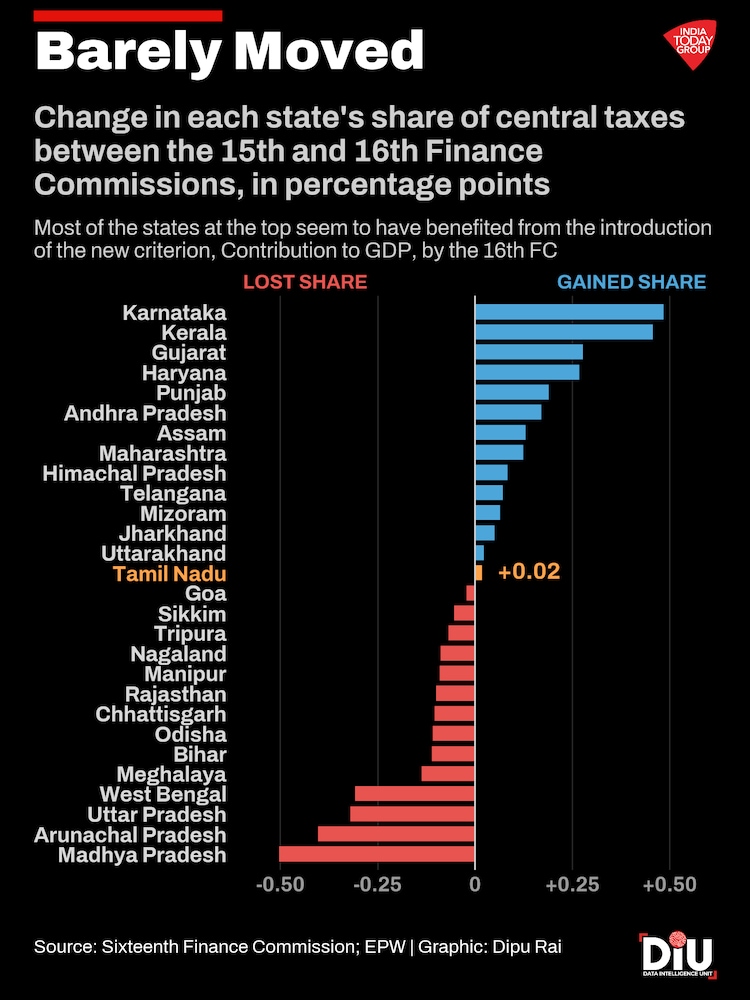
What the state won on output it gave back elsewhere. The Commission cut the weight attached to population control from 12.5 per cent to 10, and the weight for land area from 15 per cent to 10. Between them, the two cuts swallowed almost the whole gain.
The census itself is part of the squeeze. The Commission says it has now “fully transitioned” from the 1971 Census to the 2011 one. Its predecessor had argued that this very shift caused “too large a loss” for states that had successfully slowed their population growth, and added a fertility-based criterion to soften it. That is the softener now being cut.
WHAT THE COMMISSION ADMITS IN ITS OWN REPORT
The population criterion is where this story turns, and the Commission is not defensive about it.
It says a reward for slower population growth “must be phased out in due course”, and that cutting the weight rather than removing it is “a gradual transition”. Its reasoning, set out in its own report, is that the advantages of slower population growth “had been replaced by the fears of an ageing population”, and that India “faces the risk of ageing before it becomes rich”.
Tamil Nadu is asking to keep something the Commission has said it intends to withdraw.
THE SQUEEZE NOBODY IS ARGUING ABOUT
The resolution leaves out a second problem. States are promised 41 per cent of what the Centre calls its divisible pool, and the Sixteenth Commission kept it there. But cesses and surcharges sit outside that pool. Measured against what the Centre actually collected, devolution averaged only 32.1 per cent over the last Commission’s term, according to the Commission’s own figures.
One thing the August 1 transfer was not is relief. Every state’s amount matched its formula share almost to the decimal point. Advancing an instalment changes when the money lands. It cannot change how much. The Assembly asks the Centre not to penalise Tamil Nadu for having fewer children. The Commission that reported this year has already set out when it intends to stop counting them.
Data note: Shares are the inter se shares recommended by each Finance Commission, from the Sixteenth Finance Commission’s Report for 2026–31 and from a Tamil Nadu study the Commission itself ordered. Per-head figures divide each state’s share of the Rs 1,09,019 crore released on August 1, 2026, by its 2011 Census population, the same Census the devolution formula uses. The 67 paisa figure is Tamil Nadu’s share of devolution (4.097 per cent) divided by its share of the 28 states’ population (6.126 per cent).
– Ends
SOURCE :- TIMES OF INDIA


