Source :- THE AGE NEWS
The individual positions on a rugby league field, like George Orwell’s animals, have never been equal – either in reward or recognition.
In his political satire Animal Farm, published in 1945, Orwell wrote that “All animals are equal, but some are more equal than others”, referring to pigs as the privileged class. Back then, “pig” was also a popular term for a rugby league forward. The front-rower, in particular, was the dominant position on the muddy fields that dominated in those days.
Props, as they were also called, butted heads in scrums and raked shins in the play-the-ball. Some even chewed ears – and we are not talking corn. However, they grunted their way forward with ball skills under a zero-yard rule with no tackle limits and no replacements allowed.
Whereas Orwell’s pigs, in the author’s fable about Communist Russia, changed the rules to give themselves more power, the administrators of rugby league changed the rules of the game to take away power from the front-rowers. The most obvious was to render scrums non-competitive, while other tweaks to the laws over the last 70 years have seen certain positions become more important than others.
Today, it is the spine players – the halves, hooker and fullback – who are perceived as the most valuable. Yet, when the spines of two opposing teams are approximately equal in talent, another position has emerged as critical to success. So, who are these difference makers in the coming semi-finals, if the spines of opposing teams cancel each other out?
Clue: it was obvious in this year’s deciding State of Origin game. Spoiler alert: If your guess is wingers, you are wrong. Sure, they score more tries than any other position, but they concede even more under today’s rules, which blatantly favour attack over defence.
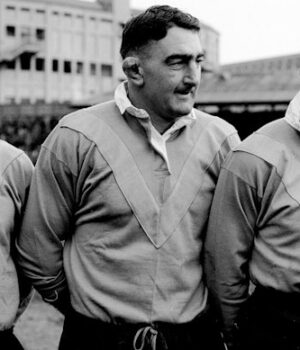
But first, follow me on the journey from the days when front-rowers like Bumper Farrell and Ray Stehr played. If a bush club needed a captain-coach, their preferred choice was an out of contract front-row forward from a Sydney club. Jack Gibson spent half a season at NSW town Grenfell.
Centre was probably the next most desirable position, but not as the result of any rule change. The zero-yard rule was amended to move the defensive line three yards back from the play-the-ball in 1956, extended to five in 1966, with a four-tackle rule introduced the following year – book-ending the career of St George champion Reg Gasnier.
Some say the rules were changed to stop the Dragons’ run of 11 successive premierships from 1956 to 1966, but the reality is that some players are so dominant in their era that they cause the position to become the most influential. The “Magic Dragon”, or “Prince of Centres”, made the position so potent that every club wanted a Gasnier.
Similarly, lock became the celebrated position when Gasnier’s teammate John Raper dominated, followed by fellow Immortal Ron Coote.
The four-tackle set was extended to six in 1971, by which time a later teammate of both Gasnier and Raper, halfback Billy Smith, became the prototype for playmakers of the late 1970s epitomised by Parramatta’s Peter Sterling.
It was impossible to wrap another No.7, Wests Tom Raudonikis, in cotton wool, but coaches would wince when opposing teams targeted the architect of their play. I recall St George monstering the Jack Gibson-coached, premiership-bound Eels late in the 1983 season, and Jack sending an early message to the trainer: “Get little Peter off.”
David Waite, at both the Knights with the Johns brothers and the Dragons with Trent Barrett and Anthony Mundine, is widely acknowledged as the coach who halved the role of the half, so to speak. He shifted the No.7 to one side of the ruck, with the five eighth on the other, principally to promote a quicker game under the 10-metre rule, which was introduced in 1993. It inspired the emergence of the fullback as the dominant player in what is now a two-hemisphere game. He became a supplementary playmaker as well as a defensive co-ordinator, standing at the back, choosing which side to make a link, or plug a hole.
With hookers like Melbourne’s Cameron Smith dictating the tempo of games, the No.9 joined the 6,7 and 1 in what came to be known as the spine, a collective group of interacting playmakers. Some will say fullback is still the most influential position, given the metres he makes.
But I contend that edge back-rower is the “unicorn position”, as players describe it. The Blues’ pair of Liam Martin and Hudson Young were the difference in NSW’s victory in the Origin decider. The expansion of the six-again rule has enhanced their role as they often carry the ball out of their half off repeat sets. If a team has dud back-rowers, its attack goes sideways. Defensively, they have a massive job; defending against fleet-footed halves and giant ruckies. They are the new link between the middle and the wide edges. They require big motors and an ability to read the play.
Their utility value is enhanced by their occasional selection in the centres to cover injuries. Canberra’s Simi Sasagi and South Sydney’s Tallis Duncan have been regular fill-ins out wide, while the Warriors’ Leka Halasima shifted there against the Titans. All were close to being the best player on the field. Key players in the position have been Manly’s Haumole Olakau’atu and the Cowboys’ Jeremiah Nanai, and the Bulldogs’ form resurgence has coincided with the return of Viliame Kikau and Jacob Preston. Edge forwards now join the spine as big money earners, demonstrated by the hype around the re-signing of Young and Duncan.
The loss of Eli Katoa for the entire season is the single biggest reason for the Storm’s demise this year. Injuries to other Melbourne edge back-rowers for extended periods, such as Ativalu Lisati, Shawn Blore and Joe Chan, have exacerbated the problem. Cooper Clarke, a youngster whose career has been confined to the middle, has been forced to play left edge. Significantly, the injury toll has been greatest on a position exposed to the most fatigue while playing the most minutes of a game.
The edge forward running out wide like Bob McCarthy suggests rugby league has gone almost full circle. Should the NRL ever realise that the prevailing injury carnage is a result of their contrived speeding-up of the game, we may return to the day when momentum is created naturally. If so, the resulting domination of giant ball-playing front-rowers – big-minute mobile men like Payne Haas – would finally mean that the “pigs” really are more equal than the others.
News, results and expert analysis from the weekend of sport sent every Monday. Sign up for our Sport newsletter.
 Roy Masters is a Sports Columnist for The Sydney Morning Herald.Connect via email.