Source : INDIA TODAY NEWS
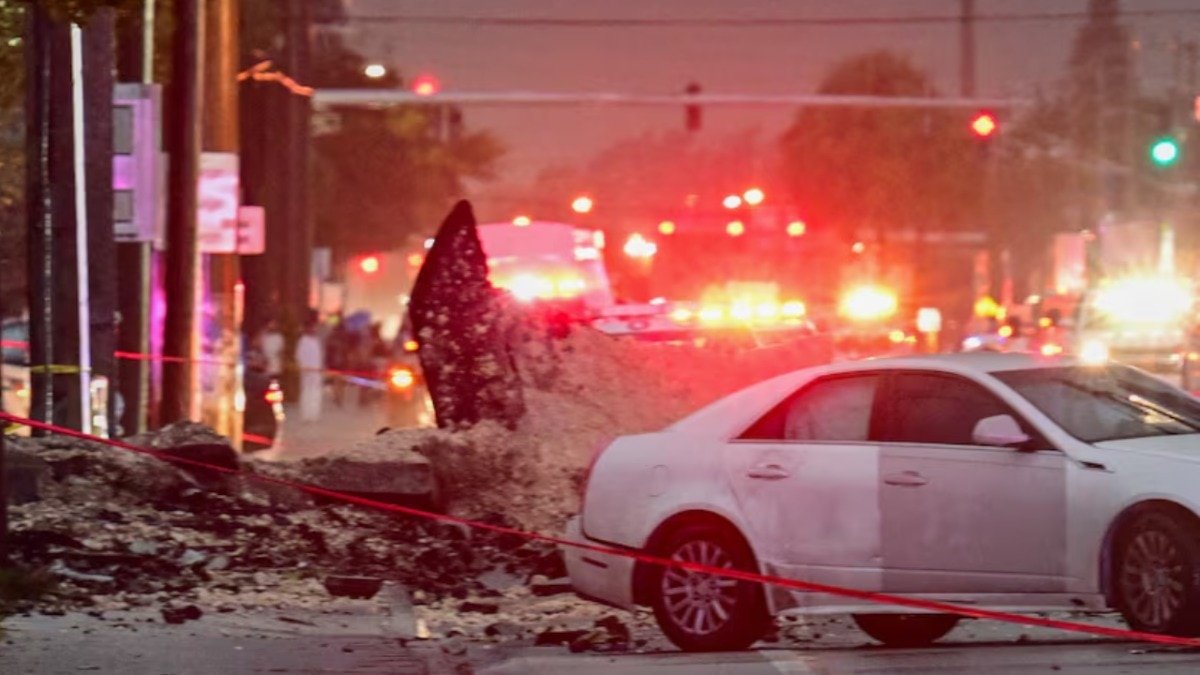
A decision to fly through a dangerous storm instead of taking a safer route may have put a doomed Learjet on course for disaster before it crashed in Florida, killing all nine people on board, according to aviation experts cited by the New York Post. The USD 2 million Learjet 60 was travelling from Texas to the Bahamas on Sunday when it encountered severe weather. The aircraft stalled at an altitude of around 35,000 to 37,000 feet before plunging towards the ground and exploding in a fireball near a trailer park in Palm Beach County.
advertisement
Investigators are still working to establish what caused the crash. However, veteran pilot Justin Crabbe, chief executive of charter-flight booking platform Jettly, told the NYP that the pilots may have made a critical error by continuing through the storm despite having the option to fly around it.
“They certainly should have gone around (the storm),” Crabbe told the NYP. He added that air traffic controllers had given the crew the flexibility to change their route to avoid the dangerous weather.
“(Air-traffic control) gave them the flexibility to deviate around that weather,” he said.
Crabbe suggested that the pilots may have been eager to reach their destination and continued with the journey despite the deteriorating conditions. He described this tendency as “get-there-itis”, a recognised aviation risk in which pilots become so focused on reaching their destination that they may overlook safety concerns.
WHAT IS ‘GET-THERE-ITIS’ AND HOW CAN IT AFFECT PILOTS?
According to Crabbe, the pressure to complete a journey is something pilots are taught to recognise early in their training. The desire to reach a destination, particularly when passengers are waiting or a schedule needs to be maintained, can influence decisions even when weather conditions make flying unsafe.
“It’s a theory called ‘get-there-itis,’ and flight schools teach you this very early on,” Crabbe said.
“It’s a risk factor. You have to sit back as a pilot and understand what is pushing you to do this trip, this maneuver, this journey in a way that may compromise the safety of the flight.”
The aircraft was carrying two pilots and seven passengers, including technology entrepreneur Adam Robinson, his wife Helen, their two young children, Emma, 4, and Charlie, 2, two adult friends, Rachael Reed and Charmi Fehr, and the family’s nanny, Anita Maria Apellido Cetina.
ICING WARNING AND A RISKY ATTEMPT TO CLIMB
The aircraft’s encounter with the storm appears to have presented the crew with another serious challenge: ice accumulating on the plane.
The co-pilot, 20-year-old Nathalia Filgueiras, reportedly informed air traffic control about sub-zero temperatures outside the aircraft and ice forming on its exterior. She subsequently requested and received clearance to climb from 35,000 feet to 37,000 feet, apparently in an attempt to reach clearer air above the weather system.
Icing can seriously affect an aircraft’s ability to remain airborne. When ice accumulates on the wings, it changes the smooth airflow needed to generate lift. This increases drag and can make it harder for the aircraft to maintain its flight.
Although the Learjet 60 was equipped with a de-icing system, such equipment cannot always prevent ice from accumulating under severe weather conditions.
Crabbe told the NYP that the decision to climb may have made the situation worse by increasing the possibility of an aerodynamic stall. A stall occurs when a wing can no longer generate enough lift because the angle at which it meets the oncoming airflow becomes too steep. This is known as the angle of attack.
When ice is present on the wings, their ability to generate lift is reduced. As a result, the aircraft can stall at a lower angle of attack than it normally would under clean-wing conditions. Crabbe said the pilots may have found themselves caught between two dangerous choices: climb towards clearer air and risk triggering a stall, or remain lower in the storm and face further ice accumulation.
He also cautioned against judging the crew’s decisions without understanding the pressure they were facing inside the cockpit.
The attempt to climb may not have been enough to get the aircraft clear of the weather. Data from the National Oceanic and Atmospheric Administration (NOAA), cited in the report, indicated that the convective storm system extended to nearly 50,000 feet. That meant the Learjet’s planned climb to 37,000 feet may still have left it inside the storm.
Aviation lawyer Zachary S. Gorwitz of Podhurst Orseck, a law firm that investigates and litigates air crash cases, described the conditions as an unusually dangerous combination of weather hazards.
“This was kind of the perfect storm of trouble,” he said. He also pointed to the danger of attempting to climb above the storm when the aircraft was already dealing with ice accumulation. Raising the nose to gain altitude increases the angle of attack, potentially aggravating or triggering a stall in one or both wings.
WHY THE PILOTS MAY HAVE BEEN UNABLE TO RECOVER
Once the Learjet began plunging towards the ground, the crew may have had very little time or room to recover control of the aircraft. Gorwitz said the aircraft appeared to have started breaking apart before hitting the ground, suggesting that the situation had become extremely difficult to control.
The expert also cautioned against blaming the crash on the co-pilot’s age or experience. Although 20-year-old Filgueiras was the crew member communicating with air traffic control, Gorwitz suggested that the senior pilot was likely handling the aircraft.
While the observations from aviation experts offer possible explanations for the sequence of events, they do not establish the cause of the crash. Investigators will need to examine the aircraft, its flight data, cockpit recordings, weather conditions and communications with air traffic control before determining what led to the tragedy.
– Ends
SOURCE :- TIMES OF INDIA