Source : INDIA TODAY NEWS
Prime Minister Narendra Modi on Saturday hit out at critics of India’s latest GDP figures, saying those responsible for pushing the country into the “Fragile Five” were now unable to accept its emergence as the world’s fastest-growing major economy.
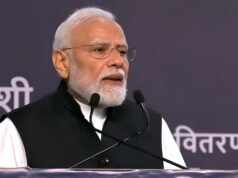
Speaking at the centenary celebrations of Shri Ram College of Commerce (SRCC) in Delhi, PM Modi cited India’s 7.8 per cent growth in the April-June quarter as evidence of the economy’s resilience amid the war in West Asia and disruptions to global trade.
advertisement
“The 7.8 per cent quarterly growth has boosted the country’s confidence. Those who became infamous for pushing India into the ‘Fragile Five’ are finding these figures difficult to digest,” he said.
His remarks came amid debate over the latest GDP numbers, with the Opposition questioning the figures and economists expressing differing views on the revised data and methodology under the new GDP series.
PM MODI TARGETS ‘HALF-EMPTY GLASS’ CRITICS
Returning to SRCC 13 years after his widely discussed 2013 address, PM Modi revived his “half-filled glass” analogy to target those he accused of remaining pessimistic about India.
During the earlier address, PM Modi had said some people viewed a glass as half full and others as half empty, while he considered it completely full, with one half containing water and the other air.
He said those who saw the glass as half empty in 2013 continued to view the country through the same lens.
“For them, the glass will always be half empty. I am talking about the glass, not about anything else remaining empty,” PM Modi said.
Presenting Saturday’s address as his “report card” since 2013, he said, “The echo of lies cannot stand before the roar of truth.”
‘FROM FRAGILE FIVE TO FASTEST-GROWING ECONOMY’
Recalling the economic climate of 2013, PM Modi cited a weak rupee, inflation of nearly 10 per cent, a record current account deficit, slowing industrial growth, corruption allegations and what he described as “policy paralysis”.
India was then counted among the “Fragile Five”, a term used for emerging economies considered particularly vulnerable to global financial shocks because of their dependence on foreign investment and other economic weaknesses.
“The world was calling India one of the ‘Fragile Five’. Today, the world is watching India become the fastest-growing major economy,” PM Modi said.
He said the latest growth figures reflected India’s economic strength despite geopolitical tensions and global trade disruptions. “India is not only growing, it is also creating new employment opportunities,” he added.
PM MODI SLAMS ‘MAI-BAAP’ CULTURE
PM Modi also cited the Pradhan Mantri Jan Dhan Yojana as an example of his government’s efforts to expand financial inclusion.
He said nearly 60 crore bank accounts had been opened over the past 12 years, bringing poor and previously excluded sections into the formal banking system.
PM Modi accused his critics of opposing financial inclusion because they wanted ordinary citizens to remain dependent on a “mai-baap” culture for basic services and opportunities.
“This is Modi. He stands like a rock in front of those who favour the ‘mai-baap’ culture,” he said.
The Prime Minister linked the expansion of banking access to his idea of “P2G2”, or pro-people, good governance, which he had outlined during his 2013 SRCC address.
He said his government had moved away from responding to problems only after they emerged and instead focused on advance planning and the direct delivery of services.
PM MODI HIGHLIGHTS MAKE IN INDIA GAINS
PM Modi also revisited the manufacturing pitch he made at SRCC in 2013, saying his call to manufacture goods in India had been dismissed as unrealistic at the time.
“When I said that we needed to work towards ‘Made in India’, people from the ecosystem of that time simply could not understand it,” he said.
“They believed that ‘Made in India’ was impossible during that period of despair. Those brought up with that mindset still make fun of it, but today you can see the brand value of Make in India.”
PM Modi said India imported most of its mobile phones in 2014 but now exported handsets worth more than Rs 2.5 lakh crore. He cited the shift as evidence that government policies had strengthened domestic manufacturing.
The Prime Minister said India was moving towards becoming a global manufacturing hub, a centre for research and innovation and a major exporter of agricultural products.
PM TARGETS ‘DIMAGI NAXALS’, ‘NARAZ FUFAS’
Broadening his attack, PM Modi accused his opponents of habitually questioning the country’s progress and opposing major government initiatives.
He claimed his critics had repeatedly expected crises, including the Covid pandemic, global conflicts and supply-chain disruptions, to weaken India and his government. However, he said, the country had continued to move forward despite those challenges.
Referring to comments from his Independence Day address, PM Modi described some ideological critics as “Dimagi Naxals” and alleged that their reaction to the term had exposed them before the public.
He also compared habitual opponents of government projects to a “Naraz Fufa”, or a perpetually disgruntled relative who objects to every decision.
PM Modi cited UPI, high-speed rail, the Statue of Unity, the new Parliament building and memorials for fallen military personnel as initiatives whose necessity had repeatedly been questioned.
“No one can stop India from doing what is necessary for the country,” he said, adding that India’s economic and social progress since 2013 had increased the “restlessness” of some people.
– Ends
SOURCE :- TIMES OF INDIA