

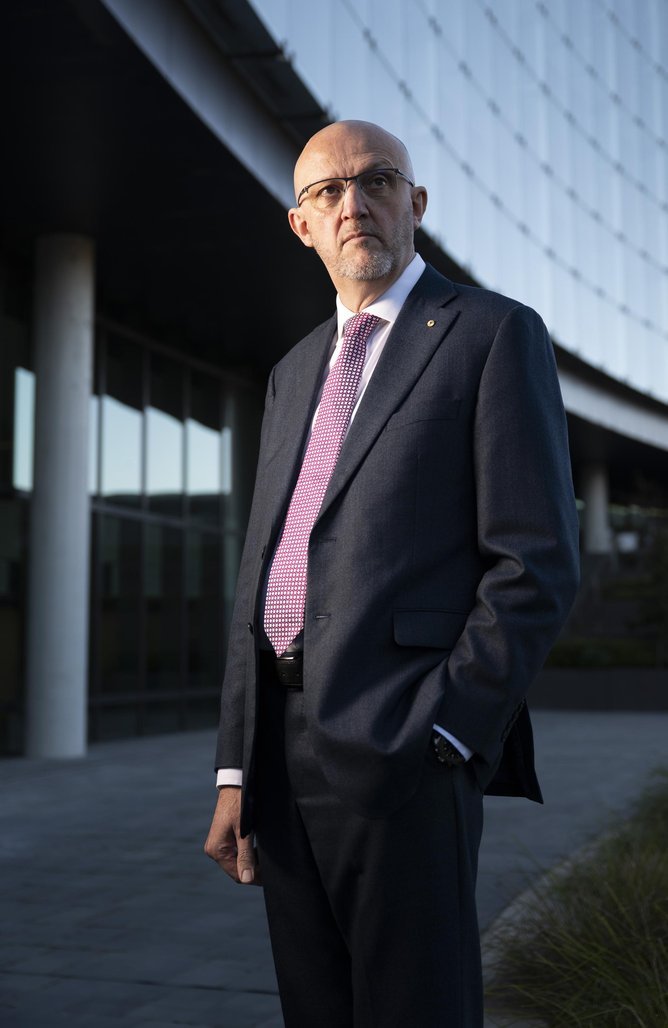
Source : Perth Now news
Australia’s security threat level will remain at “probable” despite the country’s spy chief warning he is “gravely concerned” by its temperature and trajectory.
ASIO Director-General Mike Burgess said Australia’s security environment had been “degraded” in his annual threat assessment on Wednesday – the first since Australia was rocked by the Bondi Beach terror attack and a failed alleged bomb attack on an Invasion Day rally in Perth.
While constrained by the ongoing Royal Commission into Antisemitism and Social Cohesion, Mr Burgess sought to “put this attack into context”.
“The context of a deteriorating global and domestic security environment, where a small group of extremists moving to violence with little to no warning is shocking, but sadly not surprising,” Mr Burgess said.
Neither should it be surprising when “an Australian is killed at the hands of a Foreign Government on Australian soil”, he added.
Australia’s long-time spy chief sought to paint a “frank” picture of Australia’s security threats in the wake of Australia’s worst-ever terrorist attack.
“Great power competition” and conflict in the Middle East had driven “extreme levels” of foreign interference and espionage, and strained social cohesion which in-turn increased the likelihood of violence, Mr Burgess warned.
“At the same time, global terrorism threats are re-emerging,” he said.
“Traditional groups such as Islamic State and al-Qaeda and their affiliates are growing their capability to conduct and inspire attacks, enabled by permissive geographic and online spaces.
“These groups continue to see Western interests as legitimate targets.”
As the dust settled on Iran’s war with the United States and Israel, the Islamic Republic still viewed Australia “as a legitimate target for covertly directed acts of violence”, he said.
“We assess there is a realistic possibility the group that’s been active in Europe will expand its networks to this part of the world, and could conduct or inspire acts of arson, vandalism, or even assassinations on Australian soil,” he said.
In total, Mr Burgess said ASIO was aware of at least five regimes targeting Australians through espionage – many victims being critics of foreign regimes.
“ASIO recently caught two officers trying to coerce their target at a Victorian fast-food restaurant,” he said.
Nonetheless, Mr Burgess said the security threat level would remain at probable.
“Tonight, I want to explain the terrorism threat in some detail – because I am gravely concerned by its temperature and trajectory,” he said, noting politically-motivated violence was also an “acute concern”.
“Australia’s terrorism threat level remains at PROBABLE, but I do not believe the system was designed for a situation like the one we now face. PROBABLE does not
tell the full story,” he said.
Mr Burgess said EXPECTED – the next threat level – applied when ASIO had intelligence about a specific attack.
“We do not. But we do know the environment is degrading and acts of politically motivated violence are becoming more likely than PROBABLE suggests,” he said.
“Just as climate change increases the likelihood of extreme weather but does not forecast specific storms, politically motivated violence, including acts of terrorism, is more likely even though we cannot predict a specific attack,” he said.

“In the current climate, it is too simplistic to assume there is a single terrorism threat or a most likely terrorist threat.”
Acknowledging the focus on Sunni Islamic extremism in the wake of the Bondi attack, Mr Burgess said, since then, the agency had dealt with extremists “across the ideological spectrum”.
“Including one who allegedly combined ideological and extreme Christian beliefs, and an individual allegedly inspired by an extreme left-wing ideology,” he said.
Mr Burgess said individuals were increasingly being radicalised alone and online, rather than in groups or “in prayer halls”.
“And, instead of spending time and resources planning sophisticated attacks, radicalised individuals are moving to low-capability attacks with little or no warning,” he said.
“These dynamics make the contemporary terrorism environment different – and in some ways, more difficult – than we saw with al-Qaeda and ISIL.”
Mr Burgess said even a “vast army of ASIO case officers and surveillance officers” might not be enough to stop an individual radicalised online.
Mr Burgess also noted antisemitism was “sadly, and ironically” a common theme between Islamic and neo-Nazi extremists, as well as some “issue-motivated” extremists.
“Nation-states can be antisemitic,” he said, noting arson attacks in Sydney and Melbourne ASIO allege were co-ordinated by Iran.
“Anarchists and revolutionary groups can be antisemitic. This gets surprisingly little media coverage, but Australian companies with perceived links to Israel are being subjected to repeated acts of vandalism and arson by far-left activists,” he said.
Mr Burgess sought to draw a line between criticism of the government in Israel, but warned “some of the threatening statements made by the perpetrators go well beyond political protest or commentary”.
Critical infrastructure hacked, AUKUS targeted
In his 16-page assessment, Mr Burgess also revealed ASIO had discovered that nation-state hackers has “compromised the network of an Australian critical infrastructure provider”.
“ASIO assessed the hackers were preparing for sabotage,” he said.
“They weren’t planting ‘digital dynamite’ as such; they were mapping out the network and maintaining access so they could cripple it at a time of their choosing.”
Mr Burgess said the group had not only achieved access to the provider, but had “successfully acquired credentials – log in details and passwords – for active users of the networks, including the IT professionals guarding it”.
“ASIO identified, tracked and attributed the hack, and worked with the victim company and our security partners to remediate the compromise – work which is ongoing,” he said.
Mr Burgess said ASIO’s understand of, and level of concern about, cyber sabotage was only growing.
“The scale of this activity – led by one nation state in particular – is difficult to overstate,” Mr Burgess said.
“We struggle to find a single country in our region that has not been compromised by this state’s cyber apparatuses.
“Critical infrastructure in the energy and communications sectors, as well as infrastructure supporting the military, are top targets.”
Mr Burgess warned even nations considered friendly had identified AUKUS as a priority target.

“A spy from a foreign intelligence service approached an Australian security clearance holder online, pretending to be from a consulting company,” he said.
“The spy paid the official to write two reports on Australia’s relationship with our Pacific neighbours, and then, thinking he’d been hooked, offered money for inside information on AUKUS.
“The foreign intelligence service wanted insights on the progress of Pillar 1, the technologies of Pillar 2, the amount of money being invested, Australia’s geo-strategic ambitions, relations between the three AUKUS governments and the likely trajectory of Australian public opinion.”
Mr Burgess said the clearance holder became suspicious and reported the contact.
“When my officers interviewed the clearance holder, they gained valuable insights into the foreign service’s information gaps and tradecraft,” he said.
“The person even handed over the money he’d received from the spies for writing the earlier reports.
“In effect, ASIO disrupted the foreign intelligence service’s operation and made them pay for the privilege.”
Mr Burgess said officers went so far as to use the official’s phone to ring the consultant and demanded she ceased targeting Australian citizens.
“At that point the spy hung up. Message received,” he said.
“To close off this matter, and in case she did not report our interaction, my officers raised this matter directly with the Foreign Intelligence Service (FIS).”


