Source : INDIA TODAY NEWS
For years, South Korea stood tall among the giants of Asian hockey. The continental game was once dominated by India and Pakistan, but the Koreans broke that duopoly in 1986, winning the Asian Games gold on home soil in Seoul.
They have since added three more Asian Games gold medals to their tally. Their crowning moment came at the Sydney Olympics in 2000, where they stunned the hockey world by winning silver. Fourth-place finishes at the 2002 and 2006 World Cups further underlined their stature. By 2003, South Korea had climbed to fourth in the FIH rankings, establishing themselves as Asia’s leading force.
advertisement
ASIAN CHAMPIONS TROPHY: FULL COVERAGE
But the landscape has changed dramatically.
South Korea are now a team in transition, having slipped to 20th in the world rankings. They missed out on this year’s World Cup and finished fourth at the Asian Games in Nagoya, a far cry from the heights they once scaled.
Their campaign at the Asian Champions Trophy in Jalandhar has not got off to the best start either. Despite a spirited display, Japan edged past them 3-2 on the opening day, leaving the Koreans with plenty to ponder.
With questions swirling around their future, we made our way to the South Korean team’s training session on Wednesday, October 28. How does a former Asian powerhouse hit the reset button? And what will it take to restore a team that once stood among the best in the world?
We believed the answers lay with head coach Jungbin Lim and captain Yong Bok Kim.
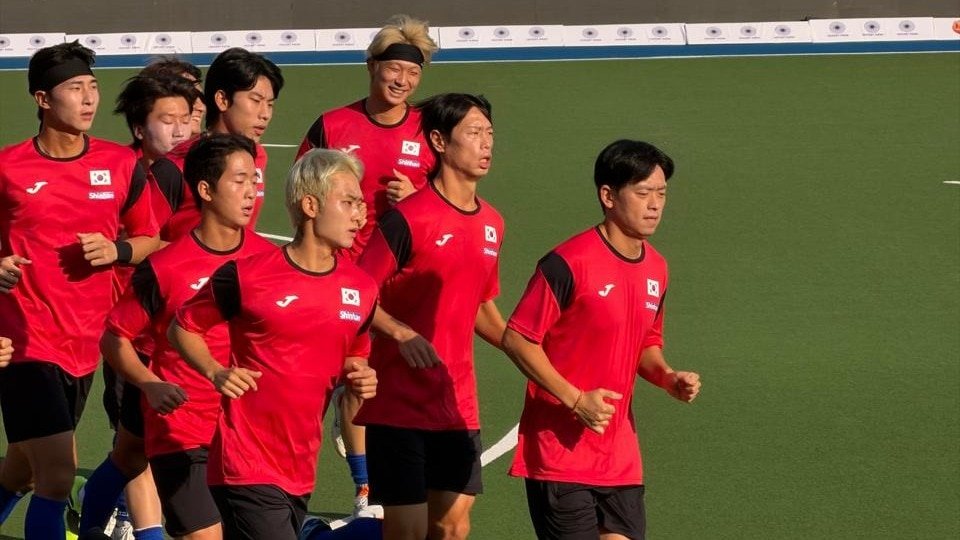
Both men were at the heart of an intense training session that offered a glimpse into the team’s spirit. There was urgency in the drills, but also a palpable sense of camaraderie. Their warm-up run was punctuated by loud war cries that echoed around the Surjit Singh Hockey Stadium, with Lim watching closely from the sidelines.
The session soon shifted to tactical work. The focus was on breaking down a high press and moving forward, with Lim constantly communicating with his players in Korean. His voice bounced off the stadium walls, catching the attention of the handful of local reporters who had turned up to watch.
We waited for our opportunity to speak to the coach and his players. But before the interviews began, we witnessed one of the most unusual interactions of our time in Punjab.
A local reporter asked questions in Punjabi while Lim responded in Korean. Neither seemed particularly troubled by the language barrier. Google Translate was the unlikely mediator, converting the questions and answers back and forth as the conversation flowed.
The same process followed captain Kim was speaking.
When our turn finally came, we knew we would have to adapt. But the conversations that followed offered more than just a glimpse into South Korea’s rebuilding plans. They revealed a team trying to rediscover its identity.
HEART AND PASSION
Lim is relatively new to the job, and South Korea are also dealing with significant changes to the squad that featured at the 2025 Asia Cup. Dain Son, their leading goalscorer in Rajgir, was missing from the squad, while Hyeongjin Kim and Yoonho Kong have retired.
Rebuilding a team while trying to preserve its competitive edge is rarely straightforward. Lim, however, appears to have a clear idea of where he wants to begin.
For him, the starting point is not tactics or results. It is unity.
“My philosophy is to lead the players on the field with a united heart and shared vision and passion. That is the best I can do,” said Lim.
His blueprint for a revival also rests on finding the right balance between youth and experience. That blend was visible during the training session, with goalkeeper Jaehyeon Kim helping his coach manage the drills and keep things moving.
Lim believes South Korea must go through a period of trial and error before they can reclaim their place among the continent’s elite.
“South Korea is currently going through trial and error to form a combination of the current players and the veterans; from here on, the country will regain its former glory,” said Lim.
Captain Kim sees himself as a key part of that process. His responsibility is to bring the group together, help the younger players settle in and ensure that the team moves forward as one.
His immediate priority is to get the best out of the next generation and turn individual ability into collective results.
“I will maximize the abilities of the young players and unite the team to achieve results,” said Kim.
For the captain, however, rebuilding cannot be rushed. The focus must remain on preparation, experience and the hunger to improve rather than on the pressure of immediate results, particularly at the Asian Champions Trophy.
“We will be thorough with our preparations, and rather than focusing on the results, we start and finish this tournament with the players’ experience and passion. I believe that with that same passion, we will achieve good results,” said Kim.
It is a patient approach, but one that reflects the reality of South Korea’s situation. The team cannot simply rely on its past reputation. It must build towards a new future, one training session at a time.
HOCKEY FINDING ITS PLACE
South Korea continue to produce world-class athletes across a range of sports. An Se-young has established herself among the very best in badminton, while the country’s football team has earned a reputation for upsetting some of the biggest sides on the global stage.
Then there is archery, where South Korea have long been a dominant force.
Against that backdrop, where does hockey fit in?
By this point, goalkeeper Jaehyeon Kim had joined the conversation and assured us that Google Translate would no longer be needed. He was pleased to hear the names of An Se-young and South Korea’s other sporting stars come up.
“An Se-young is a very good player, and the Korean football team has high potential,” said Kim.
But when the conversation turned to hockey, Kim offered a candid assessment of the sport’s standing back home. Despite the country’s rich history in the game, hockey struggles to command the same attention as its more popular counterparts.
“There is no support. Hockey is not very popular in Korea and we have no support from the government. Football, baseball and basketball are the professional sports in Korea,” said Kim.
It was a sobering admission from a team that once challenged the world’s best. South Korea’s problem is not necessarily a lack of talent, but the challenge of building a system that can nurture it and give the sport a stronger footing at home.
Kim, however, remains optimistic that a revival is possible. He believes the current crop of young players has the individual skills needed to take the team forward, even if the coaching staff and squad are still finding their feet.
“Many players have changed and we have so many young talent in the side. The coaching staff is new, but in Korea, the young players are very good with their individual skills. In 10 years, maybe we can make a comeback amongst the elite in the support. Because the potential is there,” said Kim.
The ambition is clear: South Korea want to return to the biggest stage, compete at the Olympics and reclaim their place at the top of Asian hockey. For that to happen, Kim believes the team will need more than talent and determination. It will also need greater institutional and financial backing.
“I think the first goal is to go to the Olympics and win the Asian Games championship. After that, with support from the government and big sponsors, I think, yeah, we can get there. We are almost there, just a little bit more,” said Kim.
It was a plea for support, but also a statement of belief. South Korea may be some distance from their former glory, yet their captain is convinced the foundations for a comeback are already in place.
## A WAR CRY FOR A NEW DAWN
Just before we left, we had one final question for Lim. Why was he so loud throughout the training session?
A broad smile spread across the coach’s face. Then, true to his nature, he shouted one word at the top of his voice: “fight”.
The outburst drew a few chuckles around the field, but it also brought the session neatly into focus. For all the tactical adjustments and the challenges of rebuilding, South Korea’s approach remains rooted in energy, togetherness and a willingness to fight for one another.
That spirit has long been part of Korean hockey’s identity. They once challenged the established order in Asia and went on to compete for the biggest prizes in the sport. Now, they face a different battle: rebuilding a team, developing their young players and convincing their country that hockey deserves a place among its leading sports.
The glory days may feel distant, but South Korea are not ready to give up on them. Lim and Kim know the road back will require patience, investment and plenty of hard work.
For now, the war cries continue to ring out across the training ground. And if the Koreans have their way, they will one day be heard again on hockey’s biggest stages.
– Ends
SOURCE :- TIMES OF INDIA