source : the age
An Australian teacher who travelled to Russian-controlled eastern Ukraine to interview jailed foreign fighter Oscar Jenkins has urged the federal government to do more to secure his release, saying the 34-year-old appeared to have been abandoned.
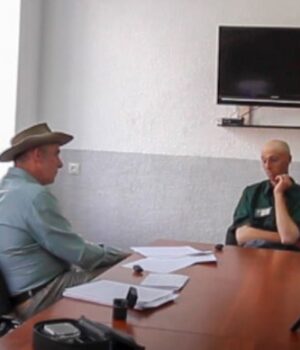
Mark Lowe, an English teacher and amateur journalist who has lived in Vladivostok, a port city in Russia’s far east, for four years spent two days face-to-face with Jenkins earlier this month inside the eastern Ukrainian prison where he is serving a 13-year sentence.
Lowe, who runs a website that reports sympathetically on Russia and Vladimir Putin’s regime, said he had spent about a year seeking to interview Jenkins and used relationships with Russian government officials who had previously been his English-language students to secure access.
He told this masthead on Monday that he wanted to give Australians a different perspective on the war in Ukraine, but also wanted to ensure Jenkins, a former Melbourne Grammar student, was not forgotten. Lowe said the access had come with no conditions or pressure from Russian authorities.
“I want to open debate around him,” he said. “He’s a young Australian who I felt had been abandoned. I wanted to make sure he was OK, and I would like to see him get home, and see him happy.”
“I understand the Australian government’s stance regarding Ukraine – I have no opinion on that. But I think the Australian government owes it to him, they need to open a dialogue and start talking about him with Russia.”
Jenkins was captured by Russian forces in December 2024 after joining Ukrainian troops despite having no previous military background. He was sentenced in May last year to 13 years in a maximum-security penal colony after a court in the self-declared Luhansk People’s Republic convicted him of acting as a mercenary.
Jenkins also extraordinarily told Lowe in the interview he had since offered to fight for Russia.
“I’ve written a statement saying that I’d be happy to fight as a soldier for Russia,” he said. “But if they don’t trust me or for whatever reason, don’t want that, then I can understand.”
Lowe said Jenkins gave no indication that he’d met with Australian government officials since being imprisoned at the gulag about 45 minutes’ drive from Luhansk, in the Russian-controlled Donbas. In the video released to the ABC, he did not ask Jenkins directly.
It is also unclear whether the International Committee of the Red Cross has had any access to the prison.
The federal government rejected the proceedings against Jenkins last year as a “sham trial”, while Foreign Minister Penny Wong has said Jenkins is a prisoner of war and must receive the protections afforded to him under international humanitarian law.
A spokesperson at the Department of Foreign Affairs and Trade said diplomats had consistently sought welfare updates from Russia and urged them to grant the ICRC and Jenkins’ lawyers access to him.
“We have made clear Australian’s expectations that Russia fully complies with its obligations under international law, including with respect to PoWs,” he said. “We continue to request Ukraine prioritise Mr Jenkins release in a future PoW swap with Russia.”
Ukrainian Ambassador to Australia Vasyl Myroshnychenko said he was pleased to see Jenkins was alive.
He said the Ukrainian government had made efforts to ensure he was afforded the rights of a prisoner of war but that Russia had refused to do so, in breach of the Geneva Conventions.
Myroshnychenko said Russia has not put his name forward under a people-swap deal.
The Russian branch of the International Committee for the Protection of Human Rights has previously said that Jenkins might be released as part of a swap involving alleged Russian spies Kira and Igor Korolev, whose case is next heard at Brisbane Magistrates’ Court at the end of September.
In the interview, Jenkins appeared gaunt, with a shaved head and wearing a prison uniform, and maintained he had never killed anyone during his time on the front line.
Lowe said Jenkins had told him he had spent much of his time digging trenches and was “happy to do my 13 years because of what I have done”.
Lowe has been quoted by Russian media on a handful of occasions as an “Australian international relations expert” in relation to the Jenkins case. He said last year many Australians had adopted their government’s view that Russia “is bad”.
“You will never change their minds. They are what they are,” he told Russian newspaper Izvestia last year.
Lowe said he found Jenkins likeable and intelligent.
“He’s quite quirky and clearly very intelligent,” he said. “The translator heard him speaking fluent Russian to his guard and mentioned that he would not have known he wasn’t a local by listening to him.”
“We had a lot of discussion, I think he enjoyed seeing another Australian.”
Jenkins described a highly regimented daily routine in prison, telling Lowe he rose at 5.30am to brush his teeth before the Russian anthem was played at 6am. He said he worked in a garden during the day, with lights out at 10pm. He slept in a 40-man dormitory.
Jenkins told Lowe he had decided to join Ukrainian forces after watching videos while working in China as a biology teacher. He had initially considered fighting in Myanmar against the military junta or joining the Israeli Defence Force, but chose Ukraine because it was easier to enter.
“I’m a young guy. It’s not that my life doesn’t mean anything to me, but sacrifices might need to be made. That’s still the attitude I have,” he said.
Jenkins’ family in Melbourne has not publicly spoken about his plight, on advice from the Department of Foreign Affairs.
The interview, which Lowe is using as the basis for a documentary, is believed to be Jenkins’ first since his conviction.
 Rob Harris is the national correspondent for The Sydney Morning Herald and The Age based in Canberra. He is a former Europe correspondent.Connect via email.