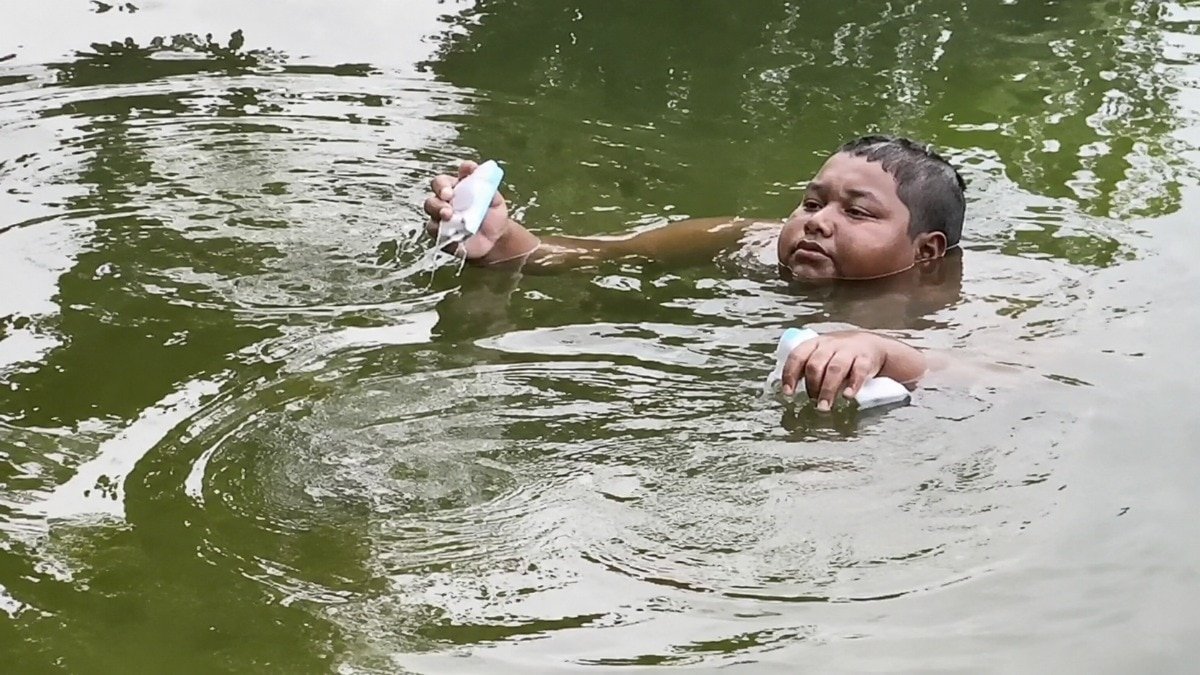
Source : INDIA TODAY NEWS
For most people, getting out of a pond after a swim means reaching for a towel. But for a 16-year-old boy from Murshidabad, West Bengal, stepping out of the water reportedly brings intense burning and discomfort across his body.
The 16-year-old, Iqbal, from Murshidabad has reportedly been spending prolonged periods in a pond because remaining in the water appears to offer relief, while coming out triggers severe discomfort.
advertisement
While the exact cause of his symptoms cannot be confirmed without a medical evaluation, his experience has drawn attention to a rare condition known as aquagenic pruritus.
The unusual disorder can cause intense itching, prickling, stinging or burning after contact with water. What makes it particularly difficult to recognise is that the skin may appear completely normal despite the severity of the symptoms.
Aquagenic pruritus is a rare dermatological condition recognised in medical literature and international clinical databases, but it is not included in India’s official notified rare-disease list.
WHAT IS AQUAGENIC PRURITUS?
Aquagenic pruritus is an uncommon condition in which contact with water triggers intense itching or abnormal sensations such as prickling, stinging or burning.
The symptoms can occur after bathing, swimming, sweating or even coming into contact with rain. Importantly, the reaction does not necessarily come with a visible rash.
Dr Kritika Sharma, a Pune-based dermatologist, said, “The most confusing part about aquagenic pruritus is that the patient can be experiencing very intense discomfort even when the skin looks completely normal,”
Unlike an ordinary skin allergy, the problem is not necessarily caused by something present in the water.
WHY DOES THE SKIN BURN?
Doctors do not yet have a complete explanation for why aquagenic pruritus occurs.
One theory is that water exposure triggers an abnormal response involving the nerves or other processes in the skin, leading to the sensation of itching, prickling or burning.
The symptoms can occur with different types and temperatures of water. This means that simply switching from cold to hot water may not necessarily solve the problem.
Dr Sharma explained, “In aquagenic pruritus, the sensation can be generated after water comes into contact with the skin without the typical signs we associate with an allergic reaction.”
HOW RARE IS AQUAGENIC PRURITUS?
Aquagenic pruritus is considered uncommon. In severe cases, however, the condition can interfere with everyday activities, particularly bathing, swimming and exercise.
The absence of a visible rash can make the condition even more difficult to identify.
A person may have intense itching or burning while the skin looks completely healthy.
CAN IT BE LINKED TO ANOTHER DISEASE?
This is one reason persistent water-triggered itching should not simply be dismissed as dry skin.
Aquagenic pruritus can occur on its own, but it has also been associated with certain blood disorders, including polycythaemia vera and other haematological conditions.
That does not mean that everyone experiencing water-triggered itching has an underlying blood disorder.
Doctors may recommend further investigations depending on the person’s symptoms, medical history and examination.
“Aquagenic pruritus does not automatically mean there is a serious underlying illness,” said Dr Kritika.
HOW IS AQUAGENIC PRURITUS DIAGNOSED?
There is no single blood test or scan that confirms aquagenic pruritus.
Doctors generally begin by taking a detailed history, including when the symptoms begin, how long they last and whether they occur every time the skin comes into contact with water.
A physical examination is also important to rule out other skin conditions.
Depending on the person’s age, symptoms and medical history, doctors may recommend blood tests or other investigations to look for possible underlying conditions.
CAN IT BE TREATED?
There is no single treatment that works for everyone with aquagenic pruritus.
Doctors may try different approaches depending on the severity of the symptoms and whether an underlying condition is found.
Treatment may include measures aimed at reducing the intensity of the sensations, while any associated medical condition may also need to be addressed.
Because the condition is uncommon and can present differently from one person to another, treatment is usually individualised.
WHEN SHOULD YOU SEE A DOCTOR?
Anyone who repeatedly develops intense itching, stinging or burning after coming into contact with water should seek medical advice.
This becomes particularly important if the symptoms:
- Make bathing difficult
- Disturb sleep
- Interfere with school, work or exercise
- Become increasingly severe
- Are accompanied by other unexplained symptoms
“A dermatologist can first determine whether this is aquagenic pruritus or another condition and then decide whether further tests are needed,” says Kritika
The reported case of the Murshidabad teenager highlights how a seemingly ordinary activity such as getting out of water can become extremely uncomfortable for someone with a rare water-triggered condition.
Aquagenic pruritus can cause severe itching, prickling, stinging or burning after water exposure, sometimes without leaving any visible mark on the skin.
However, similar symptoms can have several possible causes. The teenager’s symptoms therefore cannot be labelled as aquagenic pruritus without a proper medical assessment.
And while staying in water may appear to provide temporary relief in an individual case, prolonged immersion is not a treatment and can itself create health risks.
– Ends
SOURCE :- TIMES OF INDIA