SOURCE :- THE AGE NEWS
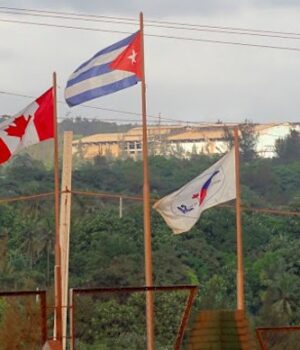
On the outskirts of a city called Moa, at the south-eastern end of Cuba, flies a Canadian flag. Its maple leaf flaps proudly beside the red triangle and white star of Cuba’s own national banner.
The flags mark the Moa Nickel mine, a joint venture between Canadian mining company Sherritt International and Cuban state-owned La Compania General de Niquel. Ore is extracted, shipped to Alberta in Canada and refined into nickel and cobalt.
In May, as part of efforts to crush Cuba’s communist regime, the Trump administration imposed sanctions on Moa Nickel. The mine, already hit by fuel shortages after the US choked off Cuba’s Venezuelan lifeline, has shut down – as has Sherritt’s refinery in Fort Saskatchewan, Canada.
Now, the Trump administration is doing the same thing to a fledgling gold and copper mine part-owned by an Australian company, Antilles Gold. And in both cases, the solution appears to be the same: sell a stake to the Americans, possibly to friends of US President Donald Trump.
“Their choices are to leave, stay and then have an immense amount of problems, or try to find a saviour,” said John Kavulich, president of the US-Cuba Trade and Economic Council, a New York-based business network.
“If I’m an executive of Antilles Gold in Australia, I’m waiting for someone to stick a gun in my stomach. Thus far, that’s the only thing the Trump administration hasn’t done.”
ASX-listed Antilles Gold was slapped with US sanctions in early June when its Cuban joint venture, Minera La Victoria, was blacklisted. The company, which is headquartered at an unassuming home in the NSW town of Bowral, owns 50 per cent of the venture through its Cayman Islands-registered subsidiary, Antilles Gold Inc.
Its main project is the Nueva Sabana open-pit copper and gold mine in central Cuba, 25 kilometres south-east of Ciego De Avila. According to Antilles’ ASX filings, the earthworks, water supply and site preparation began in early December, and a Chinese company, Xinhua Mining, was given the go-ahead on a $US30 million ($42 million) engineering and construction contract on New Year’s Eve.
Antilles Gold says work has halted while it scrambles to deal with the impact of June’s sanctions. It says the company has submitted a proposal to the US State Department that would involve selling at least 51 per cent of shares in the Caymans-based subsidiary to an acceptable US investor.
Who might that be? The company’s chairman, Brian Johnson, won’t say. Neither will Kavulich, who has been working with Antilles Gold. “I can’t go there,” he said.
In the case of Canada’s Sherritt International, its potential saviour is an entity called Gillon Capital – the family office of Heather and Ray Washburne, who happens to be a close ally of Trump.
The companies are in exclusive negotiations for Gillon to take a 55 per cent stake in Sherritt at a discount to its closing value on May 15 (it had already crashed from $US0.25 a share to $US0.09 following the US sanctions).
The State Department and US Treasury cleared the way for the talks to take place, but will need to approve any final deal.
Washburne is a businessman, investor and real estate developer who co-founded a restaurant chain in Texas. A long-time Republican donor, in 2016 he was described by the Texas Tribune as “Trump’s most visible fundraiser is Dallas”.
In his first term, Trump appointed Washburne to run the Overseas Private Investment Corporation, the federal government’s development bank, and he later served on Trump’s intelligence advisory board. He no longer holds either position.
Sherritt’s initial response to the expanded US sanctions was to say it would relinquish its stake in the Cuban venture, which it built over 30 years. But that changed. Bloomberg News reported that Sherritt’s interim chief executive, Peter Hancock, was at home in Canada watching cycling when Washburne called him to make the offer.
“This deal happened because an actor in the United States was able to make a case to the US State Department,” Hancock told Bloomberg. “We were collateral damage in a larger policy objective for the United States.”
Washburne doesn’t see it that way at all. Reached by phone on Thursday (US time), he said he was rescuing Sherritt and its mine from certain ruin, and the Trump administration had nothing to do with arranging the deal.
“The company was in severe financial straits to begin. I’ve known about the company for years, I’ve followed it, I knew that it had some valuable assets to it,” he told this masthead.
“When I saw the sanctions were put in place – I didn’t have any idea they were doing that – I just called the company and said: do you need capital? If I hadn’t come in, it would have already been shut down and gone.”
Gillon Capital was spun out of an existing family office, A. G. Hill Partners, linked to the Hunt family dynasty. Washburne’s wife Heather, née Hill, is a descendant of Texas oil tycoon Haroldson Lafayette Hunt Jr, who secured the rights over much of the enormous East Texas Oil Field.
Gillon does not own any other mining interests at present, although the family – through oil heirs Nelson and William Hunt – once owned part of one of the world’s largest silver mines, in Idaho.
Washburne says he cold-called Sherritt himself when he saw the Canadian miner was in trouble. “I literally just found the guy’s phone number … It had nothing to do at all with the administration. I had no discussion with them at all.”
He said he was not aware of Australian company Antilles Gold and its Cuba venture, and was not in discussions with them. But he was interested, and asked for their contact details. Washburne’s late mother was Australian, born in Sydney between the wars.
Antilles Gold chairman Johnson told this masthead that the company had identified a suitable American investor, and it was not Gillon Capital, although he would not disclose who it was. The firm’s proposal to the State Department remained confidential, he said.
The Australian government confirmed it had engaged with Antilles Gold and US officials on the matter, but would not answer questions about those discussions. The State Department did not respond to inquiries.
John Kirk, a professor emeritus of Latin American studies at Dalhousie University in Nova Scotia, Canada, said it was noteworthy that the State Department appeared to have no objection to Gillon Capital taking over the mine in Cuba.
“Clearly, Trump is supporting his friends in the stealthy takeover of Cuban commerce,” Kirk said. “I suspect that a similar path will be found for Antilles Gold. In both cases, greed, hypocrisy and bullying have been implemented by the Trump administration.”
ASIC records show Antilles Gold was first registered in South Australia in 1984 as Aytox Pty Ltd. It has been through several name changes; as EnviroGold and Panterra Gold, it developed a mine in the Dominican Republic in the 2010s.
The company had been turning its attention to a second Cuban project, a planned gold, silver and antimony mine on the Isla de la Juventud (the Isle of Youth). Infill drilling was supposed to start at the La Demajagua mining concession in the second half of this year, until the sanctions hit.
For foreign firms, the main effect of US sanctions is on banking. Any company using US dollars is likely to be cut off by a financial institution. Even if there’s doubt, banks are generally risk-averse and won’t want to take the chance, Kavulich says.
The US continues to impose new sanctions on Cuba and its interests. On Thursday, it designated a number of entities and people related to the procurement and sustainment of Cuban weapons.
“They went after the Cuban companies and ministries that everyone knows about first,” Kavulich says. “Now, they’re going granular, and they’re going deeper and deeper and deeper.”
Asked whether he thought the Trump administration’s approach to foreign companies operating in Cuba was effectively a shakedown, he said: “One person’s shakedown is another person’s benevolent opportunity to do what’s right.”
Last month, the State Department released a 100-page report on the dangers Cuban communism posed to America and the Western world. Havana was “a staging ground where the ambitions of Moscow, Beijing, and Tehran converge with the radical movements operating inside our own borders”, it concluded, referring to the far-left.
The report frames Cuba as a major security threat, thereby laying the groundwork for potential military intervention, which has been the subject of much speculation over the past six months. Meanwhile, it keeps tightening the noose on the country’s collapsed economy.
“They certainly can’t wait us out,” Secretary of State Marco Rubio told US news site Axios. “Every time they create a new mechanism in which they try to get out of the noose, we just close it off.”
Emily Morris, an economist and researcher specialising in Cuba at University College London, said the administration’s endgame was not clear, but “if any deal were done, it could well be a deal that allows US businesses in [to Cuba] but not others”.
Paolo Spadoni, an associate professor at Augusta University and a recognised Cuba expert, said the primary motivation of Trump’s intervention was political, rather than a play for resources.
“I think what he wants is to achieve what other presidents for many decades have not been able to achieve,” he said. “And there are economic benefits down the road.”
Get a note directly from our foreign correspondents on what’s making headlines around the world. Sign up for our weekly What in the World newsletter.
 Michael Koziol is the North America correspondent for The Age and Sydney Morning Herald. He is a former Sydney editor, Sun-Herald deputy editor and a federal political reporter in Canberra.Connect via X or email.