Source : INDIA TODAY NEWS
There was a time when mentioning CNG in India almost immediately brought taxis and commercial vehicles to mind. CNG was the fuel of choice for a large section of taxi operators, particularly in cities where it offered a straightforward way to reduce running costs. For private car buyers, however, choosing CNG often meant making compromises, not just in terms of performance, but also practicality and convenience.
advertisement
That has changed significantly.
CNG has steadily moved from being a fuel associated primarily with commercial vehicles to becoming a mainstream powertrain option for private car buyers. Today, almost every major mass-market carmaker in India offers CNG in some form. Maruti Suzuki has built one of the country’s widest CNG portfolios, while Tata Motors and Hyundai also offer factory-fitted CNG models. Several other manufacturers have explored dealer-level CNG options.
More importantly, the technology surrounding CNG has evolved. Modern CNG cars are no longer simply petrol cars with a gas cylinder added to them. Automakers have worked on engine calibration, packaging, transmission choices and even the placement of the CNG tanks to make these cars more practical and appealing to everyday buyers.
From taxis to private cars
CNG’s popularity in India was initially driven by its economics. For taxi operators and high-mileage users, fuel expenditure is one of the biggest operating costs, making CNG’s lower price compared with petrol particularly attractive.
The fuel also offered an emissions advantage. CNG generally produces lower carbon dioxide emissions than petrol and produces very little particulate matter. It also results in lower sulphur oxide emissions and can produce lower nitrogen oxide emissions under appropriate operating conditions. Compared with diesel, the reduction in particulate emissions is particularly significant.
These advantages helped CNG gain a foothold in urban transport, but the fuel’s biggest selling point remained simple: it cost less to run a vehicle on CNG.
As CNG infrastructure expanded and more fuel stations began offering the fuel, the equation started to change for private car buyers as well. Manufacturers began offering factory-fitted CNG variants, giving customers a more integrated alternative to aftermarket conversion kits.
This was an important shift. Instead of buying a petrol car and subsequently converting it, buyers could purchase a CNG variant engineered and calibrated by the manufacturer, with the gas system integrated into the vehicle from the factory.
The rise of factory-fitted CNG
Maruti Suzuki played a major role in taking CNG beyond the commercial-vehicle space. Its S-CNG range eventually spread across multiple segments, from small hatchbacks to sedans and SUVs.
Other manufacturers followed. Tata Motors introduced CNG versions of models such as the Tiago, Tigor, Punch and Nexon, while Hyundai brought CNG technology to models including the Grand i10 Nios and Exter.
This gradually changed the perception of CNG. It was no longer just a fuel for people clocking hundreds of kilometres every week. For private buyers, it became an attractive option for anyone looking to keep running costs under control without moving to an electric vehicle.
The basic proposition was compelling: buy a car that drives like a normal petrol vehicle, but switch to CNG for substantially lower fuel costs.
Depending on the vehicle and prevailing fuel prices, CNG can bring the cost per kilometre down by roughly 30-50 percent compared with petrol. For someone covering large annual distances, those savings can quickly add up.
But there was one big problem: boot space
The biggest compromise with CNG cars was never really the fuel itself. It was the hardware needed to store it.
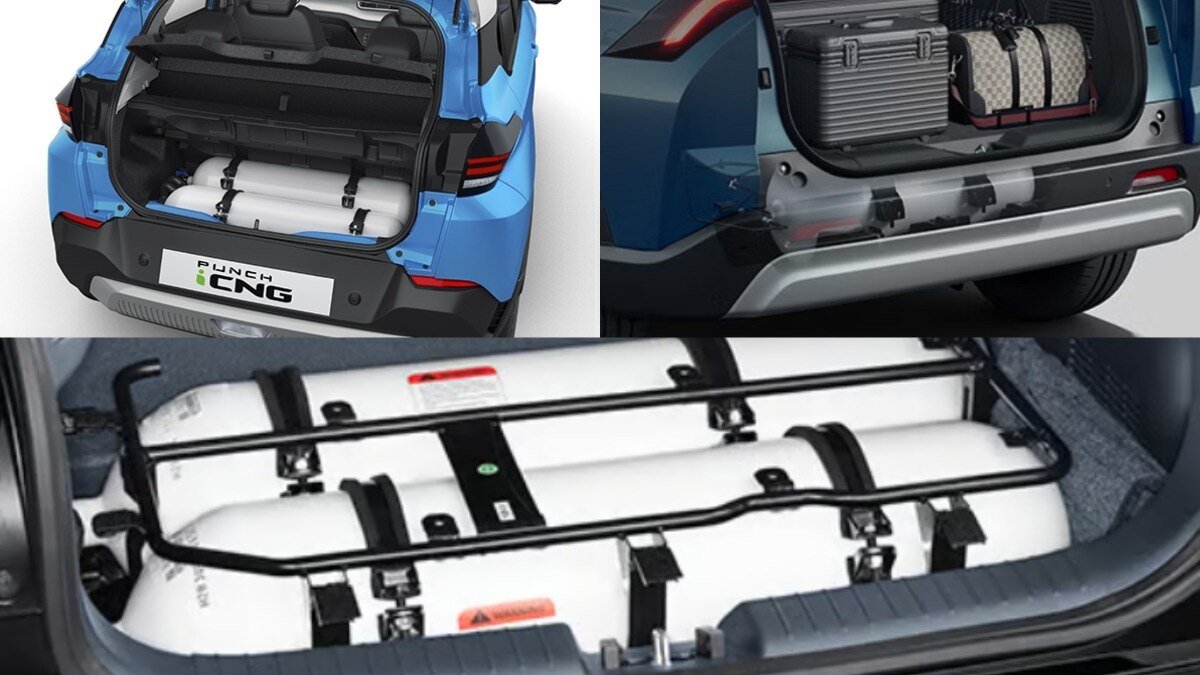
Traditional CNG cars used a large cylindrical tank mounted in the boot. While the arrangement worked, it consumed a substantial portion of the luggage compartment.
For a family car, this could be a serious inconvenience. A CNG car might deliver excellent fuel economy and low running costs, but carrying a full set of luggage for a weekend trip could become difficult.
This is where CNG technology took another important step forward.
Twin cylinders change the packaging equation
Instead of relying on one large cylinder, manufacturers began experimenting with multiple smaller cylinders. Tata Motors, for example, introduced twin-cylinder technology, allowing the CNG storage system to be packaged more efficiently.
The approach freed up useful luggage space while retaining adequate CNG capacity. It was a deceptively simple change, but one that addressed one of the biggest objections to buying a CNG car.
The evolution did not stop there. Automakers like Maruti Suzuki began exploring underbody tank placement, further improving the utilisation of cabin and boot space. The Victoris uses an underbody CNG tank.
The result is that newer CNG cars can offer considerably better practicality than their predecessors. CNG is no longer automatically synonymous with a severely compromised boot.
CNG is no longer only about small, naturally aspirated engines
Another major evolution has taken place under the bonnet.
Early CNG passenger cars were largely associated with small naturally aspirated petrol engines. The priority was efficiency and affordability rather than outright performance.
That is changing.
The Tata Nexon became an important example of how far CNG technology has progressed, offering a turbocharged petrol engine with CNG. This challenged the conventional idea that buyers had to sacrifice performance completely to get the fuel-cost benefits of CNG.
A turbocharged CNG powertrain demonstrates that manufacturers are increasingly treating gas as a genuine powertrain choice rather than merely an economical alternative bolted onto an entry-level petrol engine.
The appeal is particularly strong for buyers who want the combination of lower running costs and stronger performance.
And now, CNG cars can be automatic.
The evolution of CNG powertrains can also be seen in transmissions.
For years, choosing CNG generally meant accepting a manual gearbox. That limited the appeal of CNG in a market where automatic transmissions have become increasingly popular, particularly in congested cities.
That barrier is now disappearing.
Tata Motors has brought automated manual transmission technology to CNG models such as the Tiago and Punch. This means buyers no longer necessarily have to choose between the convenience of an automatic and the running-cost advantage of CNG.
It is another indication of how CNG has moved up the technology ladder.
From compromise to choice
Perhaps the biggest change in India’s CNG story is the way buyers perceive the fuel.
Earlier, choosing CNG often felt like making a compromise. You got lower running costs, but you had to accept the loss of boot space, limited powertrain choices and, in many cases, a manual gearbox.
Today, the compromises are shrinking.
There are CNG hatchbacks, sedans and SUVs. There are factory-fitted systems from several major manufacturers. Twin-cylinder and underbody packaging have addressed the boot-space problem. Turbocharged CNG engines have brought more performance into the equation. AMTs have added convenience.
And there is another important factor: CNG continues to retain its biggest advantage: economics.
For buyers who drive long distances and have convenient access to CNG stations, the fuel can make a significant difference to monthly running costs. At the same time, it offers an emissions advantage over conventional petrol and diesel powertrains, particularly in terms of particulate matter.
From the taxi stand to the family driveway, CNG has come a long way.
Subscribe to Auto Today Magazine
– Ends
SOURCE :- TIMES OF INDIA