

SOURCE :- THE AGE NEWS
Donald Trump has been busy. Not necessarily in ways you’d imagine. One morning, his press secretary walked into the Oval Office to find the president “clutching a tube of superglue and attempting to affix gold decorations to the marble fireplace mantel”.
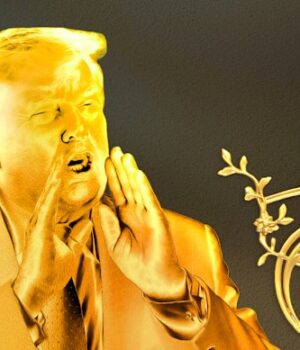
Trump is quite obsessed with interior decoration, and one of his particular decor fixations is a devotion to gold. The real metal, but the mere appearance of gold, too.
He’d respected the traditional understatement of Oval Office ornamentation in his first term but, in his second, “would unleash his inner Louis XIV”, write Jonathan Swan and Maggie Haberman in their new book, Regime Change: Inside the Imperial Presidency of Donald Trump.
“I actually hadn’t been in there for a while,” Swan tells me, until March this year when he and Haberman were allowed an interview, “and you just walk in, and it’s almost overwhelming, like the inside of a jewellery box from every direction. It’s pretty amazing.”
Trump pinched a set of golden table centrepieces that Melania liked to keep in the residence and took them to his office. He found antique gold urns in the White House collection, put them on the office mantelpiece and called them “cash”.
Why? Because, Trump says, “people look at it and all they see is cash”, write Swan, an Australian, and Haberman, both reporters at The New York Times.
Supplicants know how to take advantage of this fetish. A visiting Swiss business delegation handed Trump a gold bar worth $130,000 and a custom-made gold-plated Rolex desk clock in November.
The following week, his administration cut the tariff on Swiss imports from 39 per cent to 15. Coincidence, said the White House.
Technically, the gifts were given to Trump’s presidential library, but guess who gets to use them at his pleasure? Trump’s insatiable venality is one of the themes covered in the reporters’ book.
Financial disclosures on Wednesday show that his income burgeoned nearly threefold to $US2.2 billion last year with his return to the presidency. The Wall Street Journal described this as his clan “cashing in on the presidency in big and sketchy ways”.
The gold theme illuminates much about Trump, the president who launched a line of Trump-branded, gold-coloured runners for $US399 a pair the day after a court ordered him to pay $US349.5 million for fraudulently inflating his true wealth. He has his own special gold buyer.
The authors’ gold-dazzled visit to the Oval Office revealed other ways that Trump has been busy. Haberman and Swan had a list of detailed questions they wanted him to answer to support their reporting for the book. They didn’t get the answers.
But they were surprised to find that, with his Iran war in its 17th day, “the war seemed the furthest thing from Trump’s mind,” they write. “On the Resolute Desk, instead of a map of the Middle East, were printouts of maple trees.” Trump was selecting some for the garden. “I know how to buy good trees,” he informed them.
Next, he showed the reporters a printout of his TikTok statistics showing 339 billion all-time views of Trump and boasted: “Can you believe?” Then it was on to details of the ballroom he’s building, and another boast as he pointed out that its columns would be bigger than those of the Supreme Court.
Six American air force personnel had been killed in his war four days earlier. And six army reservists in the days before. His shameless self-indulgence in trivia at such a moment is shocking. But, as Swan and Haberman argue, “his complete absence of shame – historically unusual among American presidents – has been a political superpower.”
The significance of gold to Trump leads beyond the precious metal itself. Because it was at its modern apex in the 19th century, the time of the so-called classical gold standard. And so were Trump’s other signature preoccupations – tariffs and territory.
He acquires gold and bathes in its glow at every opportunity, just as he covets territory and imposes tariffs in a way no other American leader has in a century.
“I actually think Trump has a sort of 19th century view of the world,” says Swan, a former reporter for this masthead who has been covering Trump for 11 years. “When he looks at a map of the western hemisphere, and he sees these large stretches of land, like Greenland, Canada, Venezuela, he doesn’t see sovereign countries, he sees land that really ought to belong to the US.”
Trump’s increasingly regional view, while retreating from NATO, raises the question of whether the US is retrenching from its century as a global superpower.
This recalls the Monroe Doctrine of 1823, when President James Monroe declared the western hemisphere to be America’s sphere of influence. But that was its only sphere of influence.
Trump wages war in the Middle East, too. But is he committed to maintaining US power in the central theatre of the world economy and population – the Indo-Pacific? Or does he see it as China’s sphere?
The question is in the balance. He once likened Taiwan to a pen tip and China to the Resolute Desk. He’s called it a “bargaining chip” to use with China.
Swan’s close-up, 11-year study of Trump leads him to believe that no country, no ally, should expect US support in a crisis: “So, you know, it’s not like you can depend on it in a sort of predictable treaty-based way. It would be based on Trump’s own feelings about the leader, the personal, he’s very much a personalist leader, and you know, based on how he’s feeling that week or that day.”
The president’s attachment to tariffs is another central theme of the self-described “tariff man”. Again, the tariff was at its apogee in the 19th century. It was discredited in the early 20th.
Trump single-handedly brought the tariff back into fashion, with disastrous results as it fed inflation at home and alienated allies and friends abroad.
But, as with everything Trump touches, whether territory or tariff or otherwise, the hallmark style of Trump’s government is constant and, sometimes, calculated chaos.
For instance, when Trump invited Israeli Prime Minister Benjamin Netanyahu into the Situation Room to pitch his Iran war, he excluded his treasury secretary and his energy secretary.
The Iranians, of course, instantly turned the US-Israeli attack into a war of energy and economics and Trump was utterly unprepared. At the end of Netanyahu’s hour-long sales job, report the Times’ journalists, Trump, apparently satisfied, sat back and declared: “Sounds good to me.”
And, inexcusably, he brushed aside the repeated advice from the chairman of the joint chiefs that the Iranians could close the Strait of Hormuz.
Or when Trump was preparing his plan to impose worldwide tariffs on so-called Liberation Day and he realised that he’d forgotten to include the country that was ostensibly the main target – China. “Where are they?” he asked. Then, off the top of his head: “Put them in for 10” per cent.
Some of the chaos is calculated, say Swan and Haberman, because Trump uses it as a control tool.
For instance, his special envoy to end the Russia-Ukraine war, retired army general Keith Kellogg, was presenting a plan for applying pressure to Russia when the president shut him down.
Trump told him he was forbidden to speak to the Russians. Bizarrely, the man tasked with negotiating an end to the war was banned from contact with the aggressor: “Because we’re working a deal.”
“Trump enjoyed toying with people and operated in a culture of secrecy,” write the authors. “There would never be clear lines of authority or command, other than from Trump himself.”
Even though his daily online postings create the appearance of a radical new presidential transparency, in truth they are the surface spectacle.
His controversial choice to turn over the White House lawns to a UFC gauntlet of violence last month, for example, was a marketing opportunity for the president to appeal to the predominantly young men who follow the martial sport. Spectacular yet stage-managed.
But it has its hidden analogue in the private places within the executive mansion, as the book reveals. In his heady days of unchecked DOGE, Elon Musk had fired the head of the US tax office, the Internal Revenue Service, and appointed his own man with the brief to halve the size of the agency.
But the IRS is under the jurisdiction of the Treasury. And its secretary, a Wall Street billionaire, Scott Bessent, was unimpressed. “F–k you!” he told Musk in an Oval Office confrontation, according to the book. Musk goaded him to say it more loudly. And he did.
As they left the president’s office, “the situation got physical”, the authors write. “Musk lowered his shoulder into Bessent, and there was a shove.”
Organised violence on the lawn between paid brawlers is one thing. But physical contests for dominance between the people responsible for running the government on behalf of 300 million citizens? The president, rather than calling them to order, only asked one question, the book reports. “Who won?” In the more meaningful contest over policy, Trump eventually named Bessent as winner and DOGE, discredited, was disbanded.
For a foreign leader seeking to manage this chaotic regime, what’s the best approach. I asked John Howard whether he’d hang back to avoid risk, as Anthony Albanese does, or engage more?
“I’d engage,” said the Americaphilic former prime minister. “But I don’t know that it’d do any good.”
Swan concurs. It might help in the short run, he ventures, but it wouldn’t bank any credit for future use. “The bank could be raided overnight; it’s very situational.”
Trump’s America, a recrudescence of the late 19th century Gilded Age, so named by Mark Twain for its superficial gold coating over a rotten interior, is to be endured, not managed, by US allies.
Get a note directly from our foreign correspondents on what’s making headlines around the world. Sign up for our weekly What in the World newsletter.
 Peter Hartcher is political editor and international editor of The Sydney Morning Herald and The Age.Connect via email.