

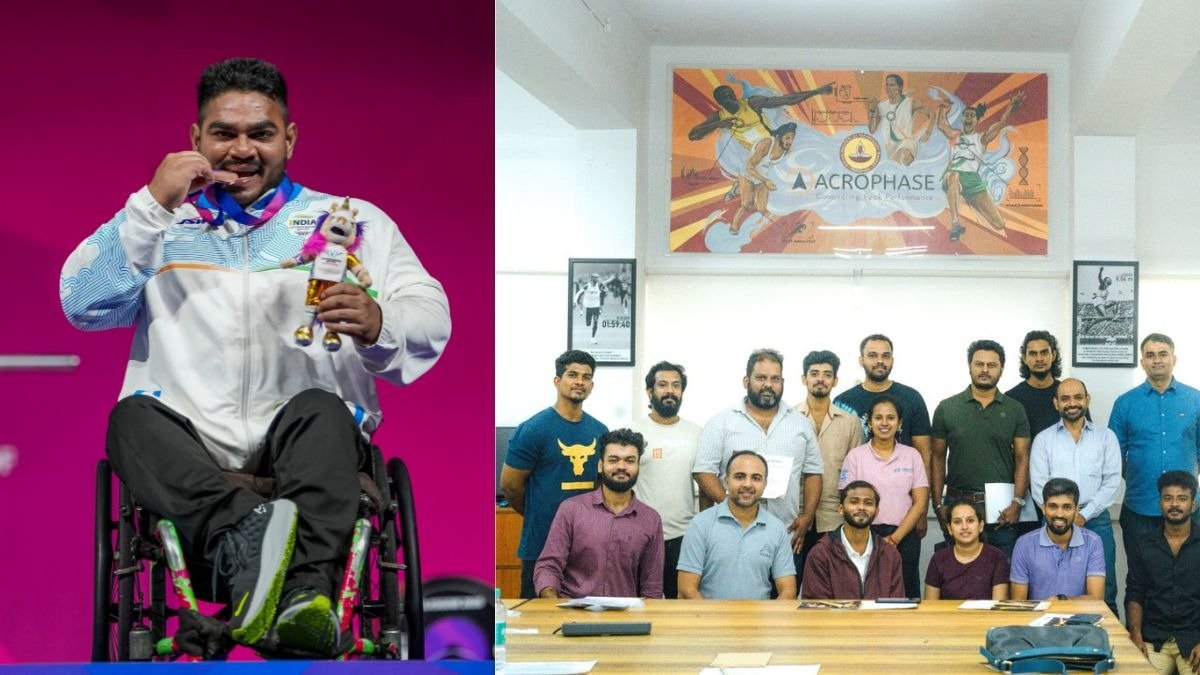
Source : INDIA TODAY NEWS
On a competition platform in Glasgow, Jhandu Kumar bent over a loaded barbell and drove 190 kilograms into the air. When the bar settled and the judges’ lights turned in his favour, a 28-year-old from Bihar’s Nalanda district had won India’s first medal of the 2026 Commonwealth Games. The bronze was his by the slenderest margin imaginable. Only a tenth of a point had kept him from silver.
advertisement
Prime Minister Narendra Modi called it a spectacular performance. Jhandu Kumar, the son of a vegetable vendor, had made the whole country proud.
Yet, the more extraordinary part of this story does not begin on that platform in Glasgow at all.
It begins several years earlier, in a room at the Indian Institute of Technology Madras, with a young researcher, an improbable idea, and a professor honest enough to admit how little he knew.
IT BEGAN WITH A YOUNGSTER AND A CONFESSION
Professor Mohanasankar Sivaprakasam leads a healthcare technology group at IIT Madras. The director of the Healthcare Technology Innovation Centre and the Sudha Gopalakrishnan Brain Centre at IIT Madras, Professor Sivaprakasam was awarded the prestigious Rashtriya Vigyan Puraskar 2025 in the Vigyan Yuva-Shanti Swarup Bhatnagar category for Technology and Innovation.
Since around 2010, his teams had been building indigenous medical devices, the sort of instruments that measure what is happening inside the human body so that doctors can help patients recover.
Somewhere around 2016 and 2017, people began putting a question to him that he could not immediately answer. “You improve the health of patients,” they said. “Could you improve the performance of athletes?”
The idea to actually attempt it did not descend from a senior professor. It came from one of his own researchers, a man barely in his mid-20s at the time. That researcher was Preejith SP, today the chief technologist of the centre that grew out of the conversation.
“I told him openly that I know nothing about sports,” Professor Sivaprakasam told India Today Digital. “We can start the work, and then we learn, and then we will grow this.”
That admission, more than any single machine, is where the story truly opens. A senior scientist agreed to walk into a field he did not understand, on the strength of a young researcher’s conviction, and to learn it from the ground up. The centre they built was named Acrophase, a word that means peak performance. The idea took shape around 2016. The laboratory was formally set up in 2021.
THE LADDER THAT ENDS TOO SOON
To understand why a room full of sensors should matter to a vegetable vendor’s son, you have to understand how sports really works in India, away from the television lights.
There are roughly five to six lakh professional athletes in the country, people who rise every morning to train because sports is their livelihood.
By the centre’s own reckoning, no more than one or two thousand of them ever reach genuinely modern, technology-driven support. The rest train largely in the dark.
Cricket is the exception, cushioned by the wealth of the Indian Premier League (IPL) and a sturdy domestic structure. Almost everywhere else, the professor says, the ladder simply ends.
If you are not in the national team, the rung below is desperately low, and access to good facilities falls away steeply. In track and field, in weightlifting, in the para sports, even a national jersey guarantees very little unless a major international competition happens to be looming.
This is the gap Acrophase set out to close, and it did so quietly. Its work was never aimed at the “Virat Kohlis and Rohit Sharmas” of Indian sport, Professor Sivaprakasam said, who reach world-class facilities anyway. It was built for the aspiring athlete nobody was watching.
A LABORATORY THAT BUILT ITS OWN EYES
The instruments that measure elite athletes are almost always imported, and they are punishingly expensive. A single high-end system can cost more than a small federation sees in a year. Acrophase could not afford to buy its future, so it built it.
Its advantage came from two places. The first was the group’s long experience of measuring the human body for medicine. The second was software. By writing clever algorithms, the team found it could take a simpler, cheaper sensor and coax from it the accuracy that usually demands costly hardware.
A hospital electrocardiogram, or ECG, the test that records the heart’s electrical activity, normally uses 12 points of contact on the body. Acrophase uses just one. The detail the other 11 would have captured is instead rebuilt by the software.
The result is a device accurate enough for serious use, yet affordable enough to handle 50 or 60 athletes at once. A comparable system licensed from abroad, the professor says, could cost millions.
Two wearable devices do most of the daily work. The first is a chest band worn only during training. It carries two sensors, one for the heart and one for movement, and together they measure what the team calls load, the total strain a session places on the body.
From the tiny variations between one heartbeat and the next, a measure known as heart rate variability, the experts can read how hard an athlete is working and how well the body is coping.
The second device is a wristband worn through the night. It tracks sleep, the truest sign of whether the body has recovered, and keeps a rough watch on emotional stress.
A third instrument, which reads the faint electrical signal a working muscle gives off, a technique called electromyography or EMG, stays in the laboratory and shows exactly when and where a muscle starts to tire.
The lab also measures VO2 max, the peak volume of oxygen a body can draw in and use during all-out effort, which remains the clearest single number for endurance.
Preejith SP, who describes the set-up with the ease of someone who built it, likens the array of equipment to the kind glimpsed in the Brad Pitt film F1.
Its purpose, though, is quietly radical. It records an athlete’s load and recovery day by day, instead of leaving them to be guessed at the end of a session.
WHY THE ENGINEERS WERE ASKED TO STEP BACK
The centre’s most important lesson had nothing to do with hardware.
In its first few years, the professor admits, the project nearly failed, and for a simple reason. It let engineers speak directly to athletes and coaches.
The reports they produced were precise, detailed and utterly baffling to the people meant to use them. The coaches would study the numbers and, quite reasonably, say they did not understand.
So the centre rebuilt itself around a layer of translators. It brought in exercise physiologists, sports physiotherapists, nutritionists and former athletes, people who lived in the athlete’s world and could turn a graph into a plan.
Today, no engineer at Acrophase talks to a coach directly. Someone from the athlete’s own domain always stands in between.
Beneath all of it lies a golden rule. The athlete is told almost nothing about the numbers. Their only task is to compete and to trust their coach. Every measurement, every correction, every warning goes to the coach instead, because an athlete’s mind, as the professor puts it, is already full.
READING A BODY THE WORLD OVERLOOKED
Para athletes ask more of this science than anyone. With an able-bodied athlete, the team can begin from a broadly standard set of tests. With a para athlete, almost nothing is standard.
Consider an athlete like Jhandu Kumar. In a para powerlifter of his classification, the strength of the lower limbs is close to zero, so everything rests on the upper body.
The lab measures the force each individual muscle can generate, checks the range through which every joint can move, and studies slow-motion video of each lift.
It watches, above all, for imbalance, the instinct to lean on one stronger limb which, in a sport decided by a whisker, can separate a clean lift from a failed one.
None of this reaches Jhandu Kumar as a spreadsheet. It reaches his coach as a handful of small corrections, and the athlete simply lifts.
Around the science sits a second kind of support, which is money. The centre runs a digital platform called the Unified Athlete Interface, a sort of professional network for Indian athletes, where anyone in the country can register, build a profile and log their progress.
More than a thousand athletes are already on it, including over 400 para athletes. Through partners such as the SBI Foundation and the Wadhwani Foundation, the centre routes scholarships and performance funding to athletes who would otherwise have none.
The next ambition is to identify talent even earlier.
Acrophase is building what it calls India’s first athlete profiling platform, testing young people across 10 sports, from athletics and boxing to archery and swimming, and using a blend of physiological measurements, on-field tests, a little genetics and artificial intelligence to work out which sport a child’s body is truly built for.
In wealthier countries, this profiling is routine by the age of 12 or 13.
India has never had a system for it. Right now, the centre works hands-on with 26 para athletes and 50 able-bodied athletes every day, a figure it began building only in July 2025 and hopes to raise to 80 and 90 respectively by the end of this year.
THE TWO GAPS INDIA CANNOT IGNORE
The professor is careful not to let the technology take all the credit. Two human problems, he says, matter far more, and both belong in any honest telling of this story.
The first is coaching. India’s coaches, he argues, need serious upskilling in how to measure and read performance the way the rest of the world does. Something as basic as an athlete’s balance can no longer be judged by eye. It has to be measured, and coaches have to learn to trust the measurement.
The second is money, and here his language turns blunt. Funding for most of India’s athletes, he says, is abysmal. By his own rough estimate, the great majority survive on a few thousand rupees a year of real performance support, while only the thousand or so at the very summit receive anything like a proper monthly stipend.
Yet the sum needed to change this is not vast. Spread even Rs 20,000 a year of assessment funding across five lakh athletes, he says, and the entire system could rise. The numbers are small. The will has been missing.
There is a quieter gap too, around the mind. Acrophase keeps a light watch on emotional stress through its wristbands and calls in respected psychologists when an athlete needs one, but sports psychology in India, the team notes, is still finding its feet.
And an athlete’s career is cruelly brief. In many disciplines, a competitor who has not arrived by 24 is already thought finished.
THE QUIET REVOLUTION
Return, finally, to that platform in Glasgow, and to the shape of the whole story.
A young researcher had an idea. A professor who knew nothing about sport believed in him, and lent it his name and his credibility. Together they built something for the athletes the country tends to forget, and years later that quiet work helped carry a vegetable vendor’s son to a Commonwealth Games podium.
“I am grateful to Acrophase, IIT Madras for enabling financial support and guiding me in my training,” Jhandu Kumar said after his win. This is the kind of backing that can help athletes like me win medals for India.
There are five to six lakh athletes in India waiting for the same chance. A laboratory in Chennai has shown, with indigenous sensors and a stubborn faith in people the system overlooked, that giving it to them may cost far less than anyone ever imagined.
– Ends
SOURCE :- TIMES OF INDIA