source : the age
High-tech industries including biomedicine and robotics will help future-proof jobs and drive Melbourne’s prosperity, as long as the city becomes audacious about attracting world-leading expertise and keeping it here.
Parkville is already considered one of the world’s leading biomedical precincts, with hopes that Clayton can become another major innovation hub.
However, experts say Melbourne’s ability to challenge London and Boston as research centres hinges on attracting foreign capital to get new ideas off the ground.
CSIRO chief executive Doug Hilton, who was formerly head of the Walter and Eliza Hall Institute of Medical Research in Parkville, understands Melbourne’s major innovation precincts like few others.
Before this, the molecular biologist worked at the Massachusetts Institute of Technology in Boston. Hilton takes a measured view about Melbourne’s place in the world – but also has some ideas about how it can step up.
“Parkville would be in the top handful of biomedical precincts in the world,” he told this masthead. “I think top six, absolutely – but there’s a gap between everybody and Cambridge and Boston. Just because of the intellectual heft, the entrepreneurship and the amount of capital.”
There are green shoots. Entrepreneurship, Hilton said, had improved significantly since a decade earlier when “it felt like we were adding fertiliser to a barren ground”. But raising capital still remains the major hurdle.
He is aware of a recent Parkville start-up that had the best intellectual property talent behind it.
“Their competitors in Boston, who weren’t as good, raised almost 10 times more capital in [their first round] than they did. And we weren’t 10 times better,” Hilton said.
“That just makes it hard. We have to raise our ambition and audacity. And then we have to go from finding the tens of millions of dollars in capital to $100 million.”
The industries and jobs of the future is a key topic of Melbourne Assembly, a three-day forum hosted by The Age and the University of Melbourne in October, which will bring together some of the world’s premier experts in city planning, innovation, education, arts and sport.
On Wednesday, we will delve into how Melbourne can attract – and keep – the best and brightest minds who will drive the industries of the future.
Melbourne has spent the past three decades trying to become a “knowledge city”, based around innovation, higher education and attracting the world’s best and brightest.
Talent ‘ecosystem’
The city’s biotechnology and medical research industry has long been touted as a future powerhouse, as Parkville houses an estimated 10,000 life scientists within a short walk of each other, spread across more than 30 research institutes, private companies, university campuses and hospitals.
This concentration of experts was one of the reasons Australian biotechnology giant CSL Limited chose to build its new global headquarters at the northern end of Elizabeth Street. It opened in 2023.
Seven of its 18 storeys are laboratories where about 370 people work on scientific breakthroughs that could lead to new, life-changing therapies. They often work in collaboration with nearby university researchers and hospitals, including the Royal Melbourne and Royal Children’s hospitals. The Royal Women’s Hospital and the Victorian Comprehensive Cancer Centre are also in the precinct.
“That’s a great pool of talent, and it’s easy for us to collaborate,” said Michael Wilson, CSL’s head of global research. “We can just walk across the road.”
Wilson said Melbourne’s biotech scene now rivals Cambridge, Oxford and Zurich in terms of size, and had potential to grow further. He called it “midway developed”.
Parkville operates like an ecosystem, he said, with CSL able to collaborate with nearby researchers and hospitals to identify the mechanisms driving diseases for its researchers to then target, while also having access to patient samples.
“It’s critical because those samples are gold,” Wilson said.
Parkville is home to a growing list of biotechnology and medical research players, including cancer treatment outfit Telix Pharmaceuticals, the University of Melbourne, Monash University’s Institute of Pharmaceutical Sciences, WEHI (formerly known as the Walter and Eliza Hall Institute of Medical Research), the Doherty Institute, the Murdoch Children’s Research Institute, and the Bio21 Molecular Science and Biotechnology Institute.
A 14-storey building to house the new Australian Institute for Infectious Disease – a collaboration between the University of Melbourne, the Doherty and Burnet institutes and the Victorian government – is being built on the eastern side of the Haymarket roundabout and is set for completion in 2029.
Although face-to-face collaboration across the precinct is a major drawcard, CSL has backed calls to improve pedestrian access across the so-called Haymarket “roundabout of death” to make this even easier.
Wilson said China’s booming biotech industry was an opportunity for Melbourne as a destination for speedy clinical studies and access to ethnically diverse patients. Many of China’s top scientists studied in Australia, too.
The next step in developing the local industry, he said, was nurturing new start-ups and ensuring they stayed in Melbourne as they grew, rather than move offshore.
Two floors of CSL’s new headquarters are used for the Jumar Bioincubator. It operates like a co-working space for biotech start-ups, and was established by CSL, the University of Melbourne and WEHI, with funding from the state government and Cicada Innovations.
One of the 40 start-ups working there, Proxima Bio, is trying to commercialise technology first developed at WEHI that repurposes antibodies to enhance medicines used to treat autoimmune diseases such as rheumatoid arthritis and lupus nephritis. It’s grown from five people to 12 since it was founded 2½ years ago.
Backing start-ups
Proxima chief executive and co-founder Jon Bernardini said the start-up’s small lab at Jumar was a “godsend”. Without it, they would have been stuck trying to develop their concept in university labs, which are not equipped for growth and have complications around intellectual property ownership.
“The sector’s kind of growing, and there’s lots of exciting things happening, but there’s nowhere for the companies to go,” he said.
“When you go to global hubs like Boston or San Francisco, they have mature incubators, they have institutions, they have these precincts, and I’m starting to see the green shoots of this happening here in Parkville.”
Bernardini said his start-up hopes to start manufacturing its product for clinical trials in about 18 months. He’s optimistic a local industry can grow, with venture capital showing more interest in start-ups.
“If we have a few success stories, if we show the world that Australian science can now be translated to Australian commercialisation success, we’re going to see this happen again and again. We have the clinician scientists, we have the medical researchers,” he said.
In March, the federal government released its Ambitious Australia report, which found the nation’s research, development and innovation system was fragmented, with un-coordinated programs, duplication across states, and caused inefficient competition for limited resources.
Further, policy settings need to support start-ups to grow into medium and large businesses so they didn’t leave Melbourne and Australia, Hilton, the CSIRO boss, said.
“How do we get renewal in our ASX top 100 companies? How do we get the level of dynamism we see in the US? Companies in the past 20 years have come from nowhere and are now among the most valuable in the world,” Hilton said.
Michelle Gallaher, the chief executive of industry group BioMelbourne, said there was still work needed smoothing the pathway from research to commercialising new medicines and therapies.
As one example, Victoria could improve researchers’ access to its large biobanks – libraries of biological samples – and disease registries, which catalogue patients’ health information.
“We have more data than we’ve ever had before about many diseases. But what we need now is more harmonisation … so international researchers and biotechnologists can discover them and use them,” Gallaher said.
She said artificial intelligence could be a game changer for the biotechnology industry, and that Victoria’s aggressive push into building data centres would be critical to future medical research.
Across the city, in Melbourne’s other major innovation hub – the Monash Technology Precinct in Clayton – researchers at Monash University, the CSIRO and the Australian Synchrotron work alongside businesses including Moderna, Telstra and Bosch.
“I see Clayton as having all of the ingredients necessary to be able to be a really vibrant tech precinct,” Hilton said.
“But that’s going to require institutions who want to work together, it’s going to require continuous investment in infrastructure and facilities, and it’s going to require a level of collegiality between researchers.”
Robotics is one area on which the CSIRO is collaborating with other institutions, such as Monash University. Adjunct science fellow Dana Kulic leads a team investigating how robots can work with humans on anything from bio-hazardous tasks to constructing and maintaining solar farms.
“This question of how do we do robot adoption is still very much an open question,” Kulic said.
“We have many smaller companies, where if they are doing something that isn’t currently automated, they might not have any automation expertise.
“One really interesting policy question for Australia is, how can we help these smaller companies more quickly experiment to see what automation and robotics tools are helpful for them? And then, also, if the experiment is successful, deploy those technologies.”
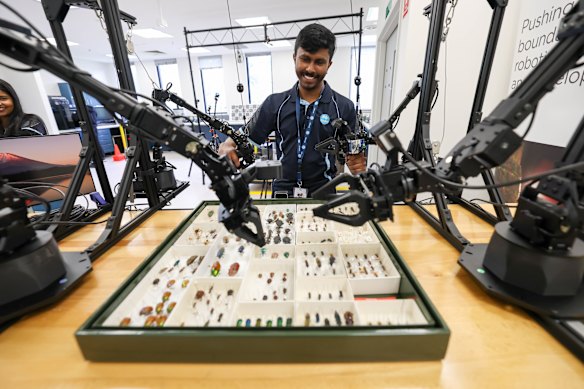
Already, the CSIRO is trialling using robots in Clayton to digitise the national collection of insects, which typically takes 20 minutes for a human to manually database.
“We are building the enabling technologies that would allow people who would just like to use robots for the tasks they would like to get done, without having the robotics expertise,” research scientist Dr Kavindie Katuwandeniya said.
Melbourne Assembly will be held from October 19 to October 21. More information is available on the Melbourne Assembly website, including special offers for Age subscribers.