

Source : INDIA TODAY NEWS
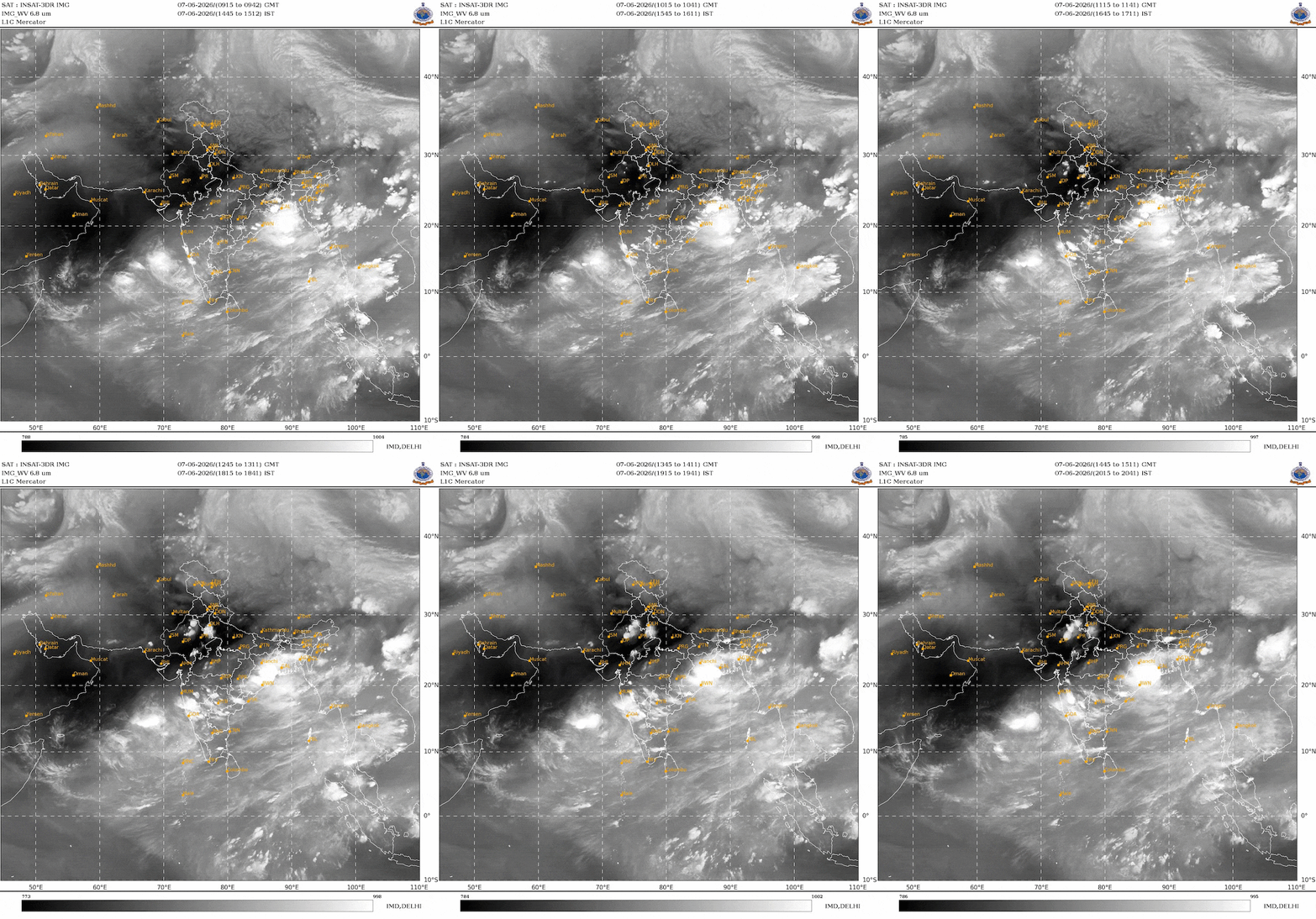
The fields of Telangana have spent weeks waiting for the sky to break. That wait is almost over, with the southwest monsoon expected to reach the state between June 10 and June 12, drawn inland by two great whirls of wind turning over the seas on either side of the Indian peninsula.
The monsoon reached Kerala on June 4 this year, three days later than its usual arrival on June 1. Since then, it has climbed steadily up the coast and across the northeast.
advertisement
Telangana, perched high on the Deccan plateau in the south of the country, is next in line.
TWO SWIRLS OVER TWO SEAS
What makes this advance possible is a neat piece of atmospheric choreography. One cyclonic circulation has formed over the northeast Arabian Sea, and a second over the north Bay of Bengal.
A cyclonic circulation is simply a swirl of winds spinning anticlockwise around a patch of low air pressure, a little like water circling a drain before it slips away.
On its own, each swirl is unremarkable. Together, they are lining up along an invisible line that meteorologists call the monsoon trough, the long belt of low pressure that acts as the backbone of the entire monsoon.
Forecasters expect this trough, or axis, to settle firmly into place around June 11.
THE PUSH AND THE PULL
This is where the rain is made. The swirl over the Arabian Sea acts as a push, hurling moist, heavy sea air north-eastward towards the land.
The swirl over the Bay of Bengal, with its core of low pressure, acts as a pull, drawing the surrounding air in towards itself.
Caught between this push and pull, two rivers of wind come crashing together over central India. Scientists call this meeting convergence.
When winds collide, they have nowhere left to go but upward, carrying their cargo of sea moisture with them.
As that air climbs, it cools, and the water vapour it holds condenses into towering clouds. The result is rain, often heavy.
It is also why the monsoon does not creep forward in a tidy line, but lurches ahead in surges.
Each time the two swirls align, they build a bridge of moisture across the plateau, and the rain pours through it.
A WELCOME PULSE IN A DRY YEAR
The timing matters. Telangana’s farmers depend on these first showers to sow their kharif crops, the ones planted in the monsoon.
Yet the wider picture is sobering. The India Meteorological Department has forecast a below-normal season overall, at 90 per cent of the long-period average, the benchmark figure of roughly 87 centimetres against which every monsoon is quietly measured.
Against that cautious backdrop, the coming days offer a genuinely hopeful pulse.
For now, two swirls of wind are arranging themselves over two seas, and a parched plateau waits for them to deliver.
– Ends
SOURCE :- TIMES OF INDIA