

Source : the age
Tensions are high in the Middle East with Iran continuing to launch missiles and drones towards its Gulf neighbours, including the United Arab Emirates (UAE). But commercial aviation carries on, and passengers are seemingly flocking back.
Emirates and Etihad Airways – both UAE-based carriers – along with Doha-based Qatar Airways, are again operating extensive flight schedules from Australia, with a web of available connections beyond the UAE to Europe, Africa, the Middle East and elsewhere. So what’s it like to fly through Dubai right now?
Surprisingly, it’s incredibly calm. The same is true of every passenger I chat with at Emirates’ onboard bar between Melbourne and Dubai (I’ve used points to snag a business class ticket, and without much difficulty compared to the usual hunt for seats). On this flight, business class ends up near-full, and economy class is also quite packed.
One passenger I speak to is heading to Austria for a quick fly-in, fly-out conference. Another is planning some downtime in Manchester after wrapping up their employment in Australia. I meet a couple who have never flown “upstairs” before and are loving every minute. Nobody is panicking: it’s very much flying as usual.
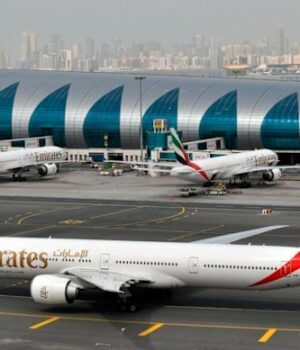
Dubai Airport feels similarly relaxed. It’s my 22nd time passing through (I track my flights) and it feels just like it did before the war began. Security is efficient without noticeably being on edge … my cabin bags even emerge from the scanners faster than they did in Melbourne. Go figure.
I explore a couple of the Emirates lounges between flights. Normally, the central business class lounge (Concourse B) is packed. Today, it’s populated but doesn’t feel quite as busy. The same is true of the neighbouring first class lounge.
It’s only after boarding my onward flight that I notice a shift. There’s an initial delay as some connecting passengers have late inbound arrivals, so we’re waiting rather than leaving them behind. Still, that’s routine.
With everyone seated, another announcement comes. Dubai Airport – usually among the world’s busiest – has just condensed all flights onto a single runway “due to air traffic control”. On parallel runways such as Dubai’s, that’s not generally done unless there are ongoing airspace restrictions.
We patiently sit on board, waiting to move, which finally comes about two hours after our scheduled departure time. It’s back to smooth sailing after that, aside from the 84-minute delay on arrival. I don’t mind; I just appreciate arriving safely.
But what can you do to prepare for a transit through the Middle East, in case things don’t go quite to plan?
First, check your travel insurance closely. Standard policies are usually void in destinations marked as “do not travel” by Smartraveller, but check whether yours is valid for countries listed as “reconsider your need to travel” – this varies by policy and insurer.
At the time of writing, the UAE (Dubai and Abu Dhabi) and Qatar (Doha) are both categorised as “reconsider your need to travel”. Meanwhile, some Middle Eastern countries that would typically have a lower warning level are now on the “do not travel” list, such as Bahrain and Kuwait. Be sure to check every country on your itinerary, including transit locations.
For added peace of mind, some specialist insurance providers offer policies tailored to higher-risk transits and travel to red-zone destinations that regular policies exclude. Emirates has launched its own travel insurance to address this, but of the 27 countries where it’s available, Australia isn’t one of them.
Alternatively, round-trip transit between Australia and Europe via Dubai, Hotspot Cover sells medical-only transit cover from $USD85 ($118). This could be an alternative to buying a second full travel insurance policy, if an existing policy covers the final destination but not the transit point.
It also pays to keep an eye on your flight bookings, as airline schedules can change – especially as the situation in the Middle East evolves. I encounter several flight changes and ultimately leave Melbourne a day later than originally booked, to accommodate schedule amendments to my connecting flight. At least the changes were clearly communicated and accepted well in advance of the trip – not at the airport during check-in.
If you find comfort in over-preparing for disruptions (guilty), there are some other simple things you can do. Start by using the in-flight power on the long leg from Australia to fully recharge all your devices, especially your smartphone and laptop. If your connection is disrupted, you’ll be able to respond, rather than strolling around the terminal in search of a power outlet.
Keep a photocopy of your passport with you. This can be handy if it’s lost or for an unexpected visa application. For instance, if there are protracted delays, you might decide to cross a land border to fly from an operational airport. Having a visa for a neighbouring country helps with this greatly. Saudi Arabia borders both the UAE and Qatar, and its tourist e-visas are easily obtained online.
It never hurts to have more than one SIM card or eSIM, particularly a roaming-friendly account that offers a choice of mobile network while travelling – helpful if one network goes offline. But most importantly, pack your patience. Like you, airline staff also want to arrive safely and get home on time. A smile on a frustrating day goes a long way.
The writer travelled at his own expense.
 Melbourne-based journalist and columnist Chris Chamberlin enjoys maximising his points to travel the world in comfort and, as a points coach, helping others to do the same. From showering on a plane to stretching out in a double bed in the sky, Chris knows all the tips for flying in style without breaking the bank. His adventures have taken him on almost 1000 flights aboard more than 80 airlines, earning lifetime frequent flyer status along the way. Follow him on Instagram @chris_chamberlin.Connect via email.

