
Source :- THE AGE NEWS
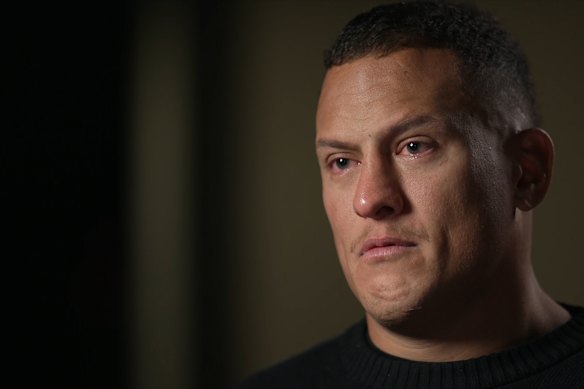
Former NRL enforcer and Fijian international Kane Evans has detailed his battles with alcohol, substance addiction and suicidal thoughts while wrestling with his sexuality in an emotional interview aired on Channel Nine’s 100% Footy on Monday night.
The 34-year-old is just the second male player to publicly come out as gay in professional Australian rugby league, and the first to do so since pioneering former NSW Origin and Kangaroos star Ian Roberts 31 years ago.
Evans, who rose to prominence as a hard-hitting Roosters forward in 2014, said denying his sexuality from the age of 15 had weighed on him so much that, once his NRL and Super League career ended, he made taking his own life a personal goal as he spiralled into addiction.
Instances where people knew of his sexuality and threatened to “blackmail me” and “out me” also took their toll before the Rugby League Players Association helped get him into a rehabilitation facility and turn his life around.
“I had three goals in life,” Evans told Channel Nine’s James Bracey as he detailed his mental health struggles.
“And it was; to play NRL. To buy my parents a house, and then I wanted to top myself, because I was living in denial from a young age.
“I know that. I know that I’m gay. But I went down every other avenue to build up these walls. To be someone, to escape who I am.
Asked how it felt to say that out loud, Evans replied: “I still can’t believe that I’m here talking to you.
“This is definitely my worst nightmare. But I know if I surrender, its just going to be a start to a new life. I’ve been fighting a war within since I was about 15 years old. And it’s not sustainable.
“I was sleeping in parks, doing drugs, trying to ultimately pass away so I didn’t have to come to this [conversation].
“But I know that there’s people who are struggling with the same struggle that I’ve gone through. So I’m very blessed that I can come here and talk to you, and be able to save a life or two.”
Evans’ decision to come out publicly follows a stint in rehabilitation and more than four months of sobriety, which he celebrated on social media in May.
The help of former Panthers premiership-winner Joe Galuvao, now manager with the RLPA’s past players and transition program, proved pivotal in Evans’ turnaround as Galuvao tracked him down while he was sleeping rough in Sydney parks.
“I started questioning; ‘Maybe death isn’t the plan for me yet. Maybe I do deserve to go and get help’,” Evans said after Galuvao had told him he deserved a “good life”.
“I’ve carried [hiding his sexuality] around my whole life. I’m here today to show people that you don’t have to live like that. Even now I feel a bit more free, just by saying it out loud, I’ve brought it to the light.
“Even over the years when I’ve tried to go down that path [of coming out on his own terms], I’ve had people blackmail me. I’ve had people try to throw me under the bus, I’ve had people try to deflect their problems by trying to out me. And it just built up a lot of shame, and fear and guilt within myself.
“Now I’ve spoken about it, I’ve shattered all those chains. They’ve lost their power. I feel like coming and speaking to you today, fear, shame, guilt – all of that, I’ve cut ties with all that.
“I feel peace within, and I feel like a weight has lifted off my shoulders.”
Evans also paid tribute to Roosters coach Trent Robinson, who handed him his NRL debut before a 131-game NRL career that also included stints with the Eels and Warriors and 13 Tests for Fiji.
On a guided tour of the Roosters’ Moore Park headquarters recently as he began to get his life back on track, Robinson told Evans he had organised for the club to help finance part of his mental health treatment.
“Somehow Robbo got my number,” Evans said. “He called me just to let me know [that] the Roosters is still my home, and that they’ve got my back in whatever I’m facing … And Robbo, out of his own money, paid four weeks of my rent, because I had just got into a place that week.”
Evans said he had not truly processed the significance of his coming out, in an Australian sporting landscape where only a handful of male athletes have done so. He said the most important and rewarding conversation would come with his parents – his father Peter Davies played 13 first-grade games in the late-1980s – between his interview being conducted and airing on national television.
“I love my mum and dad so much,” he said. “And they know. But I need to tell them. It has to come from my mouth.
“My mum, she’s ill at the minute, but I’ve got so much love for them. By the time this airs, I’ll have told them already, and I can’t wait for that moment. Because then I’ll be free. I feel free now but once I tell them I’ll be free, and nothing will stop me after that.
“I’m very blessed that I’m facing my fears. I know some people that have done some gangster things, but I feel like this is up there. I’m a bit proud of myself and when I look in the mirror, I’m going to smile now, not have those bad thoughts.”
If you are worried about your own or someone else’s mental health, you can contact the Mental Health Line on 1800 011 511 or Lifeline on 13 11 14