

SOURCE :- THE AGE NEWS
Kathmandu: On Wednesday morning, about 9.15am, poultry farmer Sidar Tamang took a call from a supplier with astonishing news from upstream on Nepal’s Trishuli River. Water, roiling with debris, was surging towards the remote village of Khalte, the supplier said, and Tamang needed to warn other residents to run for higher ground now.
With his whistle, Tamang says he rushed through Khalte’s main street, blowing and shouting until he spotted a group of children standing by the petrol station.
Minutes after his phone call, it was already too late. The flood that would leave at least 2500 people dead or missing, including 38 Australians, was barrelling down on them.
He grabbed the smaller kids’ hands and told the bigger ones to run ahead.
“As we moved to slightly higher ground, the flood suddenly surged and swept them away,” Tamang says from his hospital bed in Kathmandu.
He still had hold of one of the children; he didn’t know who. Then, somewhere among the cascading remains of homes, shops and bridges, the small hand slipped away.
“I felt an overwhelming grief,” he says. “At the same time, I was terrified for my own life.”
Tamang was swept more than 100 metres, clutching at whatever he could. When he was pushed against a field terrace, he hung on, eventually dragging himself out of the water to dry land.
“I thought, ‘I must survive, I must look for my sons’, so I slowly started to crawl up the hill and saw a house. There was a man, and when he came to me, I said, ‘Everyone is dead. I will die too, save me’, and he took me to his house and changed my wet clothes,” he says.
It would be another two days until Tamang made it to hospital in Kathmandu, about 60 kilometres in a straight line south. In between these points are jutting mountains and washed-out roads, leaving only two options: rescue by helicopter or a journey on foot.
Tamang, with serious head wounds, had not the grace of either.
First, he was shuffled to a nearby clinic, but the staff had already left, so he clambered onto a bus with others fleeing the area and made it to another clinic, which had no treatment to offer beyond a couple of pills and some oils the nurses vainly massaged into his gashes.
In too much pain to rest, Tamang dragged himself to an area where he was told a helicopter might be able to land. And then he waited.
“I saw helicopters coming, but they only went to other places,” he says. “When one came to get me, they couldn’t land.”
Nepal has declined offers of search-and-rescue assistance from other countries, believing it can do the massive job itself. Though every private helicopter in Kathmandu is booked for rescues, an official told the Kathmandu Post that the presence of so many foreign crews in the area after the deadly 2015 earthquake created too much confusion.
So Tamang, stranded deep in the Himalayas but with others helping him, moved again and waited two hours for an ambulance to take him to a remote hospital. But it didn’t have the right equipment and medicine. And neither did the one after that.
On Friday morning, a helicopter finally got him to the public TU Teaching Hospital in the capital. That’s where this masthead meets him only hours later as he begins his recovery.
It is crowded and hot, as there is no air-conditioning, though Tamang rests beneath a blanket anyway. His eyes are half-closed, and he has cuts across his face and head. Pomegranate seeds are heaped inside a plastic bag beside his pillow because that’s about all he can eat.
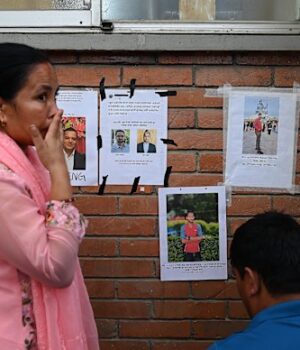
Outside in the courtyard, it is grim. More than 100 people searching for loved ones are shuffling between a staging desk and a wall, on which are pinned the lists of survivor-patients and posters of the missing. No one is smiling or whooping in relief.
One man says 12 of his family members are missing. Another, a bus driver who is looking for his brother, says he took out a group of 26 Indian tourists, none of whom returned.
The scene is playing out at hospitals across Kathmandu.
Now, there is talk of a second flood.
Tamang, badly damaged but with no broken bones, is both relieved and grieving. Dozens of friends and relatives are missing.
One of them is his middle son.
Australians in need of emergency consular assistance should contact the Department of Foreign Affairs and Trade’s 24-hour Consular Emergency Centre on 1300 555 135, or +61 2 6261 3305 (if calling from overseas).
Read more on the Nepal flood disaster:
Get a note directly from our foreign correspondents on what’s making headlines around the world. Sign up for our weekly What in the World newsletter.


