SOURCE :- THE AGE NEWS
Bidur, Nepal: Dhan Bahadur Tamang arrived at work at 7.20am on Wednesday, stretched with his team, then headed down the tunnels for another day of building a hydropower plant designed to increase blackout-prone Nepal’s power generation by at least 20 per cent.
The $900 million project, called Upper Trishuli-1, was almost finished. Then, in a matter of minutes, it was destroyed.
The inland tsunami that had just wiped out entire villages upstream on Wednesday morning reached Trishuli-1 about 9am, as Tamang was inside an access tunnel. The water, he said, filled the tunnel so quickly and forcefully that it swept away machinery and vehicles.
As he fought for his life, similar events were unfolding at other hydro-plants along the remote Bhote Koshi and Trishuli river corridors. An unknown number of workers have been killed, while hundreds of others remained trapped in the dark mountain tunnels with uncertain oxygen levels and little or no drinking water.
Close to 350 people were rescued from a tunnel on Friday. Still, the Kathmandu Post, citing the government and an independent association, reported on Sunday that at least 897 were still unaccounted for across the region’s hydro projects.
Dramatic rescue efforts were now unfolding at several plants. On Sunday night, rescuers had dug into the top of one of the tunnels where they believe dozens may be trapped, but had not yet entered.
This masthead witnessed a small rescue team arriving on Saturday from China, a significant employer at the sites.
Tamang estimated he was swept as far as four kilometres through the tunnel until he was spat out alive into a newly formed body of water swirling with debris and equipment.
When the water began to recede, he found his way to another tunnel.
“I saw many dead bodies inside that tunnel,” he said. “I had to step over some of those bodies in order to escape and be here today.”
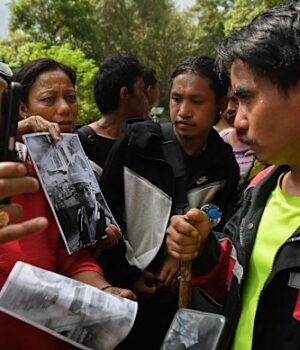
Tamang spoke to this masthead only moments after a helicopter had delivered him and three other survivors to the town of Bidur, where an army post had been transformed into an aerial operations centre and chaotic receiving ground for people rescued from across the impact zone.
Although he was walking with a stick, he and the others had escaped serious injuries.
Two women rushed over while the men slowly walked to a waiting vehicle, begging for information about a loved one, also a hydro worker. Tamang studied the photo and told the women that he knew of the missing man, but did not know if he was alive.
The death toll from Nepal’s catastrophic floods was nearing 800 by Sunday night (Nepal time). With more than 2500 people missing, 43 Australians among them as of Monday morning, the number was expected to soar.
Chinese authorities, meanwhile, said 546 people were unaccounted for, including 261 foreigners from 23 nations, on the Tibet side of the border.
When the humanitarian needs ease or become obsolete, Nepal, a landlocked, developing nation, must reckon with the decimation of electricity-generating infrastructure.
More than a dozen of its hydro plants, including some in development, like the Upper Trishuli-1, might have been impacted or ruined, crushing hopes of harnessing the Himalayan snow to produce enough electricity to power itself and others.
Tamang’s Upper Trishuli-1, which had strong investment from South Korea, was Nepal’s largest ever foreign direct investment project.
The Asian Infrastructure Investment Bank chipped in a $125 million loan in 2019. In its announcement, the bank made reference to how the 2015 earthquake – Nepal’s only natural disaster deadlier than the present one – had severely damaged services and infrastructure.
Australians in need of emergency consular assistance should contact the Department of Foreign Affairs and Trade’s 24-hour Consular Emergency Centre on 1300 555 135, or +61 2 6261 3305 (if calling from overseas).
Read more on the Nepal flood disaster:
Get a note directly from our foreign correspondents on what’s making headlines around the world. Sign up for our weekly What in the World newsletter.