

Source : THE AGE NEWS
I’ve been curious about Costco for a while, but it has taken me years since moving out of home – and therefore having to do my own shopping – to get around to the bulk-buy superstore.
For a start, I don’t have a car – or the license to drive it – making the journey out to one of Costco’s warehouses (and, more importantly, the hefty journey back home), a major roadblock.
And while Costco is often painted as a win for big families with hungry mouths to feed, the huge quantities seemed a bit overkill for a single-person household … even if that person does happen to have a rather outsized appetite.
These things have stopped me from shelling out the $65 Costco membership fee. The discounted prices, I figured, couldn’t possibly stack up enough to justify me paying for a privilege I probably wouldn’t end up using.
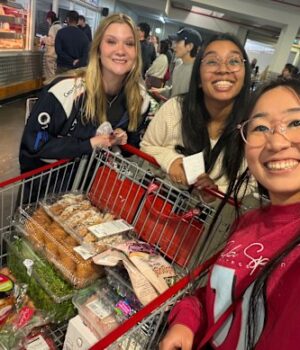
But earlier this month, two of my friends – both of whom are (unlike me) adult enough to own cars, drivers’ licenses and Costco memberships – generously offered to take me along as a guest.
So, on a crisp Saturday morning, we made the trip to the Sydney suburb of Lidcombe where we were greeted, first, by giant $3 pizza slices and $2 combined hot dog and unlimited refill soda deals at the Costco food court. Of course, I consumed all of these things.
I watched in awe as people carted around huge trolleys packed with giant portions of everything from milk to meat and pre-packaged snacks. The most common item? A plastic carton of 30 eggs.
As we walked around trying samples and marvelling at snacks we’d never seen before – or at portion sizes we didn’t know could exist – we each picked up bits and pieces that caught our eyes.
For me, this included, among other things: a one kilogram punnet of blueberries, a one kilogram tub of spinach, the 30-egg carton everyone else also seemed to be carting around, a box of protein shakes and several kilograms of chicken and beef.
Having lived in share houses for most of the time I’ve lived in Sydney and Canberra, freezer space has been a scarce commodity. But after moving into my own apartment earlier this year, I figured the meat, at least, could occupy the (now, by comparison) sweeping, icy real estate I had to myself.
I also learnt that a kilogram of spinach, no matter how much it shrinks in the pan, is a bit excessive for any single entity that isn’t a four-legged herbivore – but that a kilogram of blueberries can disappear within three days when it’s your favourite fruit.
Another important lesson I learnt was that things at Costco are not automatically dirt cheap. Some prices are comparable (and sometimes even more expensive) than prices at Coles, Woolworths or Aldi, especially when those items are on sale at the major supermarkets.
The $28 kilogram of blueberries, for example, seemed like a fantastic deal. But I later found out that the same quantity would have set me back exactly the same amount at Woolworths – and that it would have been $4 cheaper at Aldi.
And the 1.9 kilogram beef topside steaks I bought for $56, or $30 a kilogram, were only slightly more expensive at Coles and Woolworths which had similar cuts for $32.50 a kilogram, and were roughly the same price at Aldi.
There were, however, some substantial savings to be had when it came to the protein shakes, which generally retail for $5 each at Coles and Woolworths (Aldi doesn’t stock the particular brand) and closer to $4 on sale. The pack of 12 I bought at Costco set me back $39, or just over $3 each, which was a significant saving.
The baby spinach was also cheaper at $12 a kilogram compared to $17 at Woolworths, $15 at Coles and $14 at Aldi, and stayed fresh for at least a week before starting to wilt. I will, however, pay that little bit extra from now on to buy it in smaller portions that I know I can finish.
The important thing, therefore, when shopping at Costco, is to have a good idea of what everyday grocery items cost. That way, you don’t end up paying more than you would elsewhere, and you can make sure to get the best bang for your buck.
It’s also worth considering whether you will make enough savings to justify the $65 annual membership cost – as well as the time cost of travelling there if you live far away from the closest Costco.
For those living with a partner, family, or in a share house, the cost of that membership can be split between two people who each get a card with their own photo ID. And each person can bring up to two guests (not including children), meaning a bigger household could split the membership cost even further.
The membership fees are one of the main ways through which the multinational company made its $US8.1 billion ($11.3 billion) profit in 2024-25. Its membership fees, globally, brought in $US5.3 billion ($7.4 billion) in revenue, up by $US500 million ($700 million) from the previous year.
The Australian arm of the company – which also includes Costco Taiwan’s businesses – reported a $389 million profit, up from $279 million the previous year.
Since entering Australia with its first store in Melbourne in 2009, Costco has expanded to 15 locations nationwide.
At the competition watchdog’s supermarket inquiry in late 2024, Coles chief executive Leah Weckert said Australians were increasingly travelling long distances to stock up on things like toilet paper from Costco.
“When a Costco opens, we do see a significant impact, millions of dollars of impact to our network through their openings because customers are now basically buying a heap of products that they would have otherwise been buying from us in smaller quantities each week,” she said.
That’s probably true. Since my Costco visit nearly a month ago, I haven’t bought any meat (or spinach or blueberries) from my local Coles or Woolworths stores where I’d usually be seen snooping around for yellow discount stickers. As a result, I haven’t visited Coles or Woolworths nearly as often, meaning I haven’t been tempted to pick up as many knick-knacks and snacks on my (often copious) side quests around the supermarket aisles.
But while Costco, alongside Chemist Warehouse, Aldi and online retailers such as Amazon, are ramping up competition, Woolworths and Coles – which are among the most profitable supermarkets in the world – still dominate the sector with a combined 67 per cent share of supermarket sales nationally.
Part of the problem is that Woolworths and Coles have a huge store footprint. They are, for most people, still the most convenient locations to swing by after work to pick up groceries.
And people are generally creatures of habit. It’s hard to break us out of our routines and familiar routes, even if we know we’re missing out on better deals elsewhere. It can also be a time-consuming process going to a Costco, walking around its huge aisles, and carting everything through the store and back to your kitchen.
But there are some clear benefits to going to Costco: great deals for those who know their prices or have multiple mouths to feed – and a fun adventure if you go with friends who are keen to try out samples, bargain hunt and make an adventure out of the entire experience, with a huge pizza slice in hand.
It will probably take me another month to get through the remaining meat and protein shakes, but if I manage to rope my brother (and, crucially, his car) into some Costco trips, I might make a longer-term habit out of it.
The Market Recap newsletter is a wrap of the day’s trading. Get it each weekday afternoon.
 Millie Muroi is the economics writer at The Sydney Morning Herald and The Age covering workplace and economics. She was formerly an economics correspondent based in Canberra’s Press Gallery and the banking writer based in Sydney.Connect via X or email.

