

Source : ABC NEWS
When Ian Thorpe burst onto the international swimming stage at just 14, he became a world-champion swimmer and a household name.
It was the late 1990s and the national countdown to the Sydney Olympics was on.
Millions tuned in to watch the teen sensation with feet like flippers as he raced — and won — against adult men, often strokes ahead.

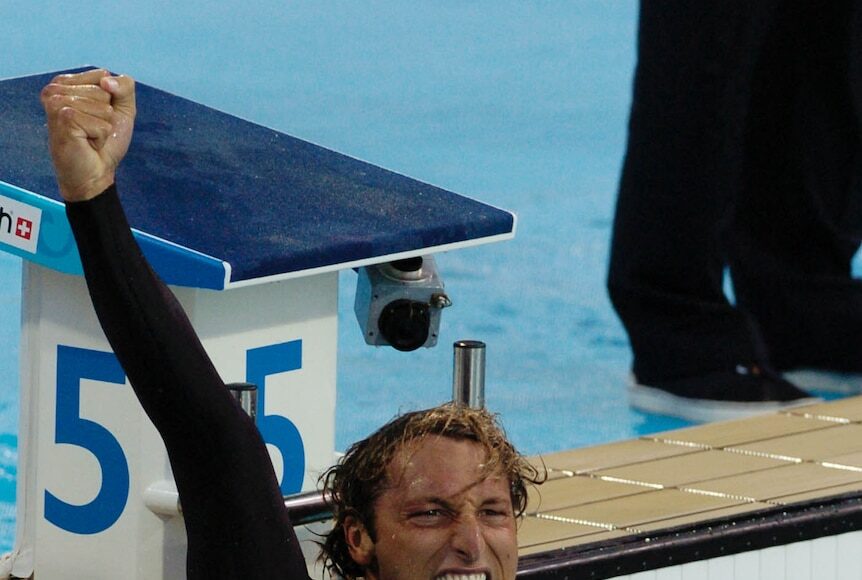
In the 200-metre freestyle final at the Athens Games, Ian Thorpe claimed his first Olympic gold for the event. (AAP: Dean Lewins)
Across a near-mythic career, he smashed dozens of race records and claimed nine Olympic medals — all while contending with intense national pressure and speculation about his personal life.
But pursuing success in his sport presented an almost cruel dichotomy for Thorpe; he craved silence over the spotlight.
Across his career under the media microscope, Ian Thorpe drew adulation and scrutiny in equal measure. (Getty: Robert Cianflone)
“I’m someone who is more comfortable in small groups, or by myself,” the 43-year-old told ABC iview’s The Assembly.
“I do usually find that after something like this, that I am more tired than most people are from doing it.”
A self-described introvert, Thorpe selectively attends large or “extroverted” events and uses positive self-talk to calm himself.
“I’ve had to learn to be comfortable … to be able to get through it,”
Thorpe said.
“For me, it’s occasionally taking a break and just going, ‘I’m all right, I’m OK’.
“I give myself a bit of a pep talk before I do it, and usually it’s OK — it’s not as big of a deal as what I made it out in my head to be.”
‘Everyone expected me to win’
It’s probably unsurprising that during his swimming career Thorpe favoured being underwater and escaping the din of the cheering crowds.
“My favourite part is the silence,” he said.
Thorpe still vividly recalls his experience competing.
Olympic great Dawn Fraser leads the Australian Swimming Team in supporting Ian Thorpe during his 400m freestyle final at the Sydney Games. (Getty: Nick Wilson/Frank Seguin, AFP: Timothy Clary)
“I’ll have a cheer of the crowd when I’m in flight,” he said.
“When I depart off the blocks, I pierce through the water into a streamline position. I hear the noise that the water makes from the splash and then the way that water and air is moving off my body.
“It’s like changing worlds in that moment. I really go into my sensory experience at that point.”
Reflecting on his record-breaking swims at the Sydney Olympics — and winning three gold and two silver medals — Thorpe said it was an “amazing” time for him.
The Sydney Olympics was a career highlight for Ian Thorpe, claiming medals in multiple events in front of a hometown crowd. (AFP: Timothy Cary/Joel Saget/Greg Wood)
“I’m from Sydney — I still live in Sydney — and when I was young, I never thought I was going to be old enough for the Sydney Olympics,” he said.
“I always thought I wouldn’t have matured enough as an athlete by then.”
With seemingly the entire country barracking for Thorpe, expectations were high.
“Everyone just expected me to win — so [there was] a lot of pressure,” he said.
The highly marketable Thorpe found himself an international sporting celebrity, with appearances on US TV shows and sponsorship deals that put his face on buses, billboards and cereal boxes.
This resulted in a far-from-typical adolescence, explained his friend and fellow Olympian Kirsten Thomson.
“Ian had to grow up very quickly, and his life wasn’t normal from a very young age,” Thomson told The Assembly.
“I can remember one point we visited Japan, and there were just mobs of Japanese people trying to get on buses that he was on.”
Kirsten Thomson, pictured with Ian Thorpe in 2000 and earlier this year, said he was “one of the most famous people in the world”. (AAP: Andy Tyndall/LinkedIn: Kristen Thomson)
‘People accept me as gay’
Thorpe’s discomfort in the spotlight is understandable, especially given the persistent questions he fielded, particularly about his sexuality.
He was only 16 when he was first asked by a reporter whether he was gay — a question he spent the next 15 years rebuffing and denying.
So, was it hard for Thorpe to find approval when he came out at 31?
“It wasn’t actually,” he said.
“It wasn’t terribly difficult to have people accept me as gay.”
But Thorpe knows that coming out can be complicated for many people, which further reinforced his decision to go public.
“[It] makes it easier for someone else to come out who may be in circumstances that are more difficult … so someone else’s journey is a little bit easier,” he said.
Thorpe said some of the questions he faced about his sexuality were founded on him not fitting the “Aussie bloke” stereotype.
Ian Thorpe and his cavoodle Kaia participated in a dog show for WorldPride in 2023. (AAP: Steven Saphore)
“A lot of it is around expectations of how someone should appear, rather than just letting you be,” he said.
We need to “continue to do a better job”, Thorpe said, at accepting a broader view of masculinity.
“In this country I believe we are becoming more comfortable in reflecting different facets … [of] diversity rather than one particular image that, ‘This is how we expect people to fit in.'”
‘There’s something not quite right’
Two years after coming out, Thorpe continued to share his inner world, this time speaking openly about his experiences with depression.
“From the outside, many would not see my pain nor be able to relate to the sometimes-daily struggle I was facing,” he wrote in a blog post for Huffington Post Australia.
Ian Thorpe, 19, attending GQ magazine’s Man of the Year awards where he was awarded Australian Sportsman of the Year. (AAP: Dean Lewins)
Thorpe told The Assembly that he spoke up as he could see other high-level athletes struggling behind the scenes with their own mental health issues, but no-one was talking about it.
“There’s a sense of guilt that you have that, ‘My life should be good, but I don’t feel that way’,” he said.
“And so, you feel that you can’t live an authentic or sincere life.”
Thorpe said his mental health issues weren’t caused by the heavy media scrutiny he experienced and that it’s still something he has to manage.
“I was — and I am — someone with depression,”
he said.
“I realised it when I was in my teens: ‘There’s something that’s not quite right. I’m not experiencing happiness and joy in a way that it should be.'”
Ian Thorpe and Grant Hackett at the 1997 Pan Pacific Games. At 14, Thorpe became the youngest male medallist in the event’s history. (Getty: Al Bello)
At the time, Thorpe said he didn’t have the language to articulate what he was feeling but he’s become “better equipped” at managing it.
“I’m in a good mental space right now and it fluctuates,” he said.
“I’m more aware of what I’m going through and what my own mental health journey looks like.”
While he concedes that “reliving” his life’s dark periods “isn’t fun”, it’s helping to lessen the stigma.
“As we talk about mental health a lot more, it becomes part of a vernacular of what people are going through. Those conversations come a lot easier and people have an understanding.”
Life in the spotlight
Since Thorpe officially hung up his professional swimming cap, he’s reflected on what he achieved.
“About one-third of my life was in the spotlight, if not more,” he said.
“I had already had a career as most people are starting.”
When Ian Thorpe retired he was one of the world’s most recognisable sportsmen, mixing with celebrities and global leaders. (AAP: Matthias Engesser/Getty: Patrick Riviere/AAP: Torsten Blackwood)
Global fame meant Thorpe was offered incredible experiences, from a Japanese record deal to a guest role on US sitcom Friends — both of which he turned down to eliminate any distractions from his swimming goals.
“Oh, my life is hysterical. Funny things happen all the time,” he said.
“I told them that I can’t sing, and they said, ‘We don’t care’.
“One of the [Friends] writers said, ‘If you would like a role on the show, give us two weeks’ notice and we can write you into the script.'”
Ian Thorpe (far-right) became an extra on Friends after being recognised in the studio audience. (Supplied: Warner Bros/HBO)
Although, if he could have his time again, Thorpe said he’d “absolutely” say yes to more of the “crazy” opportunities that came his way.
“Just [to have] a little bit more balance, like doing those cool things,” he said.
“You’ve got to remember as well, I was a very focused young person, that was thinking, ‘Anything like that is a distraction from what I am trying to achieve.'”
Fifteen years since he retired from professional swimming, Thorpe remains a leader among athletes — supporting their athletic careers but also with preparing for what happens next.
For Thorpe, after life in the spotlight, fitting in became the next step in his journey.
“There’s a significant adjustment that athletes need to make post-sporting career,” he said.
“Mine was trying to get a better understanding of how I could fit in when most of the things that I’d been able to accomplish made me stand out.”
Stream all episodes of The Assembly on ABC iview or watch Sundays on ABC TV at 7:30pm.