

source : the age
To submit a letter to The Age, email letters@theage.com.au. Please include your home address and telephone number. No attachments, please include your letter in the body of the email. See here for our rules and tips on getting your letter published.
Science, not politics
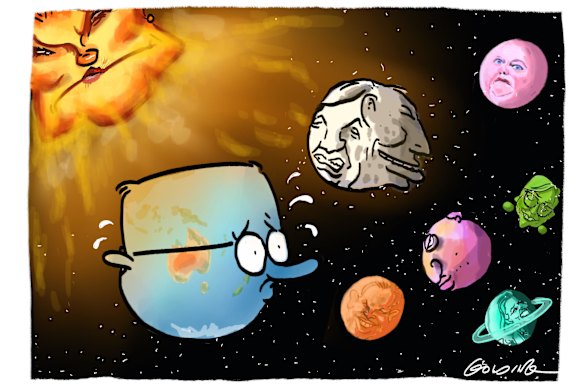
Barnaby Joyce is probably correct that “One Nation has taken the lead … in conservative policymaking (″Right-wing politics fractures″, 6/6). A defining moment was when the Liberal Party rejected Sussan Ley as leader, and chose coal-supporting Angus Taylor. Until then, including at the 2025 election, the LNP at least paid lip-service to net zero.
The Greens have always been strong on climate action. Labor has a theoretically robust net zero policy, but diluted by many exceptions, including approvals on the North West Shelf and Beetaloo.
The Liberals are clearly still split on global warming. Perhaps they should have adopted the teal independent position on this, and other small ″l″ liberal policies.
The National Party is closer to the right, though does not deny that climate change is happening, unlike One Nation.
The tragedy is that tackling the climate crisis is a matter of science, not politics. There is no difference between right- and left-wing theories of gravity, or on how to build a safe bridge.
One Nation might have “captured the zeitgeist” on climate, but not the truth.
John Hughes, Mentone
Fighting One Nation
Your correspondent (Letters, 6/6) says One Nation (with the Greens) was a ″fringe″ party a year ago, but now is a ″juggernaut″ outstripping Labor and the Coalition. Labor and Liberal supporters (and parties) might not like it, but it is instructive to look at how each of them is confronting the reality of One Nation’s surge. The Liberals’ strategy is working with (read preferencing) One Nation in the foolhardy belief that a de facto alliance against Labor will win the day. Labor strategists are not dismissing One Nation’s rise and are planning for the contingency that at the next election due 2028 its main fight could be against it, not the Coalition.
Neil Hudson, East Melbourne
Fighting hate
A decade ago, the former Army chief, Lieutenant-General David Morrison noted “the standard you walk past is the standard you accept”. That is so true today when there is so much hate speech: hatred of Jews, of Muslims, of migrants, of transgender people, and more. We have hate speech laws, but that is not nearly enough: we must try in our everyday life to eliminate hate speech and there must be consequences for those who indulge in hate speech. And yet we see many times those who perpetrate hate speech rewarded, not facing consequences.
Writers’ festivals cry ″free speech″ if asked not to platform those who have used hate speech. Publishers are accused of censorship when refusing to publish those who have indulged in hate speech. Broadcasters give voice to people who have called for bloodshed because it is a different subject.
When we accept hate speech as normal, as part of everyday life, we damage society as a whole, not just those targeted by hate speech. Until there are everyday consequences, until we refuse to give those perpetrating hate speech a platform on other subjects, we continue to destroy our social fabric.
Louise Kloot, Doncaster
Rest up, politicians
Road safety campaigns alert us to the dangers of driving when fatigued. Being awake for about 17 hours has a similar effect on performance as having a blood alcohol content of 0.051.
Why then do we allow politicians to have marathon sitting days, making crucial decisions on extremely important issues, when their decision making may be impaired due to fatigue? There are other impacts too, such as to family life. So why is it necessary?
Yvonne Bowyer, Surrey Hills
Rise up for open space
I feel like the proverbial voice crying in the wilderness.
When is there going to be a public backlash against state and local governments stealing public open space? My vote will go to the party that introduces legislation that says that any open space acquired by public authorities must be replaced square metre per square metre. This includes building on what was previously open space.
Councils that receive developer contributions for open space should be forced to spend that money on providing parkland and not squirrel it away or pretending that they are upgrading existing parks.
It is great that the state government wants to increase density, but where is the offsetting open space?
Vince Vozzo, Elwood
Humanity, deep breath
We are living in a self-delusionary bubble.
We believe our democratic system gives us some control over our destiny and we assume, on balance, our economy is set up to provide enough wealth for all to benefit.
The developments in AI in the past 20 years, including the cost in energy and water to feed the beast, have burst that bubble.
Politicians clearly don’t understand the full implications of AI. Who does? But they are captured by the projects they can boast about with the accompanying numbers of dollars involved.
The few corporate bosses running the show never ask how humanity benefits from these developments. They have the obvious benefits of AI to extol, whilst ignoring the many and deep negative impacts on our lives.
Anthropic seems to be an exception. Humanity needs to take a deep breath and spend the next 10 years learning about and deciding just exactly how we want to exploit the opportunities AI offers.
Howard Tankey, Box Hill North
More umps, please
When I played Aussie Rules we had one central umpire and a boundary umpire on each side of the ground.
Today we have four central umpires and four boundary umpires plus video replays,
Watching the number of umpiring mistakes, the AFL needs to reassess.
Seems we should have more umpires than players and then, maybe, the number of critical umpiring errors might start to fall.
Jim Hayman, Portsea
That sinking feeling
With reference to the purchase of secondhand submarines foisted on us by US, does anyone still remember the 1994 purchase of two rustbuckets, namely USS Fairfax County and USS Saginaw. Do we really need to go down this path again?
Fred Seymour, Surrey Hills
Nature is the best
Renowned ecologist David Lindemayer and co-author Sarah Rees (″A most liveable city? But it’s a long road from nature’s ways″, 6/6) remind us of something that may not be on Melburnians’ radar. Connecting to nature by having ready access to national parks ″reduces stress, improves mental health and lowers healthcare costs″. Spending time in unspoiled natural environments does us the world of good. We may or may not be immediately conscious of its effect, but there’s profound benefit to be had from immersing ourselves in healthy ecosystems.
It seems fair to claim that the more we find our place in the great web of life, the less likely we are to do it harm. Love of nature is a crucial antidote to the plague of climate action denial being promoted around the world by influential populists (″Climate denial on steroids: right-wing politics fractures″, 6/6). By fulfilling its promise of a Great Forest National Park, the Victorian government would contribute to a healthy future for us all.
Tom Knowles, Parkville
History forgotten
With Donald Trump proposing tariffs on Australia on the grounds of anti-slavery issues and forced labour, he completely ignores the fact that America’s massive wealth was built upon the blood, sweat, tears and deaths of tens of thousands of slaves removed from their homeland in Africa.
George Djoneff, Mitcham