Source : Perth Now news
Urban development along North Fremantle’s fragile coastline without proper planning and community consultation would be “totally inadequate”, according to City of Fremantle councillors.
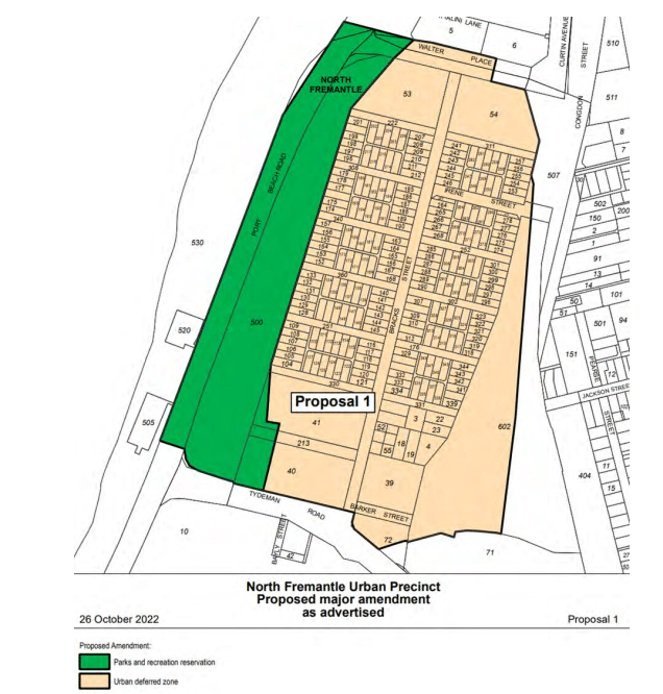
The council voted last Wednesday to submit a 51-page report to the Department of Planning, Lands and Heritage against rezoning a 23ha area near Port Beach from industrial to urban. It follows its unanimous decision last month to oppose lifting the area’s current urban deferment zoning.
The report, written by Cr Andrew Sullivan, urged the WA Planning Commission and developers to review “key matters of concern” before allowing residential development.
The report listed these as insufficient strategies to protect the eroding coastline, a failure to implement a proper public transport plan for North Fremantle, and an overall lack of public feedback on the proposed new North Fremantle Urban Precinct and Port Beach foreshore reserve.
The DPLH approved mixed-use and residential development to create the precinct in 2024, with support from the city as long as adequate planning was done beforehand.
Cr Sullivan said he supported future urban development, but it would be “premature” to go ahead with this as he believed the State Government had failed to deliver its planning promises.
“We do need to get this sorted, and the developer of course will benefit from getting it sorted because their waterfront urban precinct will actually be connected to the coastal node and the foreshore reserve and the beach,” he said.
“That will produce a really high quality outcome rather than what we currently have, which is the potential for that site to be blighted by the inability for government to do a co-ordinated whole-of-government approach to that site.”
The proposal requests a comprehensive transport study for the Leighton Peninsula, confirmation that Port and Leighton will remain as wide and continuous sandy beaches, and informed community engagement when determining the new foreshore reserve.
It also reiterates the need to move Port Beach Road to ensure the new portion of foreshore reserve can be integrated into Port Beach without a busy main road splitting it down the middle.
Another focus area that has come to light since the last council discussion is protective works proposed to mitigate erosion at Leighton and Port by the State Government, such as solid seawalls and concrete or steel pile groynes.

This would be a transition from the previous “planned or managed retreat” strategy at Port, which prioritised moving infrastructure away from coastal erosion areas to avoid directly impacting the natural environment.
Cr Sullivan said people had historically rallied “quite strongly” against heavy engineering solutions such as groynes but there had not been any consultation with the city or community to date.
The report said there was “no evidence” these solutions could fully mitigate historic erosion. Previous public feedback collected by the Future of Fremantle consultancy team also revealed people generally opposed groynes because of the amenity impact on their “wide and continuous sandy beaches”.
Members of the volunteer-run Leighton Action Coalition, a community group working to protect the Leighton and Port Beach coastline, echoed these sentiments.
“Evidence from around the world is showing that those hard engineering solutions often just cause a problem elsewhere up the beach, they don’t solve the problem. And they are very expensive, and you don’t get nice beaches,” committee member Natalie Hug told the Western Suburbs Weekly.
“What we are suggesting is if you have sufficient coastal setback, you can restore the dunes and the dunes act as a natural barrier to the sea level rising and erosion.”
Ms Hug said the group was “hugely encouraged” by Cr Sullivan’s investigation into the process, but was still waiting for a response to a letter they had sent to the WAPC months ago.
“We’ve been writing to the WAPC and made submissions to council over the last year or more. But what really alarmed us was we wrote to the WAPC in April to get confirmation of where things were up to with the whole process … and if community groups like ourselves could have some meaningful input,” she said.
“The response we got back was there won’t be any further chance to give any input … the WAPC is not sticking to their own policies, and not giving the public or other publicly visible experts the chance to comment on what setback is required.”
Ms Hug said she hoped the WAPC would improve its transparency by releasing confidential submissons from the developers, and holding proper community consultations.
“The situation is fast evolving, and the beach simply won’t be there. We won’t have a beach if we don’t leave enough setback to enable the beach to regenerate and ebb and flow,” she said.
“They need to make sure there is not just sufficient land that will deal with erosion, but sufficient land that will lead the amenities for people to enjoy the beach for the next 100 years — that is a requirement in the State Planning Policy 2.6.”
The DPLH will now receive and review Cr Sullivan’s report.