

Source : INDIA TODAY NEWS
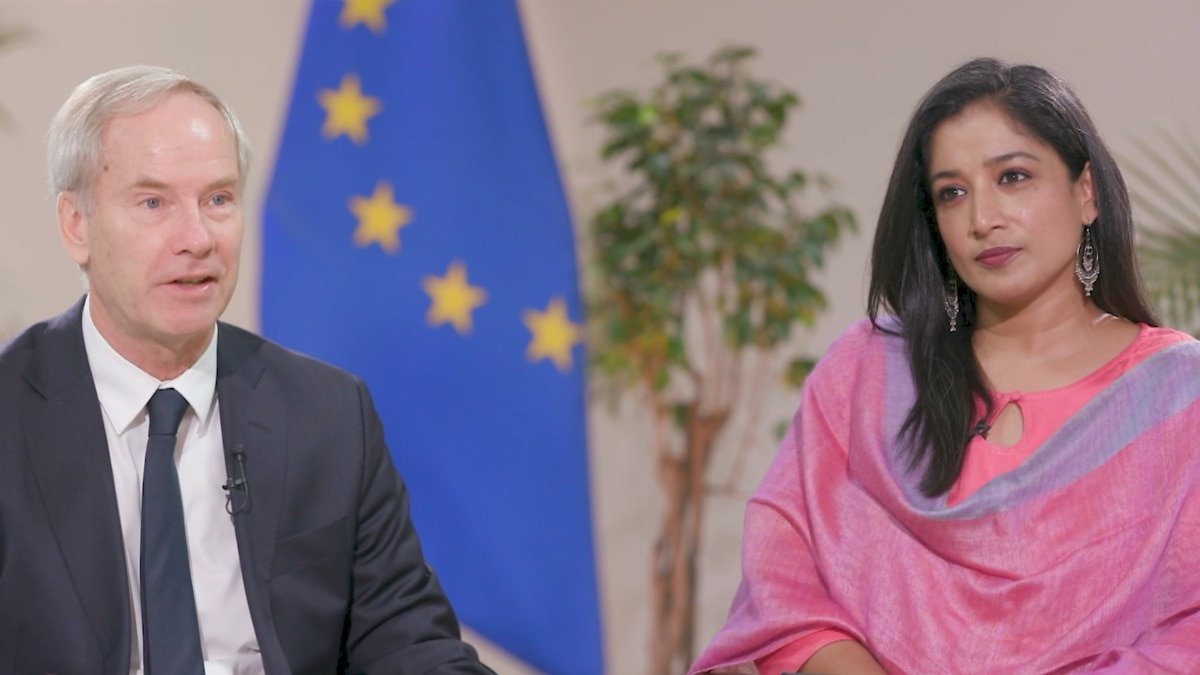
As wars in Ukraine and West Asia stretch Europe’s strategic bandwidth, the European Union is looking to deepen partnerships with like-minded countries, particularly India. In an exclusive conversation with India Today Global, Olof Skoog, Deputy Secretary General for Political Affairs of the European Union, discusses India’s growing role in the Indo-Pacific, the future of India-EU defence cooperation, and the road ahead for the landmark free trade agreement. He also weighs in on Russia’s war in Ukraine, the Iran-Israel conflict, and the shifting global power dynamics involving the US, Russia and China.
advertisement
QUESTION: You’re here for foreign policy consultations with your counterparts in New Delhi. What are the expectations? We see that the European Union, Europe per se, is quite stretched with what is happening in Ukraine, in West Asia. In such a scenario, how focused is Europe when it comes to the Indo-Pacific, and what are the consultations with India? How does India fit into that picture? Thank you.
ANSWER: Thank you very much for having me. Well, you’re right and wrong when you say that we’re stretched. It’s true that we are under a lot of pressure with the Russian aggression going on against Ukraine and the effects it has on Europe. The Middle East situation affects us as well, um, but the conclusions we draw from both of those two intense conflicts is that we need more partnerships and stronger partners around the world, partners who, like us, believe in international law, in democracy at home and in international affairs, in international cooperation, um, and, you know, in the respect of rules that we have set for ourselves, so freedom of navigation, very relevant right now, or the peaceful resolution of conflicts. We’ve seen the limits of the military trying to resolve political issues with military means. It’s led nowhere. It’s actually caused more collateral damage, and it hasn’t ended or resolved those political issues that were there in the first place. So, you know, there’s a lot around the world that speaks to the importance of two global players like India and the European Union coming together as an alternative to some of these other, you know, global players’ efforts to dominate the world, but by violating the rules.
QUESTION: OK, but where do you see India fit into this picture, not just in terms of partnership, in terms of cooperation? We see the kind of role South Korea, Southeast Asia, the Far East, and Japan play. Where does India fit in?
ANSWER: I mean, we are active all over, so for us, uh, you mentioned Korea, Japan, Australia, New Zealand are very close partners to the European Union traditionally, um, but we think that India has a lot to bring to that table of, uh, you know, mature countries that see the benefits of predictability in global affairs. So, uh, and also we see that India is also reaching out, just like we are doing, to hedge and to diversify our dependencies economically and politically, etc. So it’s a perfect fit in terms of our priorities.
QUESTION: Is there any specific area that is being discussed when it comes to maritime security in the Indo-Pacific?
ANSWER: Yes, absolutely. I’m actually here for consultations with India today. But I’m also here for the IORA, the Indian Ocean Rim Association, where we are a dialogue partner. So that’s been part of the conversation that has dominated my visit to India so far. Um, so yes, we’re really trying to hook up and, uh, contribute positively to the regional conversations about maritime security and regional security, and we think we have a lot to bring and also to learn.
QUESTION: let’s talk about the defence partnership. We’ve talked, we’ve spoken of maritime. Now, the defence partnership was signed between the EU and India on the 27th of January 2026 between Kaja Kallas and Dr. Jaishankar. What do you think, in those 10 months, have you seen in terms of concrete change or deliverables?
ANSWER: I mean, in diplomacy, 10 months is not all that long, right? But I think we’ve already seen a completely qualitative change in the way we discuss with each other. Um, an openness to discuss challenges and also the capabilities that exist on both sides in terms of countering some of the challenges we see, be that maritime security, cables, uh, foreign interference, manipulation. Um, so there’s actually, I mean, it starts with a trusted conversation, and that’s really happening. Um, and it’s part of what I’ll discuss later on today with my Indian counterparts on foreign and security policies. Um, but beyond that, the security and defence partnership also opens up very tangible cooperation, hands-on cooperation on defence industries, for instance, moving from what has been a buyer-seller kind of relationship to one where there is very developed cooperation in development, in research, and hopefully also in major defence projects where India will have the possibility to enter into the European market in a privileged way compared to countries that do not have these kinds of agreements with us.
QUESTION: Are we looking at tech transfer, co-production, Make in India, because, again, those are conversations that have taken place, but is there an active conversation to move forward on that front?
ANSWER: Yeah, I mean, what we’re trying to do as the EU is to help our own 27 countries to fulfil their defence commitments in terms of spending and also to have the capacities, and that’s through cooperation. And for major investments, you need cooperation and collaboration between countries. So that’s where we can be helpful, and we can provide loans, for example, to our member states. Now, those loans for major investments in the defence industry can also be used by our member states for collaboration with a country like India, thanks to the security and defence partnership that we have. So it does really open up a lot of possibilities, but in the end, it’s up to the defence industry to capture the moment and to see the benefits and understand what the possibilities are.
QUESTION: Right, but also the fact that, you know, India is positioned a little uniquely, and we’ve had this conversation with every European leader I’ve met and spoken to. The fact that India is now looking at defence cooperation with major European countries, with the European Union itself, with America, and yet it partners and has strategic cooperation with Russia. How does the EU then balance that out, and where does trust sit?
ANSWER: Trust is being built as we speak, um, and part of that trusted relationship is also to be able to have a conversation about issues where we maybe don’t always see eye to eye. The Russia factor, uh, I hope, is not one of those issues, but it’s clear to us that Russian aggression against Ukraine is not just bad, but it isn’t just limited to Ukraine. We see Russian aggression against many of our own EU members, so the urgency to deal with Russia as a security threat has been growing. And that’s why we will be, it’s true, very vigilant towards countries that in any way facilitate this Russian threat as it manifests itself against us. Um, so we’ll have those conversations with India as well, and we talked to India about being helpful in trying to look for de-escalation in the Russian aggression, including on the Black Sea, etc., and also to always pass the message to Russia that this war of aggression has to stop.
QUESTION: From defence to trade, the free trade agreement between India and the European Union. Uh, what are the major hurdles? We still expect ratification. Prime Minister Modi is going to be in Brussels. What are the expectations from the FTA, and what are the hurdles that we see in implementation?
ANSWER: Well, I think we’re on time. The timetable is being followed, so the member states are looking into this now, and we look to have the signatures at the high-level visit by Prime Minister Modi to Brussels in mid-December. After that, it has to go to the European Parliament. Um, but, you know, as far as we can tell, it’s their democratic right to scrutinise this, but as far as we can tell, that’s part of the process, and it will not derail the process. And after that, we can start implementation, even though ratification may take a bit longer, so it could come into effect, and people on both sides can start seeing the benefits, we hope, already in the first half of next year.
QUESTION: So you’re saying implementation can take place even before ratification?
ANSWER: Yes, we’ve had other examples of an agreement to start the implementation, although it still has to be ratified fully. So we’ve done that with other countries, and that’s a possibility, and I hope that will be followed through. But you also ask a very important question: when will you see the effects? Yes, it’s a piece of paper, right, and hopefully endorsed by both sides, but then the implementation phase really requires still a lot of effort. Um, you know, businesses and associations on both sides, the private sector needs to understand and be informed about how to now make sure that this is fully implemented and that they can reap the benefits. And for that, I think governments and institutions still need to be very active in making sure to help build capacity on both sides so that the tariffs can go down and the kind of controls that still need to happen will happen, but in a much smoother way.
QUESTION: Are there any sectors where industry leaders have come up to the leadership here or in Brussels and said, well, we’re not comfortable with this agreement and we will not participate under this agreement? Is there any sector that we should be looking at?
ANSWER: I couldn’t tell. I don’t work with this on a daily basis, but there are further elements that need to be in place in order to release the full benefits, and that includes financial protection agreements on investments, because if we really want our companies to come in and invest, they have to be able to do it for the long term, and they need to know that their investments are protected, etc. So there are still elements that could be additional to the FTA, and that would help release the full capacity and potential of the FTA.
QUESTION: Any conversation today about trade, about engagement, cannot be complete without asking why there is urgency that countries are now showing in diversification. Is President Trump a major factor? I ask you this because there was a time when America was the net security provider for many parts of the world, not just Europe or the Americas. Today, the volatility in policies has led many countries to believe that they need to look within and look for more partners. Is Trump one of the reasons why we see this increased engagement between the European Union and maybe other parts of the world, particularly India?
ANSWER: I think maybe the US administration’s policies on tariffs, for instance, but also on, at least in Europe, asking Europe to take greater responsibility for our own security. Those kinds of policies have, I think, accelerated a trend that we saw already before. We were very much in the process of breaking our dependency on Russia for energy, for instance, on China for our economic dependencies, um, and also slowly breaking a strong dependency on the United States for our security because we saw that this is not necessarily a healthy way of building our reliable strength. You need to be slightly autonomous in some of this. But the conclusions we draw are not to close ourselves inside our bubble of the EU. We’re very active in establishing new partnerships and deepening the ones we have around the world, and it’s amazing. I travel a lot, and countries that have, I think, in the past maybe looked at the EU with some scepticism or doubts are really knocking on our door and looking for a partnership with us that could provide more predictability, more trust, when there is a world where others are coming with more pressure and transactionalism. I think we represent a slightly different approach to global policy, and that includes a reliance on our international institutions and the multilateral system, which I think also makes us and India stand out compared to some of the other global leaders that met in China recently.
QUESTION: Coming to China because you mentioned it, uh, G3, how did the European Union view a meeting among the top three economies and countries of the world, where they’re conflicted and yet working together, yet having conversations, despite the Russia-Ukraine war and the Iran-Israel war?
ANSWER: Look, they can have whatever meetings they want. It’s not for us to judge, but let’s put it this way: I don’t think necessarily that the younger generations growing up in India or in the European Union feel particularly reassured when they see that kind of leadership coming together. If our youth and we are worried about climate change, worried about the governance of artificial intelligence, worried about the lack of international cooperation and negotiations in good faith to resolve the global issues of today, you know, I think they will be looking elsewhere for that kind of leadership, and hopefully India and the European Union can provide that kind of leadership for them.
QUESTION: Final question to you. The Russia-Ukraine war has been a difficult one for Europe. Uh, but there are conversations that America is now having, mediating in many ways, um, and they are talking about the withdrawal of troops from certain places. But where do you see these two wars, the Iran-Israel war, if you could address each one, and the Russia-Ukraine war, heading for Europe? Russia certainly is going to be a very important piece, and resolution is essential.
ANSWER: Well, I mean, there are two main reflections. Uh, one is that I think both in Ukraine, with Russia’s intentions to act militarily there, and also in the military confrontation with Iran, both of them have demonstrated very clearly that military solutions or using military escalation to try to resolve political issues are not working. So I think there’s, you know, never has diplomacy and mediation and peaceful resolution of conflicts been more important than it is now. Secondly, how the Russian aggression against Ukraine ends matters a lot because if we allow an aggressor to be rewarded at the cost of the victim, Ukraine, then we’re sending a signal around the world that might is right, and I think that again works against all the instincts of free people around the world.
QUESTION: Will Europe reconcile to the fact that Russia might not cede certain territories and Ukraine might have to cede those territories?
ANSWER: I don’t think that’s where we are. I think, again, you know, the sequencing here that we bring into whatever negotiations are taking place is that everything has to start with a ceasefire. You have to just end the onslaught that we see Russia conducting against the civilian population in Ukraine in order to create an environment of good faith in which you can also negotiate in good faith. And then the negotiations, the way we see it and the way it’s presented, are based on Ukraine’s territorial integrity and sovereignty. And then further on, there might be legitimate concerns that Russia may or may not have that can be resolved or discussed about broader European security, but that should not be discussed or negotiated, you know, during a full-out war against an innocent country, an independent country like Ukraine. It’s a separate conversation.
QUESTION: And G3 certainly cannot sit and tell the world what they should do and should not do.
ANSWER: Definitely not. That’s one of the lessons from European modern traumatic history: negotiations on borders, etc., should not be done without the country concerned around the table.
– Ends
Must Watch
SOURCE :- TIMES OF INDIA


