Source : Perth Now news
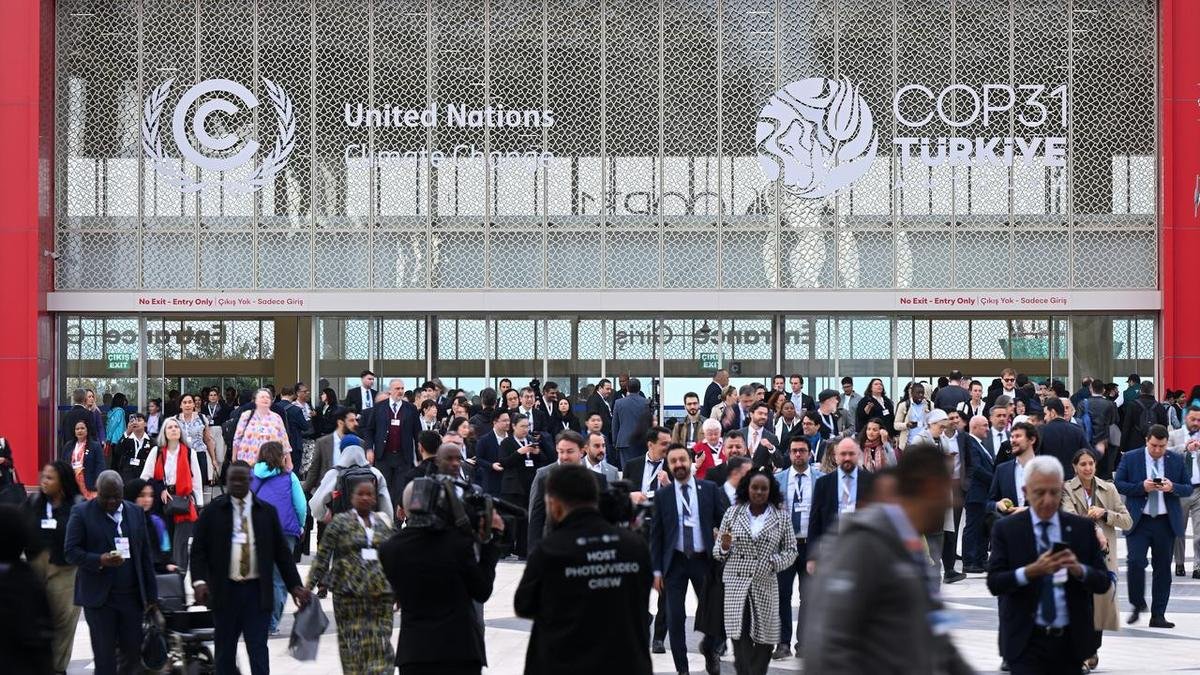
United Nations flags flutter from street lights, while roads are choked with buses and trams.
Brightly lit hotels designed to look like the Concorde, the Kremlin and Venice are occupied by besuited delegates, activists and politicians rather than joyful holiday makers.
COP31 has transformed the Mediterranean resort town of Antalya, making it more colourful and crowded than usual.
For two weeks, the Turkish city is headquarters to global climate negotiations as representatives of almost 200 nations discuss, debate and bargain over the planet’s future.
For some, the task is a heavy burden.
Tuvalu Environment Minister Maina Talia has attended more than 10 Conference of the Parties summits, yet his message remains the same: his home is staring down an existential threat.
“This is the same song we’ve been singing,” he says.
“When we come to COP, we should not be complacent that we are here. We should be frustrated.
“This is a frustrating process; we come here to tell the world that we are sinking.”
Australia’s decision to hold a pre-COP event reecntly in Fiji and Tuvalu has drawn greater attention to climate threats facing Pacific islands.
However leaders from the region say they are still fighting to access debt-free funding for adaptation projects.
Despite attracting some funding to the Pacific Resilience Facility, Dr Talia says low-lying countries still face significant barriers to accessing finance.
They should not be saddled with more regulations and red tape as a result of these talks.
“This is not some sexy, romantic issue,” he adds.
“We are continuing to tell them all there’s some beautiful island and beaches … no, no, no.
“We need to tell them that we need the money and they need to be genuine.”
Securing climate finance for developing and vulnerable nations is one of COP31’s major tasks, according to United Nations Secretary-General Antonio Guterres’ opening leaders’ summit address.
Other challenges include phasing out fossil fuels to limit global warming, taxing big polluters, expanding natural disaster warnings and delivering practical results.
“We do not need countries to agree on everything but we do need them to co-operate on things no country can solve alone,” Mr Guterres says.
“Negotiations matter but success must be measured on the ground.”
The man charged with leading those negotiations, Australian Climate Change Minister Chris Bowen, has taken up residence in a large office on the second floor of the conference venue.
Three flags stand in the corner of the room – Australian, Aboriginal and Torres Strait Islander – and the place smells like the freshly installed leather couches.
As COP31’s president of negotiations, Mr Bowen says he will include Pacific leaders in discussions and decisions as much as possible, which has rarely happened in the past.
“Normally, Pacific ministers, frankly, don’t get access to the COP presidency,” he says.
“They get brought in at 2am and told this is the decision, take it or leave it.
“I’ve said to the Pacific ministers, I can’t guarantee the outcome but I can guarantee you will know as much as I do about negotiations at various points.”
But giving Pacific nations a voice is only part of the challenge.
Mr Bowen’s role requires him to seek consensus among as many nations as possible on 60 mandates and more than 160 agenda items ranging from cutting emissions to addressing loss and damage.
He must do this as the world faces conflict in the Middle East threatening fuel supply, a powerful El Nino that could deliver extreme weather and rising energy demand from data centres – a scenario he describes as a “polycrisis”.
And while the opposition has criticised public spending on COP31 – from $2.2 million in hotels and hospitality to $32,000 on free coffee from Australia’s pavilion – the government’s most widespread criticism may be for its failure to address a fossil fuel transition.
Neither Mr Bowen nor Prime Minister Anthony Albanese mentioned the issue in their addresses to the leaders’ summit portion of the conference.
It is also unclear whether a move away from coal, gas and oil will be part of the event’s cover decision.
While Mr Bowen says he cannot pre-empt outcomes of the two-week event, a phase-out would require big commitments from nations of all kinds.
“In my view, you can’t legitimately say it’s all on fossil fuel exporters, nor can you say it’s all on fossil fuel importers,” he tells AAP.
“We’re all in it together.
“I haven’t had any minister say to me, ‘Geez, I wish you’d stop selling us that coal’.”
However, many environmentalists at the event have expressed that sentiment including Australian Conservation Foundation chief executive Adam Bandt.
The former Greens leader is calling for fossil fuel phase-out while Greenpeace Australia Pacific advocacy head Susie Byers says Australia has an opportunity to make a significant difference.
“The world’s most important job in Antalya is to deliver tangible action to end the fossil fuel era,” Dr Byers says.
COP31 is due to close on November 20 but history shows negotiations can stretch for hours or days after the deadline.
As for Mr Bowen, he says his ultimate goal is simple: “Showing that multilateralism can work in the face of a polycrisis.”