Source : the age
Social: Video clips can be found here
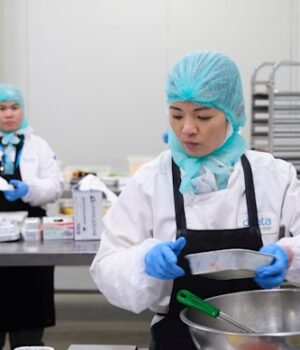
Like a scene from Willy Wonka’s chocolate factory, dozens of workers in identical blue boilersuits and hairnets file past me into a fluorescent-lit hallway pushing trolleys and carrying clipboards.
Moments before, a security guard carefully scrutinised my driver’s licence before allowing me to enter this secure facility, the size of a city block, where more than 1200 staff – from chefs to cleaners and packers – work around the clock, seven days a week.
It’s 11am and, just one kilometre north from here, almost 100,000 travellers are preparing to fly out of Melbourne Airport, blissfully unaware of the complex logistical journey that starts in this building and ends on their aircraft tray table.
Every day, Dnata produces about 20,000 meals for 26 airlines departing Melbourne Airport, including Singapore Airlines, Qantas and Delta. That figure doubles when the number of outbound flights spike in summer. If you’ve flown out of Melbourne, it’s likely that what you ate comes from the kitchen here.
Guiding me through Dnata’s inner workings is Robert Smithson, a jovial chef who has been running the show for the past 20 years as head of culinary. “We manage an inventory of more than 30,000 items across the country. Most supermarkets have just 10,000,” he says as we wait for the morning’s delivery that will include 400 kilograms of watermelon, 300 kilograms of mango and 650 kilograms of poultry.
The loading zone is split, so halal and non-halal ingredients never cross paths, and every delivery is carefully assessed. Workers check the internal temperature of each pallet and, if it’s incorrect, it is rejected.
When a traveller’s health, not to mention the reputations of premium airlines, is at stake, there’s no margin for error when it comes to food safety. The whole Dnata facility, which is climate controlled to 15 degrees, is designed in a one-directional flow. Ingredients progress from delivery to kitchen to refrigeration and packing without ever doubling back, in part to control the risk of airborne contamination from food passing back and forth between zones, but also for expediency.
Contrary to perceptions that airline food is simply reheated TV meals loaded with preservatives to extend their shelf life, the meals sent out of the facility’s gate will be consumed within 24 hours.
Following Smithson through the delivery rooms and freezers into the kitchen, we enter a surprisingly small industrial kitchen that is busy with a dozen chefs stirring large pans of Sri Lankan kottu roti, a noodle stir-fry that spices the air with ginger and chilli.
Beside the chefs are bowls of lime leaf and other seasonings calibrated for the scale of what is being cooked. If the chefs are searing steaks for first class (about the same number of covers as an intimate restaurant), they’ll use a standard grill, while a 250-kilogram pot is reserved for a large-scale meal served in economy.
“When we cook, we need to take the food above a critical control point to make sure it is safe to eat,” Smithson says. “Then we put it in a blast chiller to take it from above 80 degrees to below minus 5 degrees, but it must meet that threshold within four hours. If it doesn’t, we throw it out and start again.”
Everything is scrutinised before being refrigerated. The chef will season and taste the food. Another chef will cross-check it, then it is tasted again before being loaded onto an airline’s trolleys in the packing room.
We enter a smaller room with metal benches and neatly colour-coded stickers and tubs. This is where a team prepares special meals across 24 categories, including halal, vegan, coeliac. Knowing your ingredients is a vital skill for any chef, but it is especially important for the specialist team in this room for reasons that aren’t immediately obvious.
“Jainism is a vegetarian religion from India with nuances,” Smithson says. “You might think eggplants and potatoes are just vegetables, but Jains don’t eat root vegetables or fruits with seeds.”
That awareness of specific regional preferences extends beyond just dietary requirements. Take soy sauce. There are Chinese, Korean, Japanese and Taiwanese variants, each with its own flavour profile.
If you are on a China Southern flight, the soy sauce must be from mainland China, while China Airlines demands soy sauce from Taiwan. What appears to be a minor detail on the plate is a serious matter of authenticity for airlines.
Then there’s the humble grain of rice. In many Asian cultures, rice is the focus of the meal with vegetables and proteins relegated to supporting roles, but cooking rice depends on variables.
The grain’s carbohydrate content changes dramatically after cooking depending on where the rice has been grown and how water is absorbed. Getting the balance right between cooking, cooling and reheating rice and meeting the expectations of discerning consumers, who know their jasmine from their basmati, poses challenges.
Along the wall are tubs of single-serve portions of prepackaged oat milk, a product Dnata created when it learnt nothing existed in the market. The company designed the product with suppliers, then was able to commercialise it with its sizeable buying power.
“Many people don’t know that items like this start in the aviation sector. We’re able to give it traction and then it finds its way into retail, hospitals and aged care,” Smithson says.
Passing through double doors, we enter a room the length of five football ovals where teams of workers pack and load meals that have had time to cool in the blast chiller.
On one table, roast chicken is sliced and assembled on top of a salad for business class passengers, while on another, a dozen small plates, part of a mezze-style entree, are assembled. Elsewhere, packers prepare and weigh fruit salad bowls.
“Weight is money for airlines,” says Smithson, adding that meals are loaded onto trolleys in a way that ensures the aircraft is balanced and not carrying excess weight, which might mean it burns fuel unnecessarily.
I can’t help but notice the battalion of knives and other potential weapons around me that could be loaded directly onto the plane. It seems easy to stow one onboard inside a plate of hummus.
Smithson assures me every knife is engraved with its own identification number and must be checked in and out of a secure closet. All staff undergo an annual federal police check.
From here, I follow a loaded Delta Air Lines trolley through a final set of doors into a heavily secured zone with CCTV cameras and metal detectors, where it is loaded onto a truck and taken directly to the plane.
Nearby, a booth of logistics officers keep across flight departures, delays and cancellations and update the packing team on which orders must be prioritised.
Viewed from above, the whole facility moves in a continuous loop, with empty plates and utensils returned for cleaning before the whole process starts again at the delivery bay. There are contingency plans for blackouts, fires and floods – anything that could interrupt the never-ending need to produce meals.
As we watch the Delta trolley disappear across the tarmac to meet its aircraft, Smithson turns to me with a smile. “We have a plan for everything, and we need to be prepared for anything. This job keeps me on my feet like that.”
Things you’ve always wanted to know about airline food
Does altitude affect our sense of taste?
In 2010, German airline Lufthansa commissioned scientists to research the links between our sense of taste and altitude. The research concluded that our tastebuds’ sensitivity to sweet and salty food declined by about 30 per cent while flying due to a combination of atmospheric pressure and cabin humidity. Smithson says this research is outdated. “There is some level of taste suppression, but aviation technology has advanced to the point that any real impact on the taste of your meal is probably minimal. If your meal is bland, it’s because of its preparation and not because of air cabin suppression.” Dnata’s chefs don’t add additional seasoning or spices to meals to account for altered tastebuds in the air. Smithson says airlines generally have a bias towards serving dishes with bold flavours, such as curries and stir-fries.
If it’s the same kitchen, why are some airlines’ meals better than others?
The quality of the ingredients doesn’t change, but the composition of the meal changes depending on budget, route and audience. One airline might choose to load a meal with more rice and less curry. Another might serve it with chicken instead of beef. An overnight flight might serve a heavy meal to help passengers sleep, whereas the food might be lighter on a day flight. What ends up on the plate is influenced by a wide range of variables that can impact perceived quality.
Are celebrity chefs really designing menus for the airline?
In recent years, in-flight menus have emerged as a key battleground for airlines, which recruit celebrity chefs to bolster their dining credentials. British Airways has tapped Heston Blumenthal to design its menus, while Qantas has a long-standing partnership with Neil Perry. While big names appear on the menu, the food is still prepared by catering operators such as Dnata. “Celebrity chefs are usually given a set of dishes, or touch points, they need to work with,” Smithson says. “They come up with a concept and then sit down with us to help adapt it for an airline environment. It’s a combination of their vision and our technical knowledge about how to replicate it at scale.”
Do pilots eat the same food as the passengers?
Different catering protocols apply to cabin crew and pilots, mostly to minimise the risk of crew being incapacitated by food poisoning or other illnesses. “You don’t want a situation where the captain and first officer are eating the same meal and then, for whatever reason, are unable to fly the plane,” Smithson says. “The meals for the technical crew and pilots will be completely different to what the air hosts and passengers are eating.” Because of the amount of time pilots spend in the air, they can’t be eating heavy curries or sticky date pudding for every meal. Commercial pilots undergo regular, comprehensive health checks to ensure they meet strict physical and mental standards, and their meals are designed to be nutritionally balanced.
How do you keep food hot on the plane?
One of the most common misconceptions is that there is some kind of bain-marie or similar equipment keeping meals warm, but the food isn’t delivered hot to the aircraft. Except for soup, which is delivered in a vacuum flask, everything is loaded cold and then reheated onboard in a specialist oven calibrated to the right level of humidity to reheat a meal without drying it out or burning it. This reheating process is factored into how the meal is cooked on the ground. Airline crew juggle multiple responsibilities in the air, and aren’t trained chefs, so meals are designed to make preparation as simple as possible.
What do VIPs eat on private jets?
While the identities of VIPs flying on private jets are usually confidential, Smithson says it doesn’t take much effort to work out who it is once the food orders come in. Dnata is still responsible for catering to these travellers, typically celebrities, government officials or the uber wealthy, who can order whatever they want because they pay the bill. The only limitation is food safety. “We had a rock band request 12 buckets of KFC,” Smithson recalls. “That doesn’t fit within our food safety requirements, but we were able to recreate it in our kitchen. When Brisbane held the G20 Leaders’ Summit in 2014, we were sight-selecting salmon at the seafood markets to make sashimi for the Japanese delegation.”
What happens to the food if a flight is delayed?
Meals need to stay below a temperature threshold once they have been loaded onto a plane. If the temperature of the food exceeds that threshold, the food cannot be eaten. Catering can absorb minor delays typical in everyday aviation, but can’t absorb longer delays caused by engineering issues that might affect refrigeration. In those cases, meals intended for the cancelled flight will simply be bumped to the airline’s next flight – usually just a couple of hours later – which will have the same menu. Dnata’s logistics team is in constant contact with airline crew, so it is rare for meals to spoil and require re-cooking.
Is it safer to eat fish instead of chicken on long-haul flights?
Chicken is a common target for food poisoning claims, but Smithson says all protein is safe to eat mid-flight and that choosing between them often boils down to cultural differences rather than food safety. “In the West, red meat and chicken are always the first preference but if you look in the economy cabin of an Asian airline, you’ll find fish is preferred. Just look at the breakfast menu: Westerners don’t eat seafood for breakfast, but fish congee is quite common in China.”
Have the mashed potato and scrambled eggs improved?
Food technology has improved in leaps and bounds since the rubbery scrambled eggs of the 1990s. Dnata and its egg suppliers add citric acid and gums to stop eggs from coagulating or changing colour. In the past, potatoes were chemically dipped to minimise oxidisation, but this would create a second skin that caused lumpy mashed potatoes. Dnata now uses Belgian potatoes with a chemical structure that makes them ideal for puree and storage, which results in a creamier result.
What happens to leftover food and scraps?
This varies between states and depends on whether the waste comes from production or the plane. In Victoria, partners divert fruit and vegetable waste to farms as animal feed. In Queensland, frozen meals are donated to St John’s Crisis Centre as emergency food relief. Any food items that come off an international aircraft need to be treated and handled as a biosecurity hazard, which is strictly handled and treated separately to domestic waste in line with federal quarantine requirements. Non-perishable items like biscuits and chocolates from domestic flights are donated to food rescue organisation OzHarvest.
 Justin Meneguzzi traded his corporate suit for a rucksack and hasn’t looked back. With an emphasis on travelling sustainably, he now travels the globe as a journalist and photographer documenting the people, cultures, food, history, and wildlife that make up our big, beautiful world. Justin was recognised with the Australian Society of Travel Writers ‘Rising Star’ award in 2018.Connect via X.