Source : Perth Now news
Yemen’s Tehran-backed Houthis have attacked four cities in the south of US ally Saudi Arabia, wounding more than 70 people and setting oil installations ablaze in what appeared to be a major expansion of the six-month-old Middle East war.
Meanwhile, explosions were reported in the Iranian oil hub of Kharg Island and the Gulf of Oman port of Jask, Iranian media said, indicating a possible resumption of US attacks on Iran after a two-day pause.
Iran’s Tasnim news agency said a US missile struck an Iranian tanker six kilometres from Kharg Island, and the crew was being evacuated, though it said no casualties were reported, citing local sources.
The Pentagon had no immediate response to the reports, though a Fox News reporter, citing unnamed senior US officials, attributed the strikes to the US military.
In Saudi Arabia, the Houthis, who control most of Yemen’s populated areas including the capital, said they had launched a broad operation deep into Saudi territory. They used drones and missiles to strike a Saudi airbase in the southern city of Khamis Mushait as well as Saudi state oil company assets in the cities of Abha, Najran and Jazan.
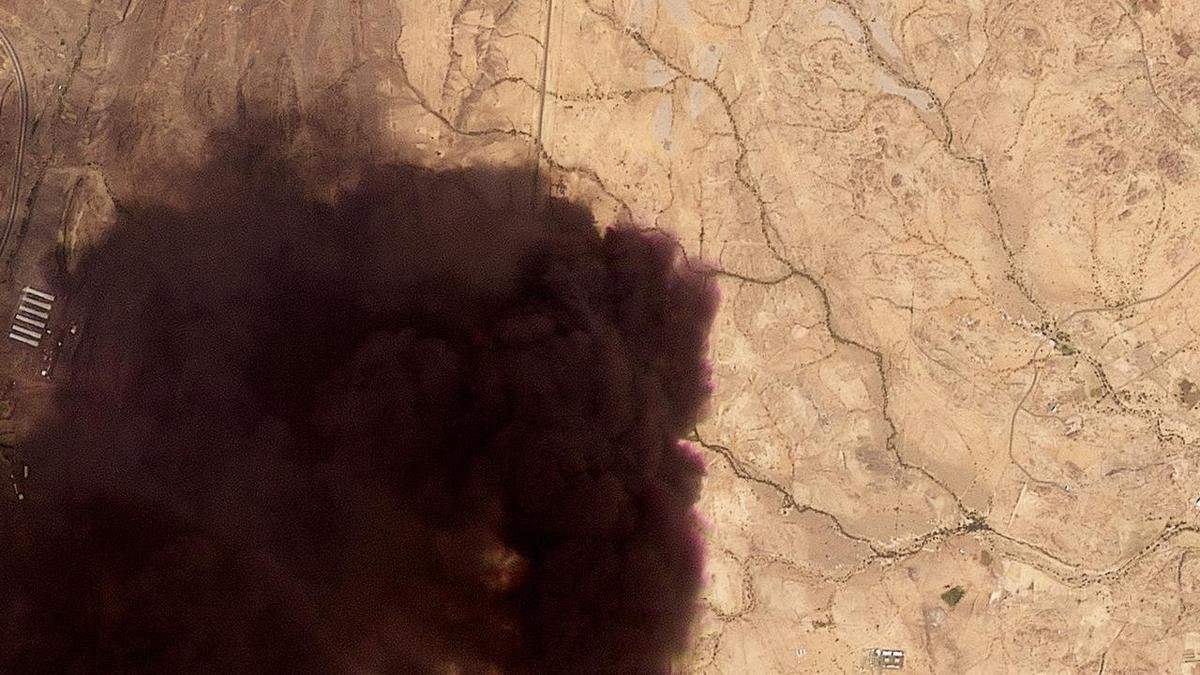
NASA satellite images showed a thick cloud of black smoke over the Jazan refinery and a column of white smoke rising from an oil distribution centre in Abha.
Saudi authorities described blazes at the sites and said women and children were among the 73 people hurt. The reports of such large numbers of wounded suggested the attacks were among the biggest carried out against Saudi Arabia since the United States and Israel launched their war against Iran in February.
No confirmed images from the ground of the attacked Saudi cities were available, and witnesses could not be reached in a country where media is tightly controlled.
After a month of calm in August, fighting in the Gulf has resumed, with Iran and the US exchanging fire, sending global oil prices back towards the $US100 ($A138) a barrel level passed at the war’s peak. Prices for benchmark Brent crude and US West Texas Intermediate rose and were on track for their highest closes since July 23.
Houthi attacks on southwestern Saudi Arabia have the potential to worsen the war’s global economic impact by disrupting Middle East energy supplies beyond the blockaded Strait of Hormuz.
Saudi Arabia has led an Arab coalition battling against the Houthis in Yemen for more than a decade. That war had calmed in recent years, but a ceasefire there has broken down, with the Houthis threatening shipping at the mouth of the Red Sea.
In recent days, Saudi-backed Yemeni forces of a government based in the south have launched a multi-pronged offensive on Houthi-held areas, after the Houthis tried to advance on government-held positions. The government, which was driven by the Houthis from the capital 12 years ago, says it now aims to recapture all Houthi-held territory.
“The coalition will take all necessary operational measures to deter this terrorist militia and resolutely confronts its hostile approach,” Major General Turki al-Malki, spokesperson for the Saudi-led coalition, said in a statement on X.
Houthi spokesperson Yahya Saree accused Riyadh of having escalated the war by launching air strikes on Yemen, and said the Houthis would respond.
The wider war in the Gulf has turned into a test of wills between the US and Iran, with each side hoping that economic pressure from competing blockades will force the other to yield.
The US Treasury announced new aviation-related sanctions on Tuesday it said were aimed at grounding Iran’s airlines.
Washington is trying to increase the flow of oil to world markets by guiding ships through the Strait of Hormuz, while cutting off Iran’s exports with a blockade.
Tehran has announced new measures to seal off the strait, saying it will soon unveil details of a “maritime exclusion zone” that will extend from the perimeter of the US blockade, through the strait and into the Gulf itself.
Washington fired at Iranian tankers over the weekend in retaliation for Iranian fire at US warships, in which Iran said it had used new, more capable ballistic missiles.