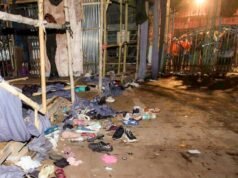
Source : INDIA TODAY NEWS
At a time when wars, economic uncertainty and political divisions are unsettling the world, a storm has hit Europe’s streets. A wave of protests, some descending into riots and violence, has prompted comparisons with the Arab Spring, the wave of uprisings that began in Tunisia in late 2010 and swept across the Middle East and North Africa, toppling several long-entrenched rulers.
advertisement
Now, in 2026, from Paris and Milan to Madrid and Tirana, protesters are challenging governments over rising living costs, unaffordable housing, deteriorating education and political corruption. Demonstrations have turned violent in France, Italy, Belgium and Albania, while other countries are witnessing strikes, school occupations and growing student mobilisation.
At least nine European countries have seen protests. They include France, Italy, Belgium and Austria, where concerns about education cuts triggered unrest.
In Spain, Portugal and Greece, protesters raised concerns over soaring housing costs. Students in Germany are opposing military-service plans. Demonstrators in Albania are protesting against corruption and unemployment.
With the demonstrations turning violent in some countries, the unrest in Europe has drawn comparisons with the Arab Spring, which began in December 2010.
However, experts have cautioned against treating the protests across at least nine European countries as a single, coordinated uprising. They say grievances and demands differ from one nation to another. Unlike the Arab Spring, which saw mass uprisings against authoritarian rulers and brought down several governments, Europe’s protests are unfolding largely within established democracies, with demonstrators primarily demanding reforms rather than the overthrow of entire political systems.
Over the October 16-18 weekend, hundreds of thousands took to the streets across France, where the protests first erupted. Clashes with police, arson and looting in several cities were reported. Agitations took place in Italy, Belgium, Portugal and Albania. Protests were also seen in Austria over education funding, and in Greece over housing costs and university policies.
“France is the epicentre of this movement … and there are signs now that this is spreading beyond France,” Alberto Alemanno, professor of European Union law and policy at HEC Paris, told Al Jazeera. He cautioned that the demonstrations were separate movements, but some shared grievances, including underfunded education, rising living costs and uncertain employment prospects.
But for American-Kuwaiti journalist Ahmed Eldin, Europe’s unrest has deeper similarities to the Arab Spring. He said that young people were challenging political elites over economic hardship, inequality and a growing sense of betrayal.
That’s what even Indian-American Congressman Ro Khanna suggested, countering US Vice President JD Vance’s argument.
While Vance blamed “imported the Third World into France” for the rioting and violence, Khanna linked the protests in France, Spain and Albania to the economic insecurities that the youths faced.
“From the high schools of France to the streets of Madrid to the universities of Tirana, young people are telling their governments the same thing: in an age of massive wealth inequality, they want a future they can believe in,” Ro Khanna wrote on X.
FRANCE BECOMES EPICENTRE OF EUROPEAN UNREST
The protests in France began gathering momentum on September 21, when students at Lycee Saint-Exupery in Creteil protested teacher shortages, deteriorating buildings and overcrowded classrooms. The demonstrations subsequently spread, drawing support from trade unions and people struggling with inflation.
On October 17, around 5.5 lakh people participated in 110 demonstrations across France, according to Interior Minister Laurent Nunez. The organisers estimated eight lakh people.
Although most marches were peaceful in several places, violence erupted in Paris, Marseille, Limoges and other French cities. Public buildings were attacked, shops were looted and barricades were set ablaze.
The Associated Press reported approximately 400 arrests on October 17.
French President Emmanuel Macron slammed what he called “unbridled” violence and asked, “How could the French people do this to France?”
The unrest also became a political battleground over immigration. On October 6, US President Donald Trump blamed France’s student protests on migration, saying, “This isn’t about schools, this is about Islam wanting to take over a once great country!”
French far-right leader Marine Le Pen blamed decades of uncontrolled immigration.
ITALY AND BELGIUM ALSO SEE CLASHES
Italian students staged demonstrations on October 16, protesting education funding, military expenditure and government policies. In Turin and Rome, some students occupied schools, borrowing tactics from their French counterparts.
At the October 16 “No Meloni Day” protests in Italy, students marched against a proposed cap on foreign pupils in classrooms, raising slogans such as “A scuola nessuno e straniero” (“At school, no one is a foreigner”), alongside demands for increased education funding, Italian news agency ANSA reported.
According to a new national decree, the government of Prime Minister Giorgia Meloni has capped the number of non-Italian students to 30% in some classes. Meloni had also said she would bring a measure to ban the wearing of burqas and niqabs in schools.
On October 17, demonstrations in Milan escalated when masked protesters threw stones and paving blocks at police and set barricades ablaze.
Belgium also witnessed protests against education cuts, higher fees and economic pressures. Police deployed water cannon during disturbances in Liege. Belgian Interior Minister Bernard Quintin described some incidents as “pure and simple violence”, reported Euronews.
SPAIN AND PORTUGAL FIGHT HOUSING CRISIS
In Spain, housing affordability has become a powerful political grievance. Protests intensified in September following the eviction of 87-year-old Maricarmen Abascal, whose rent had reportedly increased sharply. Her subsequent death intensified anger over evictions and property speculation.
In Madrid, students also demonstrated over education, while housing-access activists demanded restrictions on investment funds purchasing residential properties.
Next door, Portugal witnessed major demonstrations in Lisbon on October 17 over rents, wages, pensions and deteriorating public services.
In the early hours of October 15, police allegedly beat protesters while clearing a peaceful housing protest camp in Porto, leaving 37 people injured, including a person with a disability, according to Amnesty International, which demanded an investigation into the reported excessive force.
Europe’s housing crisis has particularly impacted the young severely. Many of them have struggled to afford independent accommodation. According to Eurostat data released in September, more than one in four Europeans aged 15 to 29, or 26.9%, lived in overcrowded households in 2025.
ALBANIA’S ANGER TURNS POLITICAL. PROTESTERS WANT PM RAMA TO RESIGN
Albania presented a different picture. Here, protests were driven less by economic hardship and more by longstanding anger over alleged government corruption, unemployment and demands for PM Edi Rama’s resignation.
On October 17, thousands of young demonstrators gathered outside Tirana’s Education Ministry, demanding Prime Minister Edi Rama’s resignation. It was the fifth consecutive day of a growing student-led movement.
Reuters reported that masked protesters threw stones at riot police, who responded with tear gas, stun grenades and water cannon.
The unrest in Albania followed months of anger over alleged corruption, unemployment and a controversial coastal development associated with Jared Kushner, US President Donald Trump’s son-in-law.
Unlike demonstrations elsewhere in Europe, Albania’s protests directly challenged the Rama government’s continuation in office. Despite the demands, Edi Rama has refused to step down, accusing his opponents of exploiting the unrest to destabilise his government.
GERMANY, AUSTRIA AND GREECE ALSO SEE MOBILISATION
Germany, Austria and Greece bring the number of European countries witnessing protests or student mobilisation to nine. However, the scale and intensity of demonstrations in these three countries have been considerably lower than the countries we discussed.
In Berlin, students blockaded entrances to Andreas-Gymnasium on October 16, opposing preparations for compulsory military service and demanding greater investment in education. The protesters also expressed solidarity with students demonstrating in France.
In Austria, students mobilised against university budget cuts and concerns over deteriorating educational facilities. Greece, meanwhile, witnessed student anger over soaring accommodation costs, private universities, housing shortages and increased military spending.
Speaking to Al Jazeera, European Union law professor Alberto Alemanno said, “In Greece, students are also calling for walkouts and they are mobilising in Germany. In Austria, we also see the early stage of a movement with mobilisation expected in the coming week.”
However, Alemanno cautioned against portraying the unrest as a coordinated uprising, saying, “This is not a single movement. It’s more about separate processes happening at the same time with some shared grievances.”
SO, IS THIS EUROPE’S ARAB SPRING MOMENT?
American-Kuwaiti journalist Ahmed Eldin, in his Substack essay ‘Europe’s Arab Spring’, compared the demonstrations with the 2011 uprisings, particularly their youth leadership, online mobilisation and anger against political elites.
He warned, “Europe’s governments have quieter ways than tanks to end a revolt.” Pointing to the need for sustained mobilisation, he wrote, “The students have already learnt to outrun the police. Outlasting the state asks more of them.”
American scientist and entrepreneur Harry Halpin interpreted the developments in Europe in a broad way. “This is just one in an inevitable sequence of protests — like the Arab Spring — that will spread across the world from Nepal to Europe as Gen Z’s future has been destroyed by the rapacious corruption of our existing elite,” he wrote on X.
British podcaster Peter McCormack, host of The Peter McCormack Show, also drew parallels with the 2011 Arab uprisings, saying, “Europe is on the verge of its own Arab Spring.” He blamed decades of inflation, wealth extraction and bureaucratic rule for the growing unrest.
Experts believe behind the protests lies a generational anxiety about an increasingly uncertain future. A June 2026 study by the Neatherlands-based TUI Foundation, involving 8,024 young people across seven European countries, found that 52% feared their generation would be worse off than their parents, while only 25% expected a better future.
The unrest has also raised security concerns. French policing experts have questioned aggressive crowd-control tactics, while analysts have warned that rioting and violence risk overshadowing legitimate grievances. The protests have also entered international political discourse. Trump and Russian officials have used France’s unrest to advance narratives about immigration and Europe’s decline.
But, as of now, Europe’s protests are not necessarily another Arab Spring. Unlike the largely authoritarian regimes challenged in 2011, European democracies offer electoral and institutional avenues for change. Will the protesters in these countries be satisfied with that?
– Ends
SOURCE :- TIMES OF INDIA