Source : the age
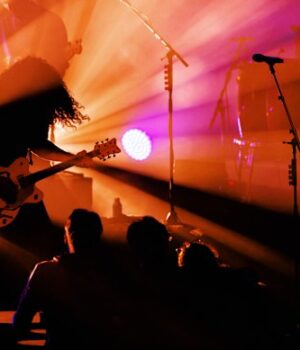
Concert Hall, Sydney Opera House, August 8
“Thanks for letting us play the show we want to play,” says Gang of Youths frontman David Le’aupepe as the evening draws to a close.
The show they wanted to play eschews the bluster, adrenaline, and stadium-filling affectations that have long been the Sydney-born, London-based band’s trademark. Instead, we get something more thoughtful, restrained and effortlessly confident.
It’s in the way Le’aupepe begins the performance – the group’s first in Australia in three years – sitting solo at the piano, teasing the opening chords of goal of the century.
While on record the song is a string-soaked epic with peaks and valleys and lavish production flourishes, here it is naked, fragile and breathtakingly delicate.
It sets the tone for an evening in which the band – now an eight-piece in the live setting – bypass many of their hits, and deconstruct those they do play to breathe new life into the material.
By performing the normally rousing Magnolia solo on guitar, Le’aupepe lends even more desperation to the song’s cry for help.
The Deepest Sighs, the Frankest Shadows is slowed to half time, surging with a newfound power complemented by the harmonies of singer-songwriter Gretta Ray, who provides backing vocals.
Do Not Let Your Spirit Wane starts smaller than its recorded form, the band teasing it to a powerful and majestic climax; Let Me Down Easy adds more nuance to its motorik strut, and is sexier for it.
A handful of new songs are debuted, hinting at an evolution in the outfit’s forthcoming fourth album.
Things Take Time is soulful and quietly joyous, with trumpet lines lending it a Burt Bacharach-esque lightness; in another, country-leaning song “about tarot cards” the horn adds a more desolate touch.
Peppering the set with moments of levity and humour adds to the sense that this is a group comfortable in their own skin – witness the cover of Jimmy Buffett’s A Pirate Looks at Forty, complete with onstage margaritas and dedicated to Le’aupepe’s wife, who turned 39 days earlier.
That it all looks so effortless is a trick only the truly great acts can pull off.
Carriageworks, August 5. Until August 8
As a dance critic rather than breakfast radio host, I don’t normally indulge the Sydney v Melbourne rivalry. Yet it feels almost impossible to review the Stephanie Lake Company’s VISTA as a Sydneysider without acknowledging just how unmistakably Melbourne it all is: the deliberately scruffy tracksuits, rat’s tails sprouting from buzz cuts, artistic earnestness, sheer fabrics, and exposed nipples.
VISTA is a smaller scale production, with just six dancers on an otherwise bare stage. The aesthetic of the first act is monochrome, muscular and austere. The costumes are loose, utilitarian greys and charcoals, with bare feet and exposed arms: somewhere between rehearsal clothes and sleepwear. Against the minimalist black backdrop and white floor, the dancers’ bodies become the main material. Bosco Shaw’s lighting is frequently sculptural and severe, carving out muscle and sweat. Robin Fox’s soundscape includes ripping Velcro and sharp exhales.
Mime, fake slaps, coy shoulders, and exaggerated facial expressions create a playful, faintly grotesque theatricality. But the play keeps curdling into threat. Lake builds her choreography around intricate chains of cause and effect: a tap prompts a head movement, a head movement rolls down the body, an imagined gunshot ricochets through a trio of dancers, invisible threads manipulate limbs, a group rushes a solitary woman under a spotlight and she flinches in terror. At times, the dancers rely so heavily on intricate hand gestures it almost becomes like a sign language.
After interval, the palette heats from neutrals to rust, ochre, blood-red, brown, and bone. The industrial tracksuits remain, but there is now a textured backdrop that reads like crumpled paper or rock face. There is touch that alternates between rescue and control. Suspended bodies, linked hands, windmill arms, and dancers anchoring one another in opposite directions reveal formidable physical intelligence in partnering and weight sharing, along with thrilling lifts.
Gravity becomes merely advisory. At other times, the choreography turns to feverish agitation, with contorted faces and bodies that twitch and convulse as Shaw’s blood-red lighting and Fox’s pounding techno drive the dancers towards a collective frenzy.
It is Melbourne grunge colliding with contemporary dance, playground games, and disaster cinema. The dancers are compelling and committed, and the production’s surface attractions are undeniable. Yet while VISTA asks us to view its two halves through completely different lenses, I was left wondering if the emperor had only changed clothes during interval.
Ensemble Theatre, August 5. Until September 12
A courtroom bench dominates the stage in David Williamson’s drama in which law, ruthless political ambition and a fractured family are in the dock.
We are back in the late eighties, yet as this morality tale of political ethics and compromises unfolds, it’s hard not to think of the real-life drama playing out across town at the Independent Commission Against Corruption.
Not much has changed since this 1989 piece premiered, aside from padded shoulders and ashtrays on cafe tables.
Williamson’s plays have become the tent poles of the Ensemble’s seasons, with several new and extant works on the bill over the past couple of years. Williamson is known for his wit and sparkling dialogue, yet this revival has a more sombre tone than his most recent The Social Ladder, staged a few months back.
Belvoir Downstairs, August 2. Until August 15
Lacuna means gap. A hole in the story; something unsaid. Maybe wilfully forgotten. Or, perhaps, an invitation to explore. You never know what you might find.
Lacuna is a new work from poet and playwright Eric Jiang, produced by independent theatre company Essential Workers as part of Griffin Theatre Company’s Lookout program. Griffin is stage-hopping while the Stables Theatre undergoes its redevelopment, and downstairs at Belvoir Street is the perfect location for this darkly hilarious dive.
We begin in the everyday life of Claudia (Rachel Seeto), a queer Asian woman trying to negotiate a path through the feckless job market, family tradition and a broken heart. So far so good, but then, when she falls through a crack in reality into the Underworld, things get weird.
First, she meets a rare ally, Tu’er, the ever-changing Rabbit God, Chinese patron saint of homosexuality (played by Dominic Lui). Then she meets Meng Po (Loretta Kung), the arch goddess of oblivion. Meng Po offers Claudia a job and, with it, the power to enter minds and purloin memories, like apples from a tree. Claudia takes the job and becomes a professional memory thief.
Theatre Royal, August 5. Until October 3
Tevye’s is such an indomitable heart as makes him larger than life: a force of nature who wears all that 1905 Imperial Russia can throw at a poor Jewish dairy farmer. Beyond coping, this champion of tradition even learns to adapt to a changing world. He can find joy in the face of adversity, and consoling humour in his unanswered querying of his God.
Few musicals are so dependent on one actor.
Troy Sussman follows Australian predecessors such as Hayes Gordon and Max Gillies. Gillies milked every drop of comedy from Tevye’s homespun philosophies and idle fancies. Gordon added voice and presence. When either sang If I Were a Rich Man, you were drawn deep into their hearts and humble aspirations; were warmed by their good cheer.
Sussman can’t quite get there – yet. He seemed nervous to begin on opening night, and therefore initially lacked presence. His singing voice, too, missed something of that barrel-chested rotundity, and not all the comedy was maximised. Yet, he slowly became more convincing, suggesting he may well come to fill out this great role, and the production will grow accordingly.