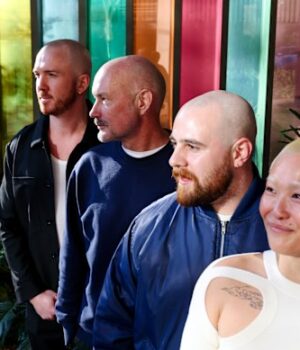
Source : the age
When Andrew Minutillo was 19 years old, his father sat him down and delivered an ominous pronouncement: “It’s coming and you need to get ready for it,” Minutillo recalls him saying.
The “it” was Minutillo’s hair thinning. “He would say things like that all the time, like ‘I’m bald, your mum’s father is bald, all my brothers are bald. It’s gonna come’.”
Despite his father’s reminders, Minutillo still panicked when his hair began to thin. “I was awash with shame,” he says. “Because I’d been encultured to believe baldness is a negative trait … It’s almost as if my incapacity to retain my hairline was intrinsically linked to my worth.”
Minutillo considered his options, including medication such as minoxidil and finasteride, but looking into the side effects and cost, he decided to embrace his bald-faced future and shave off his remaining hair.
“I don’t look back on that period of me losing my hair and then shaving my head with regret,” says the now 26-year-old, who lives in Redfern, in Sydney’s inner south.
“As much as I could search for a sad story around it or how it made me feel, there’s nothing of that kind. I really did love the final product.”
The numbers tell us that about half of all Australian men will resonate with some element of Minutillo’s story. National health organisation Healthy Male estimates pattern hair loss (known as androgenetic alopecia) affects about one in five men in their 20s, and one in three men in their 30s. By their 40s, 50 per cent will have experienced some degree of the condition.
Despite the ubiquity, studies have shown the condition can result in feelings of low self-esteem, anxiety and depression, no doubt fuelled by pop culture and media stereotypes associating baldness with villainy, ugliness and illness.
These vulnerabilities are then exploited by a booming hair restoration industry, projected to be worth $US19 billion ($27 billion) by 2033 worldwide. In a 2025 survey, the International Society of Hair Restoration Surgery said the number of hair-transplant patients has surged 20 per cent since 2021.
“Losing your hair feels like losing your identity,” says Camille Gray, a registered psychologist who has lived for 26 years with complete hair loss of her scalp, eyebrows and lashes as a result of the autoimmune condition called alopecia areata. However, she also acknowledges that it’s a different experience for men to women.
“I do feel sad for everyone with hair loss, but men with hair loss don’t receive the concern, empathy or support that women do. Why not?”
That is slowly changing. Against a backdrop of looksmaxxers who are smashing bones and injecting illegal peptides in pursuit of physical optimisation, there has been a global embrace of the feature long associated with unattractiveness in men: baldness.
In London last month, a Guinness World Record was broken when 22,141 fans of proudly bald rapper Pitbull became the largest group to simultaneously wear bald caps at the Grammy-award winner’s headline BST Hyde Park show.
Across the pond, 100 bald people gathered in New York City’s Washington Square Park in June for the Bald Meet-Up, inspired by a similar event that had taken place in Seattle earlier that month. Jubilant chants of “Bald is beautiful!” echoed around the event that the New York Times described as a “unique gathering to take a stand: being bald is nothing to be ashamed of”.
Fashion publication Highsnobiety even declared of the recent Spring/Summer 2027 fashion season that “the best summer accessory is a shaved head”.
Noticing the growing sentiment, Minutillo threw “To Skin: A dinner for bald people”, inviting 14 fellow bald people to meet over a meal. “I was really interested in the fact that baldness can transcend race, gender, age, identity, sexuality: there’s no set of people who are bald, genuinely anyone can be bald,” he explains.
Before meeting in person, one of the first places many bald, balding or prospective bald people go to find community is online. One 2024 study found that, compared with women, men with alopecia are more reluctant to show concern about health and engage less with healthcare professionals. Instead, they seek guidance on the internet.
Given this, the growing popularity of Reddit forum r/Bald is a welcome development.
Dubbed the “weirdly wonderful” by The Guardian, the online chat thread has ballooned this year to more than 1.7 million weekly users (mostly men, some women) following several viral posts and the growing pro-bald sentiment. People have discovered it’s a place where they can share their personal concerns or anxieties and be met with kindness, empathy and encouragement. Pictures of bald transformations after people shave their head are greeted with hundreds of comments of congratulations and positive affirmations.
“I’m obsessed with r/Bald,” says Luke Ryan, a 36-year-old from Newtown in Sydney’s inner west who has been bald for 16 years and attended Minutillo’s bald dinner after they met at their local gym.
“It’s the best thing because it is so daunting for people to shave their head, but I haven’t seen a single post where they aren’t like, ‘wow, I should have done this 10 years ago’. There’s nothing worse than when you see someone clinging on to anything for too long.
“If you want to get inspired to shave your head, go visit r/Bald, and you’ll understand the transformation,” he adds.
A similarly happy corner of the internet is the WhatsApp group of which 17-year-old Kyla Hodges is a member: “Bald Baddies”.
Hodges was diagnosed with alopecia areata six years ago and started losing patches of her hair immediately. Asked to pinpoint when she started feeling better about her condition, Hodges says it was the day she shaved her head.
“It felt like a relief,” she recalls. “You don’t have to worry about people seeing it all messy and patchy.”
“Losing her hair has been the making of her,” adds her mother, Belinda Hodges. “She’s got a confidence that I don’t think she would have had if she still had her hair.”
After attending a camp for kids with alopecia, Hodges and her friends started the WhatsApp group to keep in touch, share life updates, exchange tips and ask for advice, such as which wigs look and feel best.
It’s helped her feel less alone: “It just gives you a sense that there are other people going through the same thing, and it just makes you feel not so embarrassed about it.”
The deep attachment people have to their hair is something hairdresser Daniel Letizi, 36, deals with every day at his barber shop in Carnegie in Melbourne’s south-east. “Helping guys embrace being bald is genuinely something we’re passionate about,” he says.
“We see a lot of clients dealing with hair transplants, alopecia, thinning and balding hair, and helping them through that transition [rather than just cutting around it] is a big part of what we do.”
To help people adjust, Letizi and his team approach the transition in stages where they incrementally shorten the hair until clients are ready for the full shave.
“My job is to make sure people feel good and happy when they leave the shop. The last thing I would ever want is to just shave someone’s hair off, and have them walk out feeling worse,” he says.
“So it’s about helping them feel like they’re in control of a situation that, really, at that point, is out of their control.”
Psychologist Camille Gray agrees, explaining that for many people with alopecia areata, shaving their head becomes an important, empowering moment.
“Because you have spent months, if not years, trying to cover up bald spots that are hard to cover. And to remove what’s left of your hair is a way of saying, ‘I’m in charge of me, I’m in charge of my body, I decide what stays and what goes’.”
In Letizi’s experience, talk to any bald person about life post-shave and they will tell you the same thing: zero regrets.
“I don’t ever think I can recall anyone regretting it,” he says, estimating the number of heads he’s shaved in his career is somewhere in the thousands.
“I know that a lot of people with areata say they wish they’d done it earlier,” adds Gray.
Minutillo has coached multiple friends to take the leap and believes the social stigma has all but dissipated. “Baldness is actually now quite desirable,” he says.
What he’s most excited about with the current bald renaissance, though, is “how fun it is”.
“We can politicise it as much as we want, we can put philosophical meaning behind what it is to be bald and its departure from being sad, but generally, when things are fun, you should just say that they’re fun,” he says.
Gray believes building confidence starts with acceptance.“It’s about trusting that you have been lied to by the hair-regrowth industry,” she says. “You can succeed in life, you can find love, and you can be successful, even if you’re balding or bald.”
If you’re looking for more information or support regarding alopecia areata, you can visit aaaf.org.au.
Make the most of your health, relationships, fitness and nutrition with our Live Well newsletter. Get it in your inbox every Monday.