
Source : the age
Sharon Horgan can’t quite remember the quote. “The title for this came from something I read. What was it … this saying about 50 being the old age of youth. No, the youth of old age. Yeah, that was it, 50 is the youth of old age,” she says triumphantly.
It’s a line from French novelist Victor Hugo, which shows you that one, Horgan – the most acclaimed female comedy writer of her age – is a big reader, and two, she’s a pragmatist.
“Because I also thought that ‘50 is the Youth of Old Age’ is too long for the title of a TV show. So I just went with Youth.”
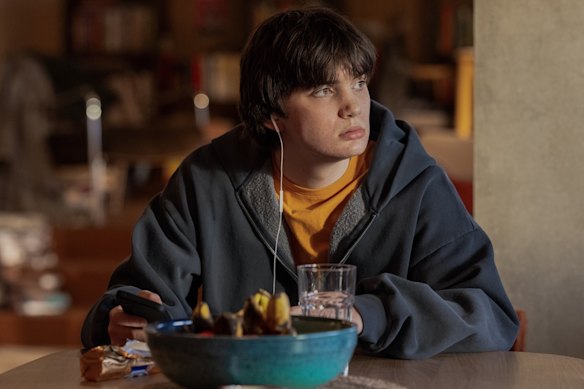
It turns out that Youth is the perfect title for her new HBO comedy because it’s as much about a 50-year-old woman, played by Horgan, as it is about her son, a teenager played by Aran Murphy (son of Cillian). And her ostensible love interest, Patrick (Rupert Friend, Homeland), is also someone who can’t quite leave his youth behind.
“He’s described by Sharon as, ‘an institutionally single man-child’,” Friend says. “He’s just in his mid-to-late 40s and he hasn’t considered things like families and commitment. Not in a dastardly, caddish way, just in a kind of Peter Pan way: he never grew up.”
Youth is all about growing up, even for so-called grown-ups. In the case of Horgan’s character, literary agent Alex, she’s embarking on growing up for the third time. She has a marriage behind her that didn’t work, she’s very close with her son, but he’s now off to college and so Alex is left doing the things we all do in our 20s – except that she’s 50. On reflection, it’s a life stage that seems to have been largely overlooked in storytelling.
“It’s about this particular time in a woman’s life, but also it’s the sandwich generation thing,” says Horgan, referring to the modern predicament of middle-aged parents looking after their children and their own ageing parents at the same time.
I meet Horgan and Friend on set in the London suburb of Clerkenwell, where they’ve taken over an 18th century courthouse, now a fashionable restaurant and members’ club. Today, it doubles as the office of Alex’s publishers: she works alongside her best friend and boss, Sam (Sharlene Whyte), doing things like trying to break it to Damian Lewis, in another Homeland nod, that maybe his book isn’t the next big thing.
The real story of Youth, however, is Alex herself, and as with much of Horgan’s work it’s personal. When Horgan talks about her character, she does it in the first person – “I” do this, then “I” do that, which suggests how much of the story comes from her own life. Her youngest daughter, for example, is currently sitting her A-levels when we meet. She will soon go to university, leaving Horgan, also a divorcee like Alex, in a similar predicament: with her baby moving out, she thinks that at 50, now’s the time to get her life back.
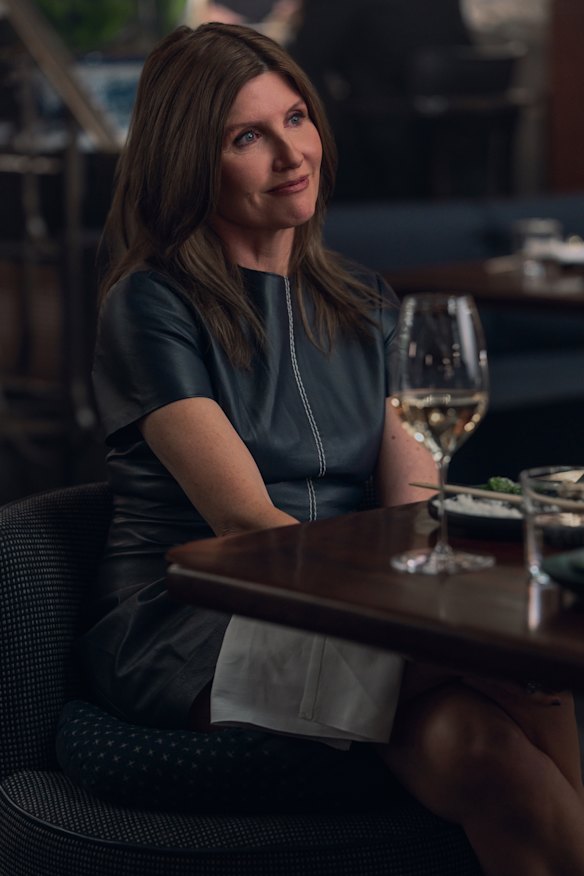
“I mean, I’m still desperately sad that he goes,” she says of on-screen son Ruari’s departure, “but for me it’s just this sudden feeling of f—ing freedom. The character has this sort of epiphany. She gets arthritis in her jaw and she’s like, ‘Is this the start of a general decline? I’ve got 10 years as a sexual person tops, you know, I need to find someone now’.”
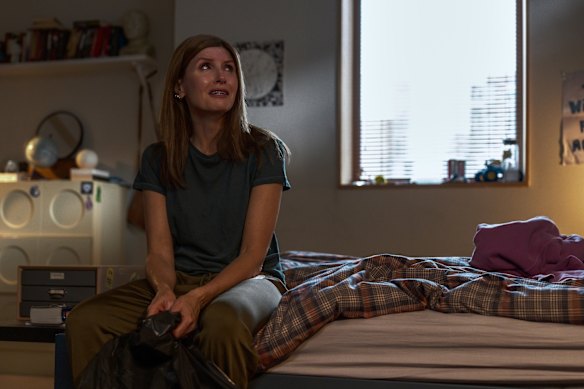
Naturally, things soon fall apart. Ruari is forced to move home again in a matter of weeks.
“So the show is me navigating that,” Horgan says, “trying to find the final part of my story … to find happiness and not die alone. But life decides something else.”
‘I feel like I don’t know how to write something that isn’t hopefully going to f— you up a bit.’Sharon Horgan
On the page, this could all be desperately sad. But on the screen it’s also achingly funny. It’s the gut-wrenching, bittersweet combination that has become a hallmark of Horgan’s writing, through modern classics like Pulling, Catastrophe and most recently Bad Sisters.
“I feel like I don’t know how to write something that isn’t hopefully going to f— you up a bit,” she says. “I mean, my dream is that the first episode takes you somewhere really funny, and then really slaps you around the head at the end.”
Much of the head-slapping in Youth comes from Horgan’s interactions with her son, who is a most challenging of challenging adolescents, and then with Patrick — an equally bamboozling on-off boyfriend. As with Rob Delaney’s character in Catastrophe, or even Claes Bang’s “The Prick” in Bad Sisters, Horgan is as adept at writing men as she is women.
After all, as she says, “It’s not just women – especially now – who reach a point in their life where they feel like, ‘What am I doing?’ Men are also feeling the ticking clock in a way, asking what’s expected of you as a man and what you’re supposed to bring to the world. I hope that that’s what [Friend’s] character is representing because I’m really interested in that as well.”
‘I wanted to avoid the notion of jumping on some kind of bandwagon to talk about menopause.’Sharon Horgan
The abstract Rupert Friend, an actor best known for scowling and subterfuge, might not have been the obvious choice.
“I wanted Rupert to do it because he’s so f—ing funny,” says Horgan. “He’s so funny. I mean obviously people would mainly know Homeland, but he’s a really great comic actor. And his bullshit detector is on a par with mine. When we’ve been on set together, if something doesn’t feel authentic or real, he’s on it.”
Friend duly appears, bullshit detector active to the extent that he immediately spots my light bewilderment that he’s got the role at all.
“Patrick’s actually not a cad or a player, which I know means the fact that I’m playing him is a surprise,” Friend says, laughing. “Neither does he have a knife under his bed nor any extra expertise with guns. He’s not that guy at all. He can barely boil an egg, and that’s one of the things that was so exciting when Sharon asked me to do it.”
Horgan picked Friend for the role and called him out of the blue. He says he has long admired her comedy and her acting, but most of all her writing.
“One of the things I love in this is that every time that we sort of enter a Richard Curtis film, Sharon subverts it. Even within a scene we will look at each other and go, ‘Is this getting schmaltzy? Is there like a spotlight coming on?’ and if it is, then we’ll dodge it. Because frankly, real life isn’t like that. You might find the person of your dreams but as you get older, there’s always a big conversation to have.”
In other words, Youth isn’t just about women of a certain age, it’s about everyone at a certain age.
“I didn’t want to write anything that had middle-aged female tropes and I wanted to avoid the notion of jumping on some kind of bandwagon to talk about menopause,” Horgan says.
“I just wanted to write about what I know and what I’ve learned at this particular point in my life. And to show through a comic lens … how hard it is.”
Youth in streaming on HBO Max now.