

SOURCE :- THE AGE NEWS
Lindsey Graham, the uber-hawk Republican senator from South Carolina who perhaps more than anyone else in Congress urged Donald Trump to start the war against Iran, is also one of the president’s most vocal sycophants. No matter what Trump does – bomb or not bomb – Graham can be relied on to chime in with praise.
But when it comes to the memorandum of understanding with Iran, Graham has barely mentioned Trump’s name. On his social media feed, he described Vice President JD Vance as “the architect of the deal”, and said it was imperative that Vance “and his negotiating partners” present the final agreement to Congress.
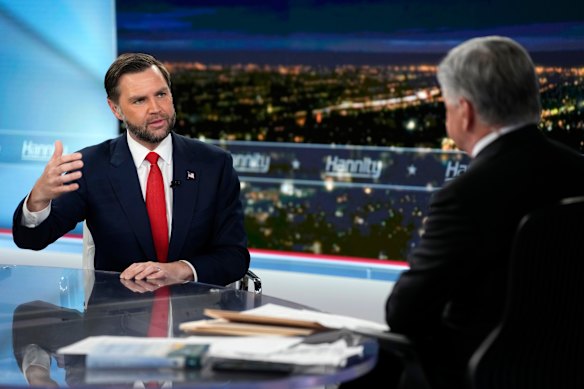
Hours after announcing the deal was done, Trump left the country bound for the G7 in France. Vance was left to sell the agreement to Americans in a string of morning and evening television appearances.
Fair enough, perhaps – it was Vance, along with Trump’s envoys Steve Witkoff and Jared Kushner, who negotiated the settlement with the Iranians and their intermediaries.
Politically, though, it places Vance in an interesting position. The vice president who did not want this war in the first place – who campaigned against foreign follies and warned the president against it, according to reporting by The New York Times – now has to own the peace plan.
This may turn out to be advantageous for a man who wants to be president in 2028 – or it could be an albatross around his neck.
Vance is in many ways a better communicator than Trump: more orthodox, more professional, more obviously across the detail. That does not necessarily make him more appealing.
It is precisely because Trump does not sound like a politician that he has been so successful in courting Americans who feel let down by politicians.
Throughout many media appearances over the past two days – he even did The View – Vance was on-message: the deal he and Trump signed with Iran would only reward Tehran if and when it fulfilled its end of the bargain.
“We’re not talking about rewarding words,” he said on CNN. “We’re talking about changing the way that we deal with Iran based on their actions.”
Vance has a tough job here. He has to defend a plainly threadbare agreement – he said it was only one-and-a-half pages long and “a very general document” – that really only begins the conversation about where the talks will go from here.
He has to combat a wave of propaganda and obfuscation from Iran, but can’t do so with the text of the agreement because it is being kept secret.
On the other hand, the document being under wraps makes it difficult for anyone to conclusively say it’s bad. All Vance really has to do is not misrepresent or oversell it until it is made public, which he says will happen soon.
The vice president clearly has big ambitions for what could be achieved. He previously spoke about securing a “grand bargain” with Iran that would see it reintegrate with the world economy and cease to be regarded as a rogue, terrorist state. He spoke in those ambitious terms again on Monday.
“If the Iranians behave like a normal country, then we want to treat them like a normal country,” he told CNN. “This agreement contemplates a very significant sanctions relief package for the Iranian people that transforms how they interact with the world and with the region. But they only get that benefit if they meet their obligations under the agreement.”
It is widely believed in Washington that Marco Rubio’s star is on the rise, powered by articulate and confident performances, perceived foreign policy successes (especially in Latin America) and his simultaneous handling of multiple high-profile roles (which has become a popular internet meme).
Vance – until recently the presumptive favourite to seal the next Republican nomination – now has opportunities to strike back. As well as selling the Iran deal, he is travelling the country spruiking the administration’s policy to crack down on alleged welfare and social services fraud, a campaign that is popular with the Republican base.
The Iran war itself was unpopular with most Americans, and Trump clearly owns that. Vance’s distance from that decision works in his favour, especially among the isolationist MAGA types who have gone off Trump and believe he was suckered into a foreign war by Israel’s Prime Minister Benjamin Netanyahu.
Vance said this week that it was Trump who suggested he take a leading role in the negotiations with Iran that ultimately produced this “deal”.
We don’t yet know whether that will be a blessing or a poisoned chalice.
Get a note directly from our foreign correspondents on what’s making headlines around the world. Sign up for our weekly What in the World newsletter.
 Michael Koziol is the North America correspondent for The Age and Sydney Morning Herald. He is a former Sydney editor, Sun-Herald deputy editor and a federal political reporter in Canberra.Connect via X or email.