Source : the age
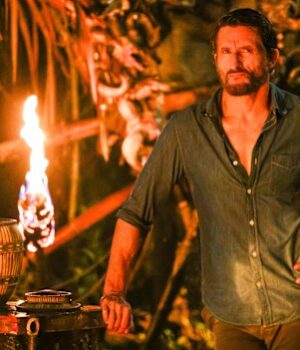
The last time I spoke with Jonathan LaPaglia, we were on set in Samoa for what neither of us knew would be his final season of Australian Survivor. It was a brief and sometimes tight-lipped interview, snuck between filming commitments on a sweaty day which followed a tricky late-night tribal council.
Had I known what was coming, I tell him at the start of this new interview two years later, this time over the phone, I would have asked different questions. “Well, had I known, I probably would have given you different answers,” he says, laughing.
LaPaglia certainly didn’t hold back this time.
A year on from his controversial sacking, the longtime host is returning to reality TV with a new show and a new appreciation for his surprisingly loyal audience.
“I really had no idea how much [fans] appreciated what I was doing,” he says, reflecting on the outrage that many Survivor fans and past players have expressed over the past 12 months at his “blindside” from the network. “I was just head down, grinding away – and I wasn’t doing it to get praise or approval … [The response] has been heartwarming and humbling. And it still continues now.”
His discontent with former employer Network 10 continues, too. When I ask for his response to the many Australian Survivor fans who say they’re boycotting the show without him as host, he had a cheeky one-word reply: “Good.”
The network, he says, “told me ratings were declining, and they were looking for a way to boost that. But that hasn’t worked out, has it? They’ve lost 40 per cent of their audience. Honestly, I can’t believe they’re going again with ratings like that. Those ratings are really catastrophic. And if it continues like this, I don’t see how they can sustain it.”
That 40 per cent drop refers to the overnight ratings for this year’s finale. It’s slightly less than that, but he’s not far off.
On free-to-air and 10Play that night, 462,000 people tuned in to see new host David Genat crown Caleb Beeby in April; that’s compared to a total of 764,000 the year before when Myles Kuah triumphed. Notably, this year’s final episode clashed with the finale of Australian Idol (which pulled 1.08 million viewers) but that doesn’t wholly explain the smaller audience.
JLP’s last season, a shorter international special called Australia v The World, pulled 653,000 viewers for its final instalment at the end of 2025 despite being up against The Block with a mammoth audience of 1.62 million.
In response, Network 10 said that much of the show’s audience comes from catch-up after those figures are collected. And if you look at the whole season, livestream numbers were up 6 per cent from the season Myles Kuah won in 2025. The latest season premiere, for instance, grew its audience 58 per cent in the seven days after it aired. But a drop of 300,000 viewers between the 2025 and 2026 finale is undeniably significant either way – especially considering the latter was triumphantly billed as a live finale and reunion.
“It makes me sad in a way because we all worked really hard on that show,” LaPaglia says. “For 10 years, we worked hard trying to build success … It’s kind of sad to see it crumble like that. It’s not what it was. And there’s a whole bunch of reasons for that.”
“Honestly, I can’t believe they’re going again with ratings like that. Those ratings are really catastrophic.”Former Australian Survivor host Jonathan LaPaglia
Speaking over the phone from his home in Los Angeles, LaPaglia seems unfazed by the prospect of appearing impolite or ungracious. He feels Network 10 and the production company Endemol Shine Australia have made “terrible decisions” for Australian Survivor – from this year’s “clunky” theme to what he perceives as heavy-handed production and, of course, the decision to let him go.
Though he admits to not watching the full 2026 season, not having access to it in the US, LaPaglia is also happy to comment on his successor’s performance: “The stuff with David felt weird, you know?”
LaPaglia theorises Genat is being “fed everything in his earpiece … it disconnects you from the players – and I think that’s what the audience is sensing”.
Wearing an earpiece to communicate with producers is standard practice in TV production, and in Australian Survivor scripts are often used as jumping off points for broader conversations – especially in unpredictable situations such as challenges or tribal councils. But LaPaglia, a trained actor, says he prided himself on memorising as much as possible before filming to make things feel organic.
“If the producer is trying to control every word that comes out of your mouth, you’re not in the moment any more,” LaPaglia says. He specifically praises Jeff Probst, the host and executive producer of Survivor in the US, who famously operates without an earpiece at all – occasionally to the show’s detriment.
A spokesperson for Endemol Shine Australia, however, defended Genat saying, “Australian Survivor is produced today exactly as it always has been, including how the host communicates with the cast. Nothing about that process has changed between hosts. Any suggestion otherwise is untrue.”
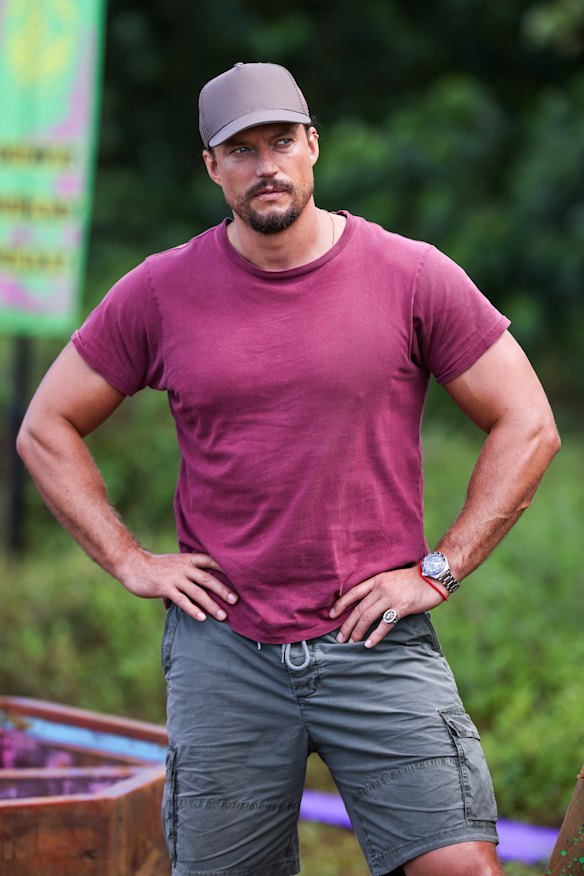
It’s tempting to read LaPaglia’s comments as sour grapes – and that might be partly true – but he’s also clearly motivated by a genuine passion for the show. Two of the three interviews LaPaglia has done in the past year have been with respected fan podcasts, diving deep into the mechanics of the game and how it could be improved. And that’s a passion the show’s former executive producer also appreciated.
Shortly after LaPaglia’s shock exit, former EP David Forster (who had left the show around the same time and was not speaking on behalf of Network 10 or Endemol Shine) told me the pair had “epic fights” and “creative differences” over the years but “Jonathan was a brilliant host. And he was super, super, super dedicated to making the show the best it could be.” Forster does not share the former host’s criticisms of the network or production company.
LaPaglia is also liberated, of course, by the fact he has a new gig to focus on.
The presenter is returning to reality TV as the narrator of Apocalypse, a new series co-commissioned by Binge and Channel 4 in the UK, which drops five Australians and nine Brits into an abandoned town for 28 days with no food, running water or power – and no rules. It’s Survivor-adjacent. But a closer comparison would be Alone. The series is actually produced by some of the team behind Alone Australia, as well as the much flashier Netflix sensation Squid Game: The Challenge.
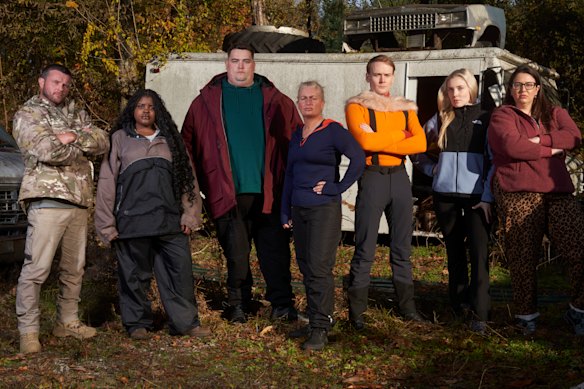
“This show doesn’t have [Survivor’s] game element,” LaPaglia says. “It’s more an experiment about survival and society.”
It has a far spookier aesthetic, too, at least partially informed by its unique setting. The eight-part series is filmed in Muscatatuck, Indiana, a once fully functional town the size of Sydney’s CBD that was created in the 1920s for psychiatric patients but has since been abandoned. The site has been used for the past two decades to train civilian first responders and military personnel in urban warfare. As it’s depicted in the show, it could just as easily be a set for The Last of Us or The Walking Dead.
“When I first saw the trailer, it really reminded me of The Blair Witch Project,” LaPaglia says. “It forced me to ask more questions than I was getting answers, and to me, that’s good, right? That’s good TV.”
There are a few surprises, but LaPaglia confirms there are no zombie jump scares. All the same, the show reveals reasons for contestants to be nervous around each other. Unlike Alone, these people are not survivalists. They’re everyday people with everyday jobs – from taxi drivers to cattle farmers to content creators – who occasionally have very different ideas on how to get things done.
Before the first episode is over, one contestant has already unilaterally decided to start rationing food and threatened to burn everyone’s shelter to the ground if they disagree.
“You’re not only trying to survive the environment, but you’re also trying to survive each other,” LaPaglia says. “It’s a pressure-cooker situation. I think even the players are surprised sometimes about how they behave.”
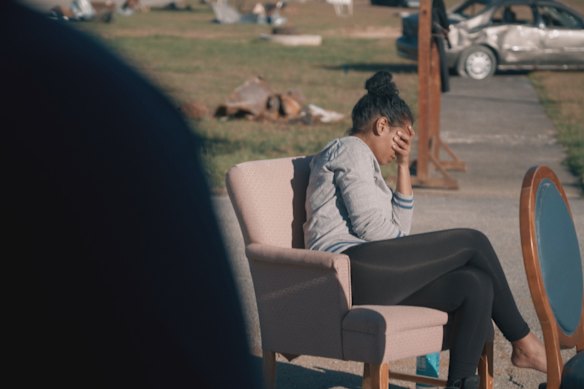
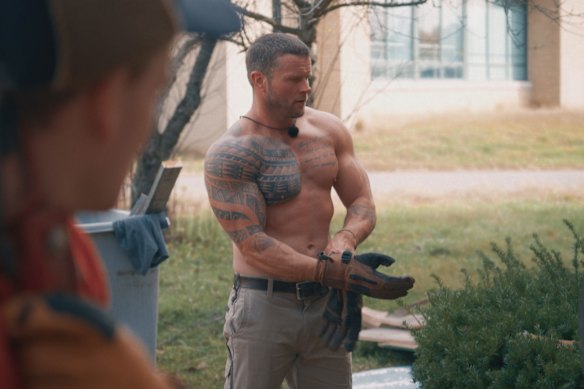
Conflict like that makes for compelling reality TV. But Apocalypse doesn’t just benefit from other people’s misfortune. As with other survival-based shows – from Alone to Man v Wild to Outlast – it enables audiences to imagine how they would fare in a similar situation.
“We all live in modern societies with all the conveniences that we take for granted – water, food, power, heat, air-conditioning, plus all the distractions that we have in phones,” LaPaglia says. “I think people fantasise about what it would be like to remove all of those things.” He’s done it himself, as a “big fan” of Alone.
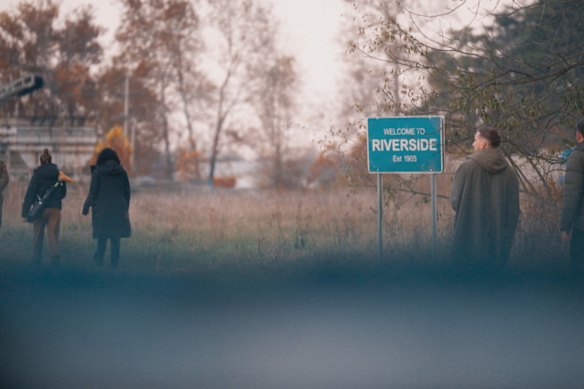
“These kinds of stories allow you to safely explore your fears,” LaPaglia says, explaining the enduring appeal. “Every period in history has some kind of potential global threat, right? The Cold War or the nuclear threat or climate change or the pandemic. And now we have AI, right? Is that going to wipe out society?
“I think there’s a there’s a real fascination with that: what that means, what that looks like and who’s going to be left.”
However harsh the circumstances of the show, it was a nice change of pace for LaPaglia.
“This is a very different gig [to Survivor],” he says. “All I have to do is narrate this one! It’s so much easier. I’m not out in the field, in the dirt, in the elements for months on end. I get to go into a nice air-conditioned booth once a week and read a script. I don’t have to memorise anything. What’s not to like, right?”
He then adds, unprompted: “The producers have been great on this show. Very welcoming, very collaborative.”
But, after a decade on one of the most beloved reality series in the world, there’s still an element of fear in embarking on something new. How do you follow up that kind of success?
“There’s always that in the back of your head,” LaPaglia says. “But at some point you just gotta step off the edge and take the leap.”
He’s also been approached for a proposed new reality show on Stan*, which he can’t give more detail on and, of course, there are those tabloid headlines suggesting Nine wants him as host if they can secure the rights to Survivor. LaPaglia says he hasn’t had any conversations with Nine – or any other broadcaster – about the show.
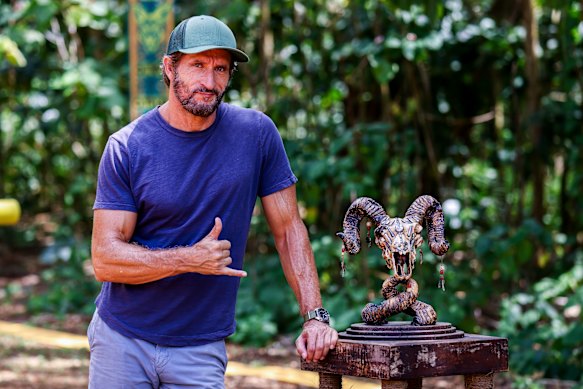
But is there a world in which he would ever come back to Australian Survivor?
“You mean if another network picked it up?” The nervous laugh that follows sounds like a no to Network 10, then…
“If another network picked it up,” he says earnestly, “yes, I would consider it.”
Apocalypse is streaming on Binge and Foxtel on Demand from September 16.
*Stan is owned by Nine, which also owns this masthead.